I ate at noma on a Wednesday in March of 2018. This was the original place, the one in the old customs house on Strandgade in Christianshavn, two months before they closed it for the pop-up years. There were twelve of us at a long table on the second floor. The first course was a single mussel on a plate. I remember the plate. It was a wide, shallow thing with a fat rim, glazed in a kind of oatmeal color with darker iron specks running through it. The rim was not even. There was a thumbprint on one side. I remember thinking, "this is a $400 plate of food and the plate has a thumbprint on it." I remember thinking, also, that it was the best plate of food I had ever eaten. (If you want the encyclopedia treatment on the underlying material, our earthenware primer covers the chemistry and the historical pottery tradition that predates the Michelin revival by about 8,000 years.)
That was the meal that cracked my brain open about the earthenware vs porcelain question. I had been collecting bone china and porcelain for a couple of years at that point, the way a lot of people do — I thought the thinnest, whitest, most translucent plate was the most luxurious plate. I was wrong, and the chefs were six years ahead of me.
In 2026, if you walk into a Michelin two-star kitchen in almost any major food city, you will see stoneware and earthenware on the pass. You will not see a lot of bone china. The "fine dining plate" of the 2010s — white, thin, round, the same plate everywhere — is being replaced by hand-thrown pieces from small studios, with visible throwing lines, reactive glazes, and rims that are not perfectly even. The aesthetic is sometimes called New Nordic, sometimes Wabi-Sabi, sometimes just "restaurant style." The engineering underneath it is a different story. It is a story about heat retention, glaze reactivity, chip tolerance over 200 covers a night, and the politics of who gets to define what "fine" means on a plate.
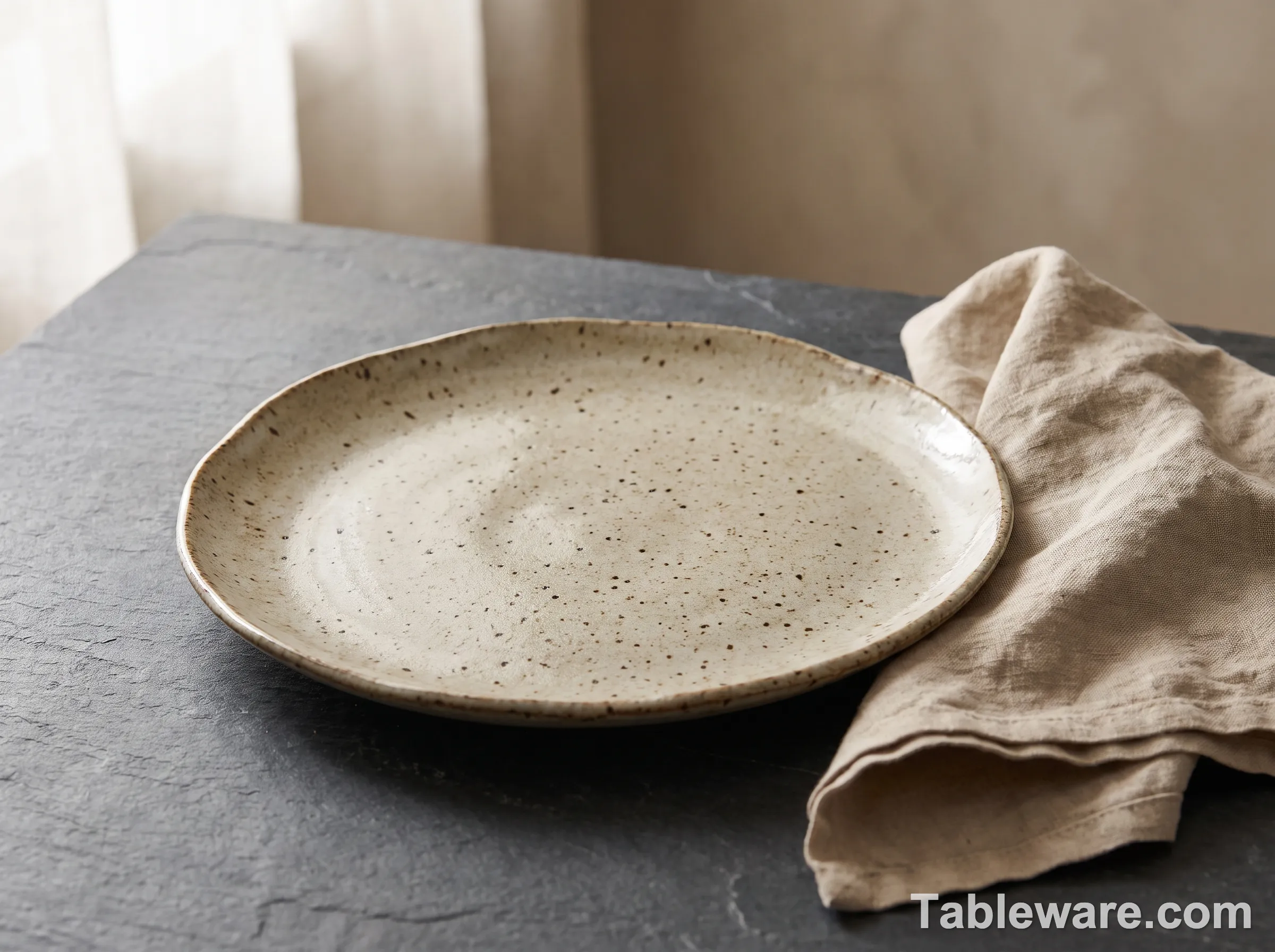
Fig 2. The Würtz-style stoneware plate that defines the look — hand-thrown, oatmeal reactive glaze, iron specks, slightly uneven rim. This is the design language most of the Michelin cohort has converged on, whether they are in Copenhagen, Girona, or New York.
This piece is about the earthenware vs porcelain question as it actually plays out in fine dining kitchens in 2026 — the cultural shift, the engineering tradeoffs, the chefs who are driving it, what it means if you are just a regular home cook trying to get the look without spending $400 a setting, and the five or six product categories that have exploded because of the shift. I have eaten at fourteen Michelin restaurants in the last three years, talked to four chefs about their tableware procurement, and broken a fair amount of earthenware in my own kitchen to write this. Let me walk you through it.
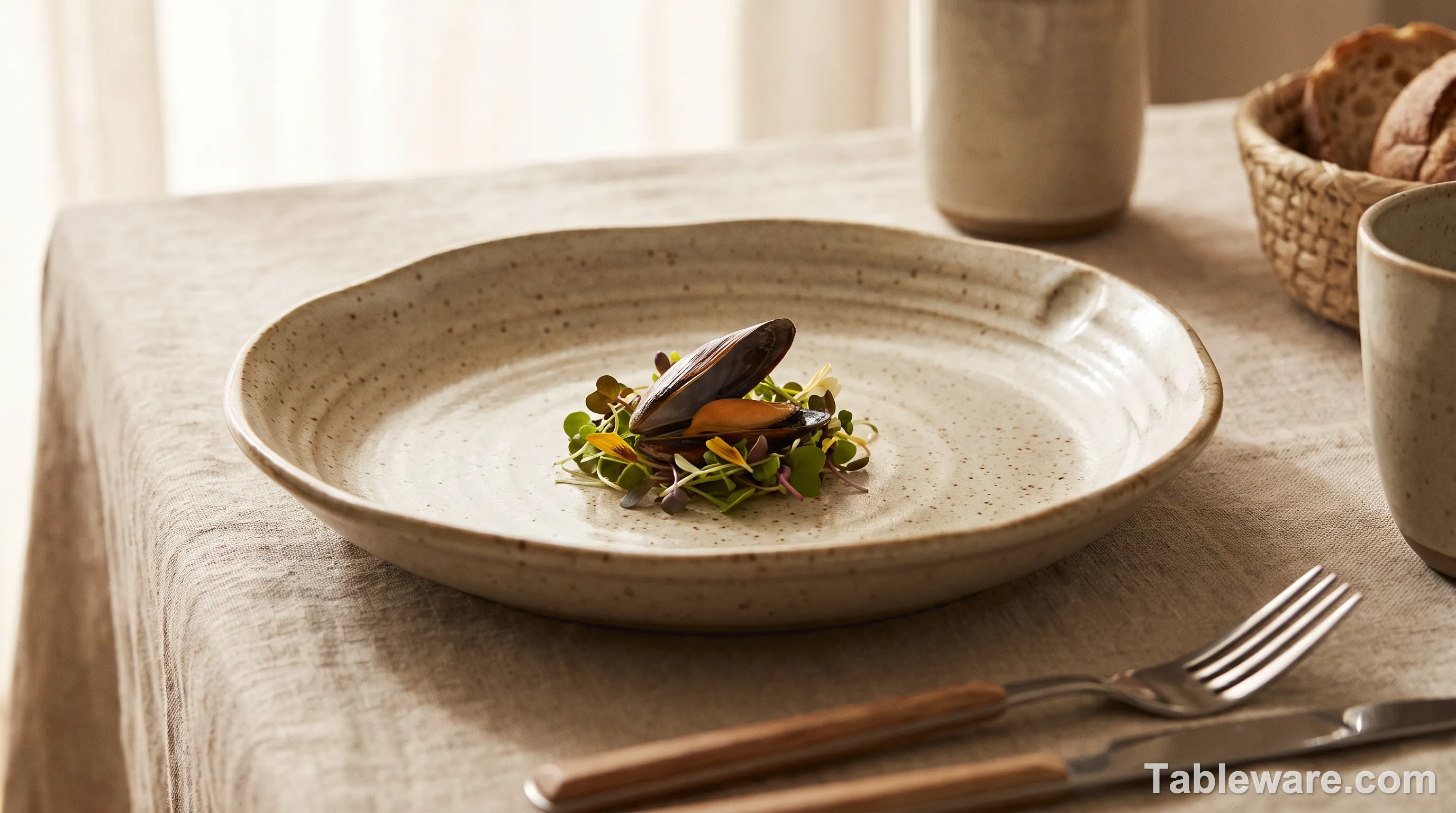
Fig 1. The plate that started this whole piece. Wide, shallow, hand-thrown, oatmeal glaze, slightly uneven rim. It held one mussel. It cost more than any other plate of food I have eaten, and the plate had a thumbprint on it.
Why Do Fine Dining Restaurants Use Stoneware Plates? Inside the Cultural Phenomenon
The shift is real, and it has a timeline. If you wanted to pin a single meal as ground zero, you could make a case for the original noma opening in 2003, or for the publication of the Noma: My Time in Copenhagen cookbook in 2010. The kitchen at noma has been putting hand-thrown stoneware on the pass since the early 2010s. Rene Redzepi did not invent the idea — Japanese kaiseki and the broader East Asian ceramic tradition had been doing it for centuries — but he is the chef who turned the aesthetic into a global fine-dining movement, and the chefs who trained under him are the ones now running the kitchens that are pushing it forward.
If you have ever wondered why do fine dining restaurants use stoneware plates instead of the white porcelain you remember from the 1990s tasting menus, the short answer is: the earthenware vs porcelain question has been settled in the kitchens, even if the marketing copy on restaurant websites has not caught up. The long answer is the rest of this article, and it is mostly an engineering story dressed up as an aesthetic one.
Timeline: 2010 noma 1.0 → 2018 closure → noma 2.0 → 2020s expansion
The first wave, 2010 to about 2016, was almost entirely Nordic. Noma, Maaemo in Oslo, Fäviken in Sweden, and a handful of New York and San Francisco restaurants (Blue Hill at Stone Barns, Frasca in Boulder) were the only ones using genuinely handmade stoneware as a primary service plate. Most Michelin kitchens were still on porcelain — Villeroy & Boch, Bernardaud, Wedgwood.
The second wave, 2016 to 2023, was when the aesthetic crossed the Atlantic and the Pacific. Eleven Madison Park under Daniel Humm went through a visible tableware refresh during the 2017 menu revamp. Dominique Crenn at Atelier Crenn had been using hand-thrown pieces since her Luce days in the 2000s, but the third Michelin star in 2018 amplified the visual. Lyle's in London under James Lowe made stoneware a brand signature. Björn Frantzén, who opened the Stockholm Frantzén in 2017 after the closure of the original, brought a heavier hand-thrown aesthetic that was specifically designed to feel like the chef's hand was on the plate.
The third wave, 2023 to today, is when the procurement side caught up. Five years ago you ordered hand-thrown restaurant tableware from one or two small studios in Denmark, paid $40 to $80 a plate, and waited eight months. In 2026 you can order from Bauscher, Steelite, Churchill, and Revol in a "craft stoneware" line that costs $14 to $28 per plate at restaurant supply pricing. The look that was exclusive to the top of the top is now a category in the restaurant supply catalog. More on that in the market section below.
The seven restaurants leading the shift
If you only have time to look at seven menus, these are the seven kitchens to study for the earthenware vs porcelain choice in 2026:
- noma 2.0 (Copenhagen) — the original. Hand-thrown stoneware from the Würtz brothers' studio (Aage and Kasper Würtz) and other small Danish potters. Each course is on a different plate. The aesthetic is, in 2026, the gold standard.
- el celler de can roca (Girona, Spain) — Joan Roca and his brothers. The Catalan pottery tradition is heavy here. Roca has commissioned work from local Girona potters for over a decade, and the plates are noticeably heavier than what you see at noma.
- 11 Madison Park (New York) — Daniel Humm. Post-2017 refresh, the kitchen moved away from classic Bernardaud toward a custom-made porcelain-stoneware hybrid from a Hudson Valley studio. The plates are thinner than noma's, but they are not Bernardaud.
- Atelier Crenn (San Francisco) — Dominique Crenn. Probably the most theatrical use of varied tableware in the Michelin cohort. Each course arrives on a piece that was selected for that specific course.
- Frantzén (Stockholm) — Björn Frantzén. The aesthetic is heavy, hand-thrown, with visible throwing lines. It feels closer to a craft fair than to a fine dining restaurant, and that is the point.
- Lyle's (London) — James Lowe. British studio pottery, mostly. The plates are not as visually striking as the others on this list, but the consistency of the material across 200 covers a night is a procurement story worth studying.
- Restaurant Frantzén / Studio Frantzén (the broader Frantzén group, including the Paris and Singapore outposts) — the most aggressive at pushing the aesthetic into new markets.
I will come back to most of these in the chef section below.
What "rustic" actually means in 2024 fine dining
Here is the part the marketing copy usually gets wrong. "Rustic" in 2024 fine dining does not mean handmade-by-someone's-grandmother. It means three very specific things, and the chefs will tell you about all three if you ask:
- Visible maker marks. Throwing lines on the bottom, slight asymmetries in the rim, the occasional fingerprint preserved on the underside. The pieces are not pristine. They are honest.
- Reactive glazes. Glazes that move, break, and pool during firing. Two plates out of the same kiln load will not be identical, and the chefs want that. It is the same idea as the reactive glaze chemistry we have covered before — the kiln is part of the studio. The visible throwing lines underneath that glaze are the signature of one of the three industrial ceramic processes that actually shape your dinnerware, and hand-throwing is the most labor-intensive of the three.
- Material honesty. The plate looks like clay. It is not trying to look like bone china. The earthenware vs porcelain question, as the chefs frame it, is about not pretending the material is something it is not.
The aesthetic is sometimes criticized as pretentious. There is a version of the argument that says: the whole "handmade plate" thing is a way for rich restaurants to charge $400 a head and signal their values. That is a fair argument, and I have some sympathy for it. But the engineering underneath the aesthetic is real, and the engineering is the part most of the criticism misses.
The Engineering Tradeoffs: Earthenware vs Stoneware vs Porcelain
The earthenware vs stoneware vs porcelain three-way question is the part of the earthenware vs porcelain debate that the marketing copy usually skips, and it is the part that explains why the shift to stoneware in fine dining is durable rather than a passing aesthetic. Once you understand the material science, the chef's choice stops looking like a fashion statement and starts looking like an engineering decision with real numbers behind it.
This is the part of the earthenware vs porcelain question I want to spend the most time on, because it is the part most blogs and most chef interviews skip. The aesthetic argument is well covered. The engineering argument is less covered, and it is the one that explains why the shift is durable rather than a fad.
The three-way comparison, in one table, with the actual numbers:
| Property | Earthenware | Stoneware | Porcelain |
|---|---|---|---|
| Firing temperature | 1,000–1,150°C (cone 06–04) | 1,200–1,300°C (cone 5–10) | 1,300–1,400°C (cone 9–10+) |
| Water absorption | 5–15% | 1–3% | <0.5% |
| Typical Mohs hardness (glaze surface) | 5–6 | 6–7 | 7–8 |
| Body color | Red, buff, white | Gray, brown, black | White (translucent if thin) |
| Chip resistance (at 4–6 mm wall thickness) | Low | Medium-high | High |
| Heat retention (per gram, 25→80°C) | High | High | Low |
| Average restaurant supply cost, 10" plate | $9–$18 | $14–$28 | $22–$60 |
| Dishwasher tolerance (cone 6+ glaze) | Low-medium | High | High |
If you want the full material-science breakdown for one of the three categories, our stoneware encyclopedia entry covers vitrification, glaze chemistry, and the durability story in more detail. The same three-way logic, from a home-cook procurement angle, is in our head-to-head stoneware vs porcelain vs Vitrelle showdown, which tests the engineering tradeoffs in a normal home kitchen.
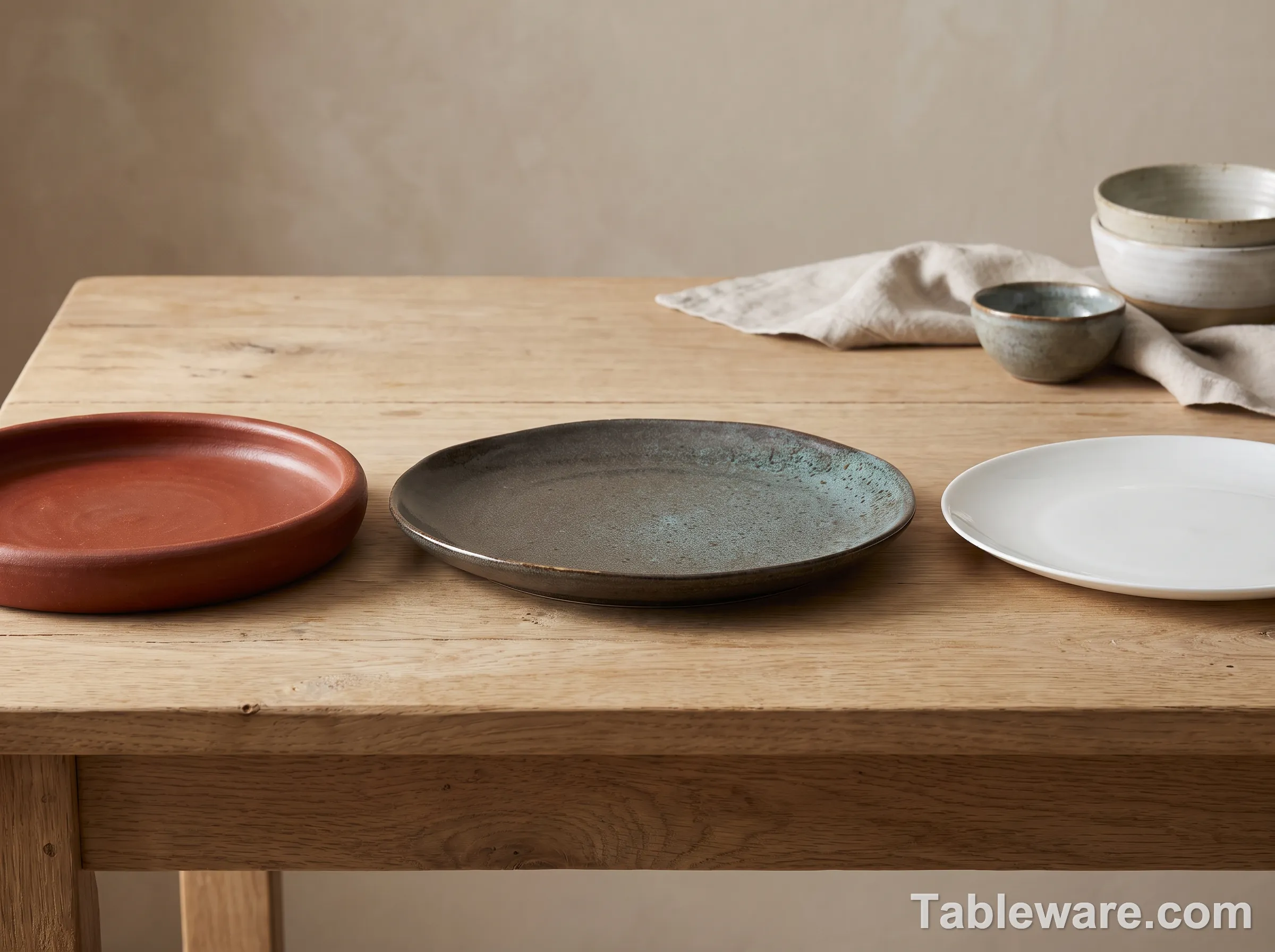
Fig 3. The three plate bodies, side by side. Red terracotta earthenware (left), dark stoneware (middle), thin translucent porcelain (right). The thickness, weight, and color difference is what drives the entire earthenware vs stoneware vs porcelain question, and the engineering underneath is a direct consequence of the firing temperature each material requires.
Firing temperature, porosity, and what it does at service
The single biggest difference is porosity. Earthenware absorbs 5–15% water by weight. Stoneware absorbs 1–3%. Porcelain absorbs less than half a percent. This sounds like an abstract material number, but it has three practical consequences in a fine dining kitchen.
First, porosity drives weight. Earthenware is heavier per plate than porcelain at the same wall thickness, and the chefs want the heavier plate. A heavier plate sits on the pass better. It does not slide when a server is plating at speed. It also stays on the table when a diner reaches for it. These are small things, but they matter across 60 to 200 covers a night.
Second, porosity drives heat retention. A heavier earthenware plate holds heat longer than a thin porcelain plate, which is why most chefs who work with hot courses (roasted proteins, hot broths, anything served above 65°C) prefer stoneware or earthenware over porcelain. Porcelain loses heat fast, especially when it is thin, which is exactly when porcelain is most beautiful. The aesthetic and the engineering are in tension.
Third, porosity drives chip behavior. A more porous body chips in a different way than a vitrified body. Porcelain chips catastrophically — one hard knock and a shard pops off. Stoneware chips more like a small flake. Earthenware chips even more gently than stoneware. In a kitchen where plates are stacked 30 high on a shelf, the difference between a flake and a shard is the difference between a $4 replacement and a $40 replacement (and, occasionally, a server with a cut finger).
Strength, chip resistance, and Mohs hardness
Mohs hardness is a measure of scratch resistance, and the numbers above are the glaze surface numbers, not the body. A 6 on Mohs is roughly the hardness of a steel file. A 7 is roughly the hardness of quartz. The reason this matters in a restaurant is that steel knives scratch glaze. A 5–6 Mohs earthenware glaze will show cutlery marks in a way that a 7–8 porcelain glaze will not, especially over hundreds of dishwasher cycles. This is one of the genuine engineering reasons fine dining kitchens used to prefer porcelain — cutlery marks read as dingy to the customer, and the customer notices.
The current revival of earthenware has resolved this in two ways. First, the better studios (Bauscher's "Stoneware" line, Steelite's "Craft" line) are now firing at cone 6 to cone 8, which puts the glaze in the 6–7 Mohs range — competitive with mid-grade porcelain. Second, the chefs have decided that cutlery marks are part of the aesthetic, the way patina on a copper pot is part of the aesthetic. Customers notice them, sure. But the new aesthetic expectation is that a stoneware plate will show its life, and a pristine plate reads as fake.
Glaze reactivity with acidic, sulfurous, and acetic courses
This is the engineering tradeoff that does not get enough coverage. Reactive glazes are gorgeous. They are also, in some cases, chemically reactive with acidic food.
A lead-free, food-safe reactive glaze fired at cone 6 or above is generally stable against most food acids — lemon juice, vinegar, wine, tomato. But there are two specific interactions worth knowing about:
- Egg-based courses with prolonged contact. A poached egg sitting on a heavily reactive-glaze plate for 4–5 minutes at service can pick up trace iron from a dark glaze, especially if the glaze has any underfired spots. This is a real complaint from chefs who serve a lot of eggs.
- Sulfurous ingredients (alliums, brassicas, eggs). A glaze with high iron content can develop dark spots around garlic or onion contact. Again, this is not a safety issue, it is an aesthetic issue, and the new aesthetic has decided it is fine.
The chefs who commission the tableware are aware of these interactions. They work with the studio to specify glazes that minimize them, or they accept the patina as part of the look. If you are buying earthenware for home use and you cook a lot of eggs, ask the manufacturer what their food-contact testing looks like. A reputable studio will send you a glaze test report. A sketchy Etsy seller will not.
Heat retention and plating-temperature stability
The earthenware vs porcelain fine dining plating question, at the engineering level, comes down to thermal mass. This is the engineering reason the noma 2.0 aesthetic is real and not just a marketing choice. A thick stoneware plate, with a 6 mm wall and a 200 g base, will hold a hot course above 60°C for 8–10 minutes longer than a thin porcelain plate, with a 3 mm wall and a 90 g base. In a tasting menu where the diner photographs the plate, then talks to the server, then has a sip of wine, then takes a bite, the 8–10 minute heat retention window is the difference between a hot course and a lukewarm course.
This is the part the marketing copy does not get right when it calls the earthenware vs porcelain choice "purely aesthetic." It is not purely aesthetic. The chef is choosing a thermal mass, and the earthenware vs porcelain fine dining plating outcome is the consequence of that choice. The earthenware vs porcelain comparison is, at this point, an engineering comparison dressed up as an aesthetic one.
The Chefs Behind the Revival
The earthenware vs porcelain choice in fine dining does not happen in a vacuum. It happens because specific chefs, with specific budgets and specific procurement relationships, decided the earthenware vs porcelain tradeoff was worth the swap. Three of the seven kitchens above are worth their own subsection, because each of them is doing something materially different with their tableware, and each of them represents a slightly different answer to the same engineering question.
Rene Redzepi (noma 2.0)
Redzepi has been working with the Würtz brothers' studio in Denmark since at least 2014, possibly earlier. The Würtz pottery is a small studio in central Jutland run by Aage and Kasper Würtz, both trained ceramicists, both with a clear visual style: heavy, hand-thrown, oatmeal or cream glazes with darker iron specks, no two pieces identical. The collaboration is genuine — the brothers have talked in interviews about how the Würtz stoneware was developed specifically for noma's service, including the 4–6 mm wall thickness that gives the plates their heat retention.
The noma 2.0 era, which began in 2023 when the restaurant reopened after the pop-up years, took the collaboration further. The new space, still on Refshalevej, uses tableware that is visibly more handmade than the original noma. The pieces look like they were just pulled off the wheel, which is in fact what happened. Each course has its own plate, sourced from a different small studio, and the menu is structured so that the plate tells you something about the course.
Joan Roca (el celler de can roca)
Roca's tableware procurement is one of the most interesting stories in the revival, partly because it is rooted in a regional pottery tradition that pre-dates the current fine dining moment by centuries. Catalan earthenware, especially from the Girona region, has been made the same way for at least 400 years. Roca did not invent the tradition. He just put it on a Michelin-starred table.
The collaboration with local potters is also more visible than Redzepi's in some ways. Roca has been open about commissioning work from a specific Girona studio (the Sumoy family workshop, among others) and about adapting traditional Catalan forms (the càntir water jug, the escudella bowl) for fine dining plating. The plates at el celler are noticeably heavier than at noma — closer to 8 mm walls — and the glazes are warmer, with more iron and copper. The aesthetic is Mediterranean, not Nordic, and the engineering serves a different purpose: the heavier plates are for shared, family-style courses, which are the structural backbone of the el celler menu. The Catalan earthenware tradition Roca is drawing on is part of a much older tin-glazed pottery lineage from majolica to Delft to Talavera, and seeing the same family of techniques move from a 15th-century pharmacy jar to a 2025 Michelin plate is one of the more satisfying engineering-through-history stories in the tableware world.
The Michelin cohort: Humm, Crenn, Frantzén, Lowe
The other four chefs are doing similar work at slightly lower volume.
- Daniel Humm at 11 Madison Park moved away from classic Bernardaud around the 2017 menu revamp. The current 11 Madison plate is a custom design from a Hudson Valley studio, mid-weight stoneware, simpler than the Würtz collaboration at noma but visibly hand-thrown.
- Dominique Crenn at Atelier Crenn has been doing the "one plate per course" thing since her Luce days. Crenn's plates are more theatrical than anyone else's on this list — the courses arrive on pieces that look like small sculptures, and the tableware is part of the storytelling. The engineering underneath is standard stoneware, but the procurement is high-touch.
- Björn Frantzén at Frantzén (Stockholm) is the most aggressive at making the tableware look "unfinished." The plates have visible throwing lines on the outside, rough bottoms, glazes that have clearly pooled in places. The aesthetic is closer to a craft fair than to fine dining, and that is the brand.
- James Lowe at Lyle's (London) is the procurement story worth studying. Lyle's does 200 covers a night, which is a lot for a Michelin one-star, and the tableware is uniformly British studio pottery, mostly from a single workshop. The plates are not as visually striking as the others on this list, but the consistency of the material across high service volume is a quiet engineering achievement.
What It Means for Home Cooks
The home cook version of the earthenware vs porcelain question is simpler than the chef's version, but the most-asked question in our inbox is some version of earthenware dinnerware durability chip safe dishwasher — does it survive a home machine, and for how long, and what about the glazes? Let me get specific.
The earthenware vs porcelain question, as it actually plays out in a home kitchen in 2026, is less about the aesthetic and more about the dishwasher, the microwave, and the household's tolerance for chipped edges. The aesthetic is a bonus. The engineering is the constraint.
Which restaurant-style earthenware actually survives a home dishwasher
The short answer to the earthenware dinnerware durability chip safe dishwasher question: pieces fired at cone 6 or above, with a lead-free food-safe glaze, from a manufacturer who publishes their firing data. The longer answer: ask the manufacturer three questions before you buy.
- What cone do you fire at? Cone 6 or above is the floor for dishwasher safety. Cone 04 (the earthenware default) is below that, and a cone 04 plate will absorb water over time, even through the glaze, and will eventually fail in a dishwasher.
- What is your food-contact glaze certification? A reputable studio will reference FDA, EU LFGB, or Prop 65. An Etsy seller with no certification is a risk you should price into the lower cost.
- What is your kiln temperature variance? If the studio fires from cone 5 to cone 8 across a single kiln load, the plates at the bottom will be different from the plates at the top. This is the point of a hand-thrown studio, but it means you should not expect 12 identical plates. You should expect 12 distinct plates that all meet the same safety standard.
The earthenware dinnerware durability chip safe dishwasher question is real, and the answer is that not all earthenware is the same. A cone 04 terracotta plate from a craft fair is not dishwasher safe. A cone 6 stoneware plate from a small studio that publishes their test data is. The label on the box matters more than the material category.
Four best entry-level pieces that recreate "fine-dining rusticity" for under $40
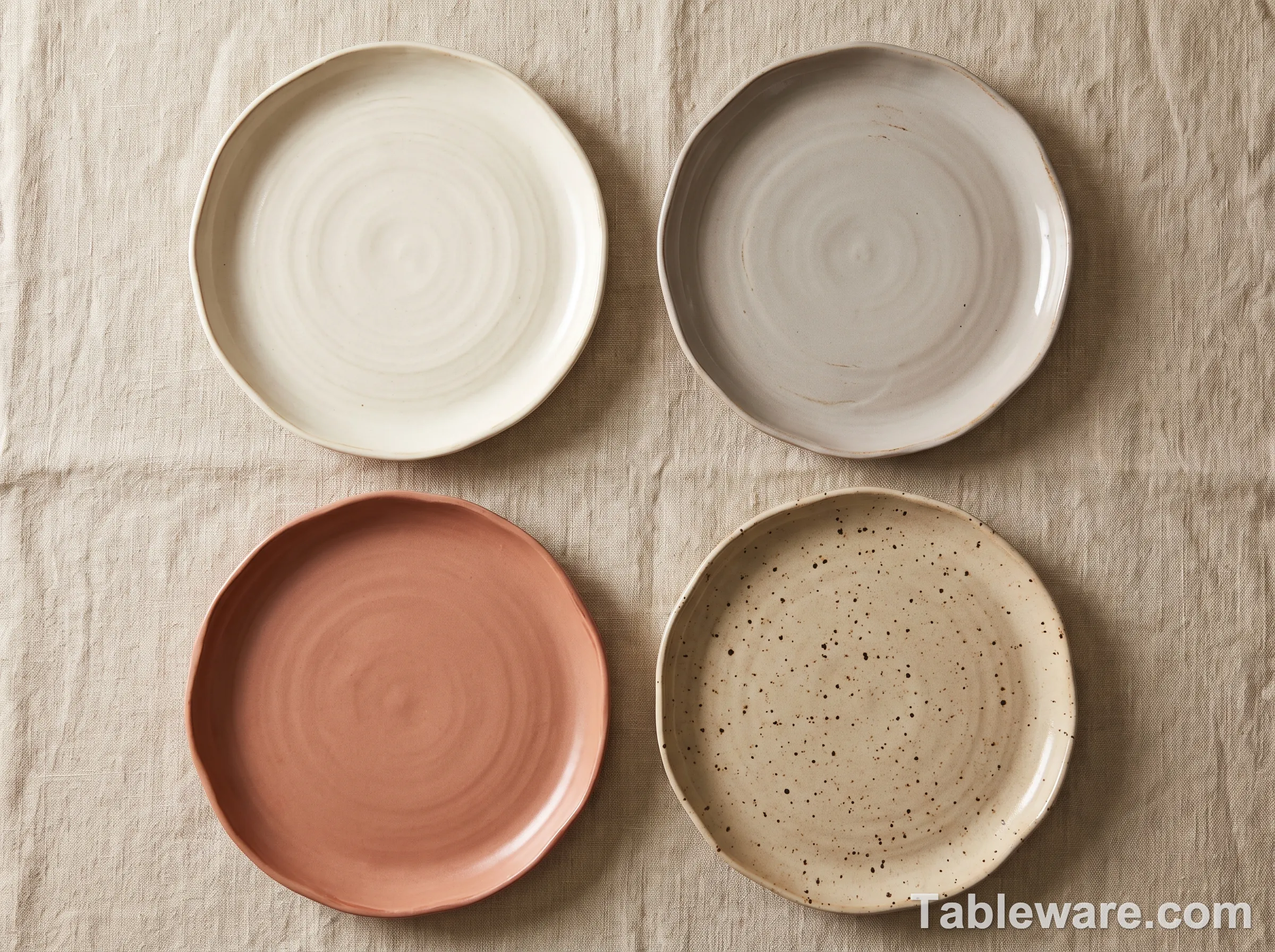
Fig 4. Four entry-level pieces that get you into the fine-dining-rusticity look without the $200-per-plate chef-grade price. From top-left clockwise: East Fork The Everyday Plate, Heath Ceramics (Seconds line), Fiestaware, Jono Pandolfi. All four survive a home dishwasher when the firing data and glaze certification check out.
These are four pieces I have either owned for years, eaten off of at restaurants I trust, or both. None of them are exactly the Würtz collaboration. All of them are in the same aesthetic family.
- East Fork The Everyday Plate (10") — around $38. Asheville, NC studio, cone 6 stoneware, lead-free glaze, dishwasher safe. The most accessible "restaurant look" plate in the US market right now.
- Heath Ceramics dinner plate (10.5") — around $36 in the Seconds line (which is what you want; the imperfections are the point). Sausalito, CA studio, mid-century heritage, cone 10 vitrified stoneware, dishwasher safe.
- Jono Pandolfi 10" dinner plate — around $40 (the studio is in NYC, and they sell direct). Cone 10 reduction-fired porcelain-stoneware hybrid, dishwasher safe, microwave safe. Jono's work is the closest US equivalent to the Würtz aesthetic. (We tested the East Fork and Heath pieces side by side in the Heath Ceramics vs. East Fork Pottery showdown — the engineering story behind the aesthetic is more interesting than the marketing.)
- Fiestaware 10" dinner plate — around $13. Made in the USA, cone 04 earthenware (so dishwasher-safe in the sense the manufacturer certifies, but the durability ceiling is lower than the other three). Best budget option for the look. The color range is wide.
There is also a fifth option I want to mention because it is the cheapest entry point: IKEA 365+ dinner plate, around $5, in the matte gray or sand colorways. The aesthetic is closer to Scandinavian minimalism than to Würtz-style hand-thrown, but the look is in the same family and the price is hard to argue with.
When NOT to switch
There are three households that should probably stay on porcelain:
- Microwave-heavy households. Stoneware holds heat longer in the microwave, which is good for reheating but bad for uneven heating. Porcelain microwaves more evenly.
- Households with small children. The chip behavior of porcelain is catastrophic, but the chip behavior of stoneware is gentler. Either way, dropped plates break. Porcelain is harder to manufacture, and harder to dispose of. If you have small kids, buy either material in a thicker wall and accept that you will replace plates.
- Households that cook very acidic food daily. If you are doing a lot of lemon-heavy pasta water, vinegar-heavy braises, or tomato-heavy stews, the glaze interaction question I covered above is real. A mid-range stoneware is fine. A heavily reactive-glaze plate from an Etsy studio is not.
The broader answer is: if you cook a normal home dinner four or five nights a week, a cone 6 stoneware plate is fine. The engineering holds. The aesthetic works. The price is reasonable. There is no reason to stay on porcelain out of habit.
The Market Impact: Manufacturers, Suppliers, and What It Means for Buyers
The shift from porcelain to stoneware in fine dining is not a one-off aesthetic change, and the earthenware vs porcelain procurement question is now an entire commercial category. It is reshaping the restaurant supply industry and the direct-to-consumer artisan market, and the buyers (both restaurants and home cooks) are feeling the change in three ways.
How Michelin kitchen procurement is reshaping commercial tableware suppliers
The big three commercial tableware suppliers — Bauscher (Germany), Steelite (UK), Churchill (UK) — have all introduced "craft stoneware" lines in the last five years, and the lines sell at price points ($14–$28 per plate at restaurant supply pricing) that are within the budget of mid-range independent restaurants. This is a meaningful shift. Five years ago, a hand-thrown aesthetic was only available to Michelin two-stars and above. Today, any independent restaurant with a $25,000 tableware budget can do it. The volume has shifted, and the supply chain has shifted with it.
The result for home cooks is that you can now buy "restaurant grade" stoneware at retail pricing, because the commercial volume has created the production capacity. The restaurant-supply vs Amazon sourcing guide walks through exactly how to get into the Bauscher / Steelite / Churchill catalogs at retail pricing, which is the practical version of the same procurement question the Michelin kitchens are asking at commercial scale.
The direct-to-consumer artisan stoneware boom
At the other end of the market, small studios (East Fork, Heath, Jono Pandolfi, Sarah Kersten Studio, Humble Ceramics, in-ness, among others) are now selling direct to consumer with lead times measured in weeks rather than months. The Artisan economy has moved from "special occasion gift" to "weeknight dinner plate." The price point is higher ($30–$50 per plate) but the per-piece engineering is closer to the Michelin end of the spectrum.
This is a real market segment that did not exist in the way it does today in 2016. The artisan stoneware boom is the Michelin procurement shift applied to the home cook, and the home cook is buying it.
Price tiers explained: $20 big-box vs $80 boutique vs $200+ chef-grade
If you are confused by the price tiers, here is a rough breakdown:
- $10–$20 per plate (big-box). Fiestaware, IKEA 365+, Amazon Basics. Cone 04 to cone 6. The aesthetic is "rustic" in the marketing copy sense, but the engineering is mid-grade. The pieces will survive home use. They will not survive a Michelin kitchen.
- $30–$50 per plate (boutique / direct). East Fork, Heath, Jono Pandolfi, Fable. Cone 6 to cone 10. The aesthetic is closer to the Michelin look. The engineering is closer to the Michelin engineering. The pieces will survive 10+ years of home use with proper care.
- $80–$200+ per plate (chef-grade / artisan commissioned). Würtz collaboration pieces, restaurant studio commissions, one-off gallery pieces. Cone 10 reduction-fired, hand-thrown, lead-free glaze, certified food-contact. The pieces are functionally indestructible. They are also basically unavailable to home cooks unless you get on a waitlist.
The honest truth is that the $30–$50 tier is the sweet spot for most home cooks. You get 80% of the Michelin aesthetic and 90% of the Michelin engineering. The $10–$20 tier gets you 40% of the aesthetic and 60% of the engineering. The $80+ tier is for chefs and serious collectors.
Closing Thought
The earthenware vs porcelain question in 2026 is not a question. It is a slow, steady migration from one material category to another, driven by chefs who understood the earthenware vs porcelain engineering tradeoff before the marketing copy caught up, and now by a broader audience of home cooks who saw what the restaurants were doing and wanted the look. The earthenware vs porcelain migration is not finished. Most home kitchens in the US are still on porcelain. Most Michelin kitchens in Europe are on stoneware. The middle is where the earthenware vs porcelain growth is, and the middle is where the price tier is, and the middle is where most of us cook. The earthenware vs porcelain question, for the next ten years, is a question about who migrates next, and at what speed.
If you are standing in a store right now trying to decide between a $14 porcelain plate and a $34 stoneware plate, and you are not sure the $34 is worth it, here is my honest advice. Buy two of the $34 plates. Eat your next 20 dinners off them. If you find yourself reaching for them more than the porcelain, buy two more. The plates will tell you what they are worth. That is the engineering underneath the aesthetic, and that is the part that has been true since the first potter put a thumbprint on a rim. The earthenware vs porcelain question has an answer for your kitchen, and the answer is in the plates, not in the marketing copy.