I keep a small Heath Ceramics saucer in my kitchen. It cost me $14 at a Sausalito seconds shop, on a rack of seconds that had a tiny pinhole near the rim. The plate sitting next to it in my cabinet came from a 16-piece set I bought on Amazon for $96. They look like they came from different planets. The Heath piece has a quiet, broken color — kind of cream near the rim, kind of slate gray in the well, with these soft orange haloes that look like rust. The Amazon plate is uniformly tan with a faintly mottled surface. Up close you can see the difference instantly. From three feet away, on a normal dinner table, the Amazon plate sort of fakes it.
The thing is, the Amazon set literally has "reactive glaze" in the product title. It's not lying — there is a glaze on it. But the visual is mostly a printed underglaze pattern, not the real chemistry. And almost nobody buying the set knows the difference.
This piece is the one I wish someone had handed me five years ago, when I bought that 16-piece set and felt vaguely disappointed without understanding why. I'll walk through what reactive glaze chemistry actually is, what makes it look like that, who makes the real version well, and how to spot the fakes before you spend the money.
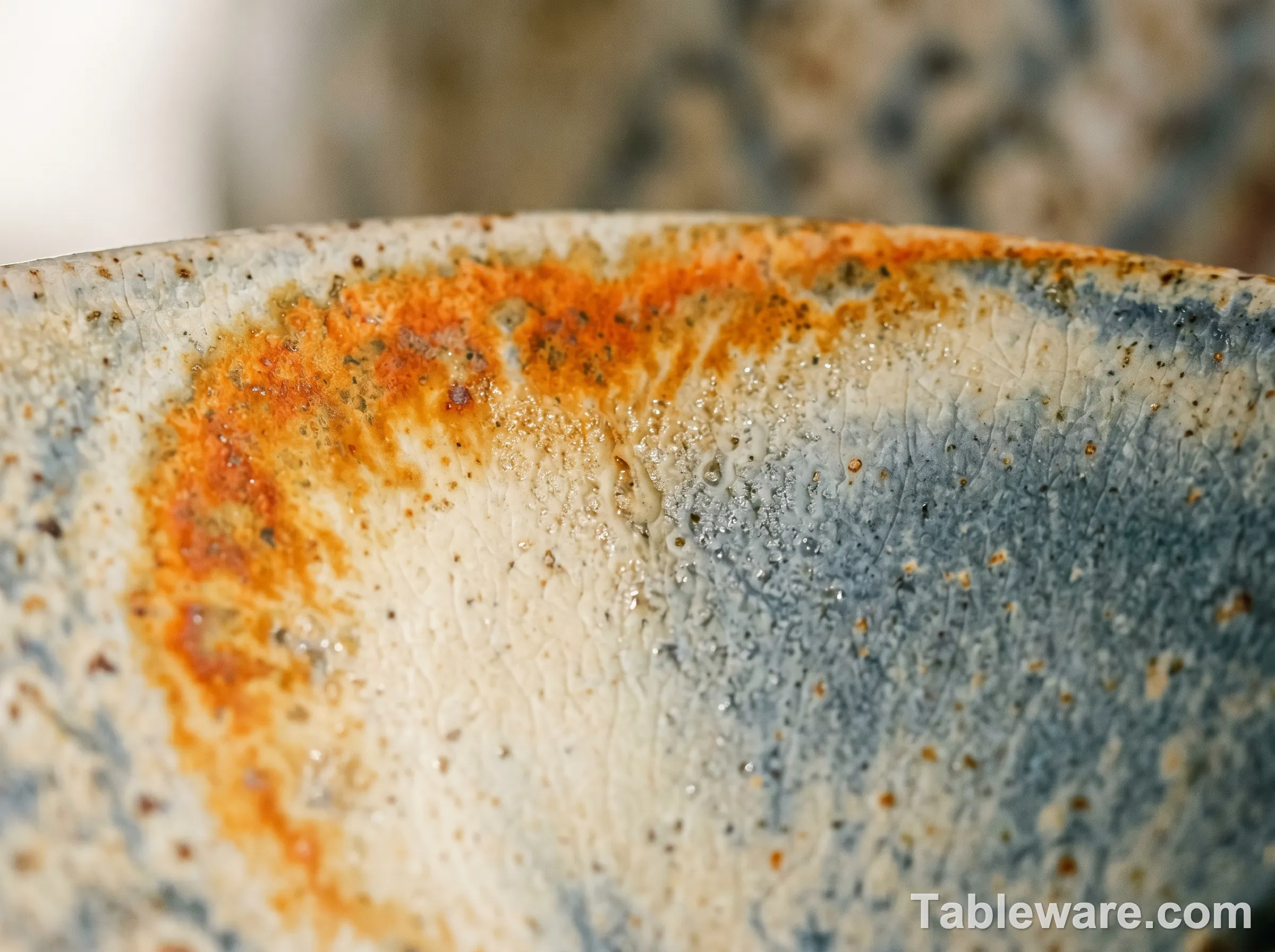
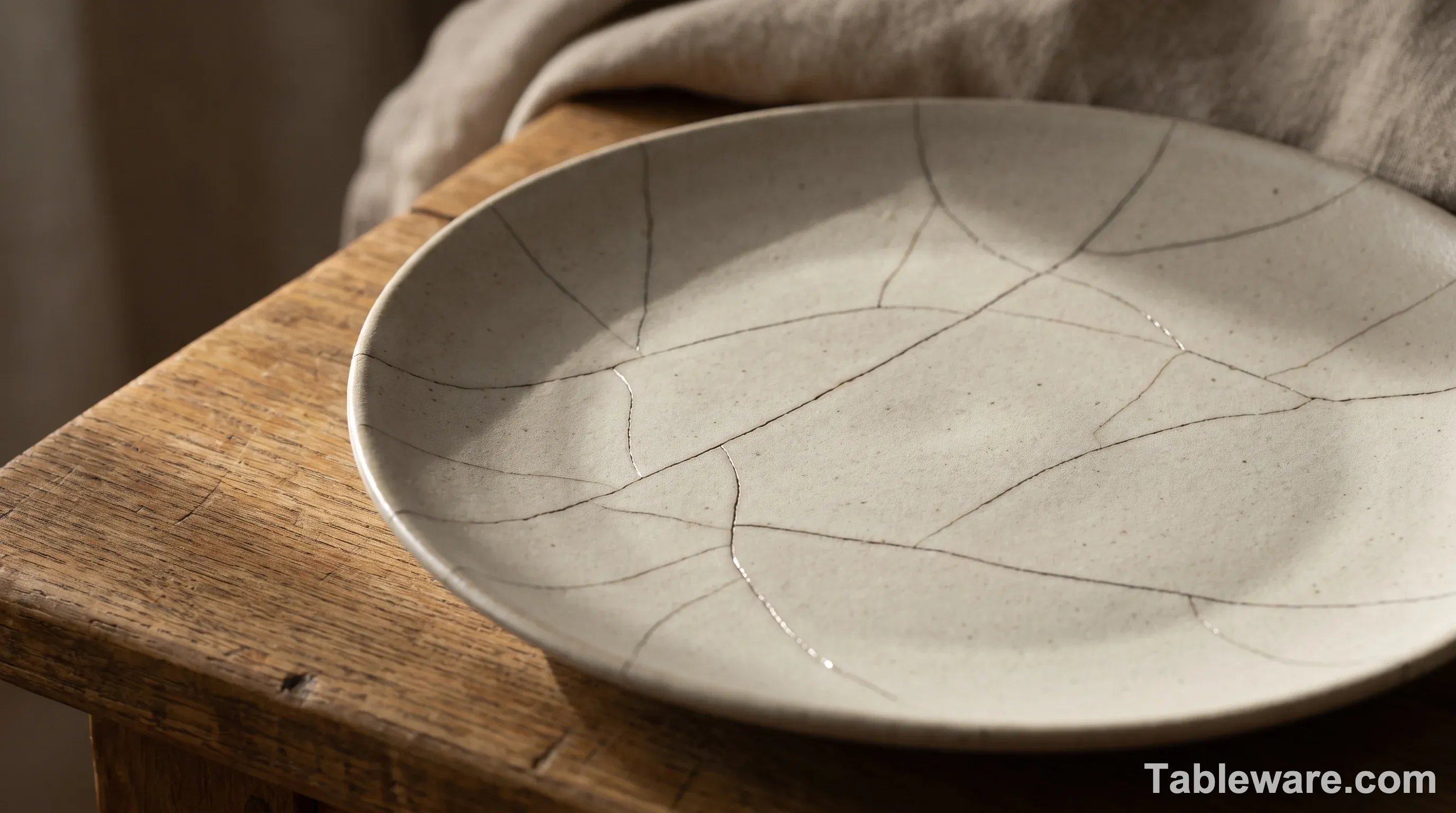
Fig 1. Close-up of a true reactive glaze surface, showing the orange rutile break and soft color shift from cream to slate that cheap printed patterns cannot fake.
What "Reactive Glaze" Actually Means
"Reactive" is a marketing word that used to be a technical word. In a working ceramic studio, a reactive glaze is one in which the oxides in the recipe physically interact during the firing and the cool-down, producing visual effects the formulator did not paint on. Two glazes may be poured over each other. Metal oxides may migrate. Crystals may grow during the slow cool. The result is a surface that has variation across every square inch — sometimes within a single inch — and variation from piece to piece of the same production run.
That last part matters. If a "reactive" dinnerware set has twelve plates that all look identical, you are looking at a printed underglaze. Real reactive ware never has twelve identical plates. Some potters embrace this so much that they sell the pieces one at a time. East Fork, the Asheville-based company, sells most of their reactive-glaze dinnerware as open stock for exactly this reason. They want you to build a 12-piece set over three years and end up with four different glaze colors. That is the aesthetic, not a flaw.
Here's the short version of what is happening on a microscopic level during a cone 6 oxidation firing (cone 6 is roughly 2232°F, or 1222°C — the modern workhorse temperature for studio ware):
- The clay body has fused into a vitrified (glass-like) mass.
- The glaze, which is itself a thin layer of silica, alumina, and fluxes, has melted into a liquid.
- As the kiln cools — slowly, over 8 to 12 hours — minerals in the glaze start to find their favorite crystal structures.
- Some form crystals. Some form glass. Some form the soft "blooms" you see at the edge of a color break.
The visual variation is not paint. It is a record of what the glaze wanted to do when it cooled.
The Chemistry, In Human Terms
You do not need a chemistry degree to read a glaze recipe. The recipe on a studio technician's index card is a list of materials, with percentages, that end up supplying a handful of metallic oxides to the kiln. Those oxides are where the color comes from. And the ratios — the percentages — are what determine whether the glaze looks quiet and even, or moves around and breaks.
A few of the usual suspects:
Iron oxide (Fe₂O₃). Added at 1% to 4% in most recipes, iron is the workhorse. In oxidation (with plenty of oxygen in the kiln) it produces warm tan, butter, caramel, and rust. In reduction (with the oxygen starved out) it produces celadon green, tenmoku black, and the iron-saturate "oil spot" effects on Chinese Song dynasty ware. A "rutile break" — the orange halo you see around a darker spot in a reactive glaze — is essentially iron precipitating out of solution as the glaze cools.
Copper carbonate (CuCO₃). At 2% to 5%, copper is the most dramatic color-shifter in ceramics. In oxidation it gives you the famous copper green (celadon-adjacent, Egyptian paste, Islamic glazed tile). In reduction it gives you the famous copper red (sang-de-boeuf, oxblood, peach bloom). The same oxide, fired under different conditions, makes two completely different palettes. This is one of the reasons reactive glaze work is so hard to control.
Cobalt carbonate (CoCO₃). 0.5% to 2% gives you blue. Cobalt is the strongest coloring oxide in ceramics by weight — even a quarter percent will visibly tint a glaze. Most potters use it sparingly, both because of cost and because a half-percent error visibly changes the result.
Manganese dioxide (MnO₂). At 3% to 8%, manganese produces soft purple-browns, grays, and blacks. It is also volatile at high temperatures — it will literally evaporate and re-deposit on cooler shelves in the kiln, staining anything nearby. Studio potters call this "manganese fume" and it is the reason most studio kilns have a separate manganese-only firing schedule. If you have ever seen a kiln shelf stained brown in a halo pattern, that is manganese migration.
Rutile (TiO₂ with iron impurities). Rutile is the cheat code for reactive-looking surfaces. It is naturally occurring titanium dioxide with 5% to 15% iron oxide contamination. When the glaze cools, the titanium dioxide wants to crystallize and the iron wants to color the crystal — and you get the soft, broken, variegated surface people call "reactive." Most of what you are seeing on a Heath, an East Fork, or a Jono Pandolfi piece is rutile doing its thing. It is also the most expensive ingredient in the recipe by volume, which is part of why real reactive ware costs what it costs.
Redart clay. A natural red earthenware clay from the Redart mine in Ohio, used at 5% to 15% to give warm, brick-ish base tones. It is not glamorous. But it is in a lot of the studio recipes that produce the soft "blush" effect you see on newer studio pottery.
OK, that is enough chemistry. The point is: when you see a $14 Heath saucer with a soft cream-to-slate gradient and a faint orange halo, that is the visible result of those six ingredients, in specific ratios, doing specific things as the kiln cooled. It is not paint. It is not a printed pattern. It is the chemistry being a little bit out of control in a controlled way.
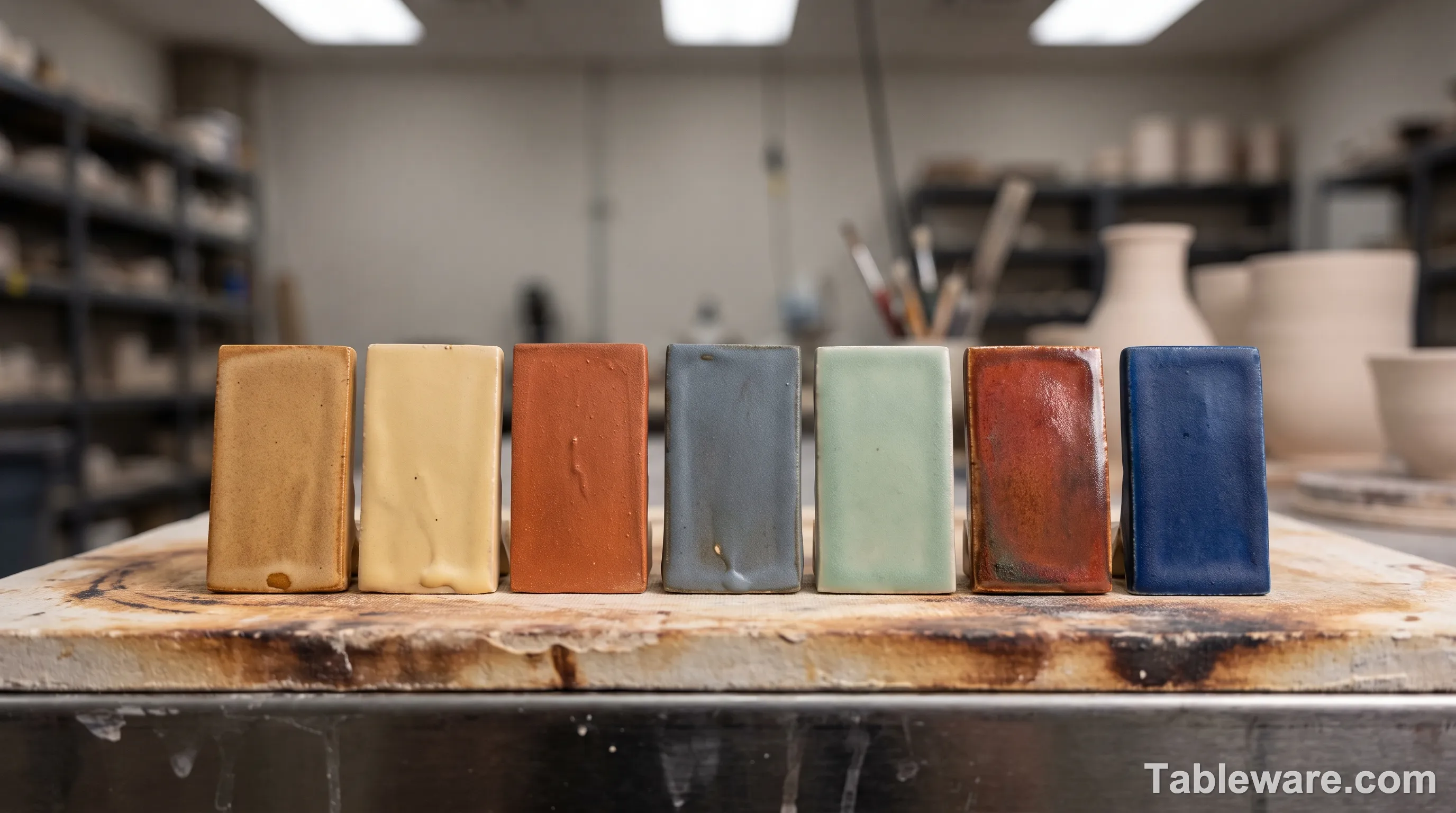
Fig 2. A row of studio glaze test tiles, each fired with a different oxide ratio. The orange-to-slate color breaks are not painted on — they crystallized out of the molten glaze during the cool-down.
The "Reactive" Part — What Makes It Move
Two specific phenomena produce the visual signature of a reactive glaze. The first is glaze-on-glaze layering. The potter dips the bisque-fired piece in one base glaze, lets it dry, then pours or dips a second contrasting glaze over the top. Where the two glazes meet, they do not fully mix during the firing. They form a "break" line where the chemistry partially homogenizes. The result is the soft halo you see where cream meets slate, or where rust meets cream. This technique is older than anyone reading this — it goes back at least to Song dynasty Chinese ware, where the potters were layering iron-rich and iron-poor glazes to get visible color breaks.
The second is crystal growth during the slow cool. This is where the rutile does its job. As the kiln passes through the 1100°C to 900°C range on its way down, the titanium dioxide in the glaze starts to form needle-shaped crystals. The iron in the rutile colors those crystals yellow-orange. If the cooling is fast (200°C per hour), the crystals are too small to see. If the cooling is slow (50°C per hour through that range), the crystals grow large enough to scatter light, producing a matte, variegated, slightly rough surface. This is also why the same glaze recipe can look glassy in one kiln and matte in another, depending entirely on the cool-down schedule.
The implication for you, the buyer, is this: the visible variation on a reactive plate is not an accident. It is a record of a specific firing schedule and a specific layering technique. Two potters can use the same base glaze recipe and get wildly different results, because their kilns, their cooling rates, and their layering techniques are different. If you are a restaurant buyer ordering 200 plates for a 12-table Michelin kitchen in Tokyo, you are partly buying a kiln schedule. That is one of the reasons the restaurant suppliers (Steelite, Fortessa, Hotelware brands) use extremely tight, repeatable single-color glazes. They want batch to batch consistency. The studio potters — Heath, East Fork, Jono Pandolfi, Sarah Kersten, Frances Palmer — are doing the opposite. They want the kiln to have a personality.
The Brands Doing It Right
Let me name some names. These are not paid placements. These are the studios I think are doing real reactive glaze work, with a short note on what they are doing.
Heath Ceramics (Sausalito, California, founded 1948). The OG American reactive studio. Edith Heath's original recipes, many of which are still in use, were layered satin-matte glazes over a heavily grogged stoneware body. The current production line still uses some of those recipes. The look is restrained — soft cream, slate, sand, oxblood, the famous "Black" glaze — and the variation is subtle. A Heath set in a real kitchen is unmistakable. Walk into a Heath showroom and pick up four of the same plate. No two will be identical. The reason is partly the chemistry and partly the fact that they are still producing in California, on a 70-year-old tile line, in batches of 200 or so.
East Fork (Asheville, North Carolina, founded 2010). The newer American reactive studio. East Fork's "every color is a different recipe" philosophy is not marketing — it is literally true. They have something like 40 active glaze recipes, and they retire and develop new ones constantly. Their most iconic reactive glazes — Morel, Eggshell, Panna Cotta, Socialite — are all layered, slow-cooled satin matts. The pieces are dishwasher safe but the catalog is very clear that they will show metal marking (the gray-black scuff from your fork) and that this is part of the look. East Fork is also one of the few American studios that publishes an annual transparency report. They tell you how many pieces they made, how many were seconds, and what they did with the seconds. It is a good read.
Jono Pandolfi (Hoboken, New Jersey, founded 2006). The restaurant supplier side of the studio reactive world. Jono Pandolfi supplies a lot of the New York tasting-menu restaurants — Cosme, Crown Shy, Frenchette, the various Major Food Group spots. His work is reactive-glaze but built for a commercial kitchen: thicker walls, more durable bodies, and glaze recipes that survive 200+ dishwasher cycles without losing the visual. He is a real studio. He is not a hospitality-industry brand pretending to be a studio.
Fiestadt. Not reactive. Solid color. Calling Fiestadt reactive is the single most common mistake I see in product listings. Fiestadt (the German dinnerware brand, not the Fiestaware brand from the US) makes wonderful, durable, solid-color porcelain. It is not reactive. Do not pay reactive-glaze prices for it.
Mud Australia (Sydney, Australia, founded 1994). Porcelain, not stoneware, and they are doing layered reactive underglaze work. The pieces have the muted pastel palette Australians are weirdly good at — a soft blush, a soft slate, a soft mint — and the porcelain body means the pieces are lighter than a comparable Heath or East Fork piece. Mud is one of the few studios doing reactive work at scale in porcelain rather than stoneware, and the result is a noticeably different weight in the hand.
Vintage California pottery (1950s–1970s). This is the part the modern marketing does not want to talk about. Most of what the current American reactive studios are doing is a deliberate revival of mid-century California studio work. Bauer Pottery, Vernon Kilns, Pacific Pottery, Gainey Pottery, and a half-dozen smaller California studios were doing layered reactive glazes on stoneware in the 1950s. Bauer alone had something like 30 active glaze recipes. A Bauer "Ringware" dinner plate from 1962, in a really good reactive glaze, will set you back $80 to $200 in the secondary market. The current generation of American studio potters is reviving this work because it was genuinely good, and because the recipes survived. Bauer Pottery re-opened in 2018 and is making reactive ware again. The aesthetic is not retro-for-retro's-sake. It is a real continuation.
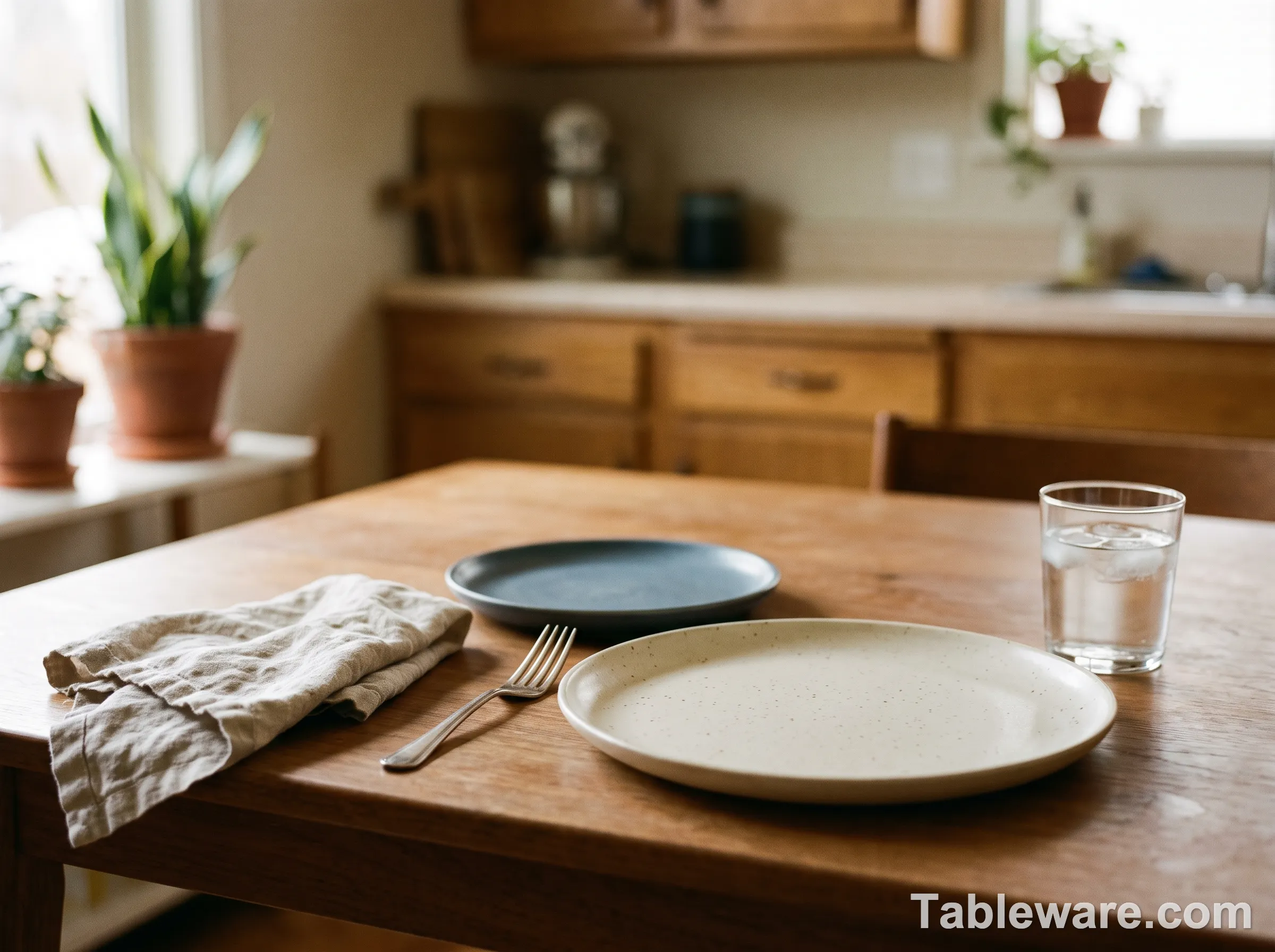
Fig 3. A real dinner table with a Heath Ceramics dinner plate next to an East Fork side plate. Both are reactive glaze, both are satin matte, both show the soft color break that defines the form. The variation between them is the point.
The Downside — What Reactive Glazes Do Badly
Here is the part the catalogs do not want you to read. Reactive glazes have real failure modes. Most of them are cosmetic. Some of them are functional. The honest thing to do is to tell you about them so you can buy with eyes open.
Crazing. A network of fine cracks across the glaze surface. Caused by the glaze contracting at a different rate than the clay body during cooling. It is almost always cosmetic, but it does two things you should know about. One, it can harbor bacteria if the cracks reach the body. Two, it makes the piece more fragile over time. A crazed plate that has been through a few hundred dishwasher cycles is more likely to chip at the rim than an un-crazed plate. Most American studios are pretty good about avoiding crazing now. Imported reactive ware from less-regulated factories is where you see it most.
Crawling. The glaze physically pulls away from the clay body during firing, leaving bare patches. Crawling happens when the glaze is too thick, when there is dust on the bisque, or when the glaze has too much plastic clay in the recipe. A crawled plate is a second. Reputable studios sell it as a second or break it. If a "reactive" plate you receive has bare clay patches, that is a manufacturing defect, not a feature.
Pinholing. Tiny pits in the glaze surface, usually from gases escaping the clay body during firing. Most pinholes are pinprick-sized and you only see them in raking light. They are a fact of life in matte glazes. Heath's seconds rack is full of pinholed pieces, and the studio sells them at 30% to 50% off because the pinhole is purely cosmetic.
Dunting. The plate cracks in the kiln. Usually a hairline crack that runs from the rim partway across. The plate is unusable, the studio eats the loss, and the piece never makes it to inventory. This is not something you will see as a buyer, but it is the silent tax on reactive ware. Studios report dunting rates of 3% to 8% on layered reactive glazes. The simpler the glaze, the lower the dunting rate. The more layering and the slower the cool, the higher the rate.
Metal marking. The gray-black scuff your fork leaves on the plate. This is the one that bothers people most. Metal marking happens because the matte glaze surface is slightly porous at a microscopic level and the soft metal of your fork deposits a tiny bit of itself on the plate. It is not permanent. It washes off with a mild abrasive (a paste of baking soda and water, or a Magic Eraser). But it will happen, every time, on every matte reactive plate you own. East Fork is unusually candid about this in their care guide. Most other brands just hope you do not notice.
Look, the truth is most of these "flaws" are part of why people buy reactive ware. A satin matte stoneware plate that crazes slightly after three years and shows a faint fork scuff is a plate that looks like it has been used. It has not. The visual is a sign of the material, not of the use. Some people want a plate that looks like it has been in the family for two generations. Reactive glaze is the cheat code.
How to Tell Cheap "Reactive" From Real Reactive
Here is the practical test. If you can run all four of these checks, you will not get fooled by a $30 set from Amazon.
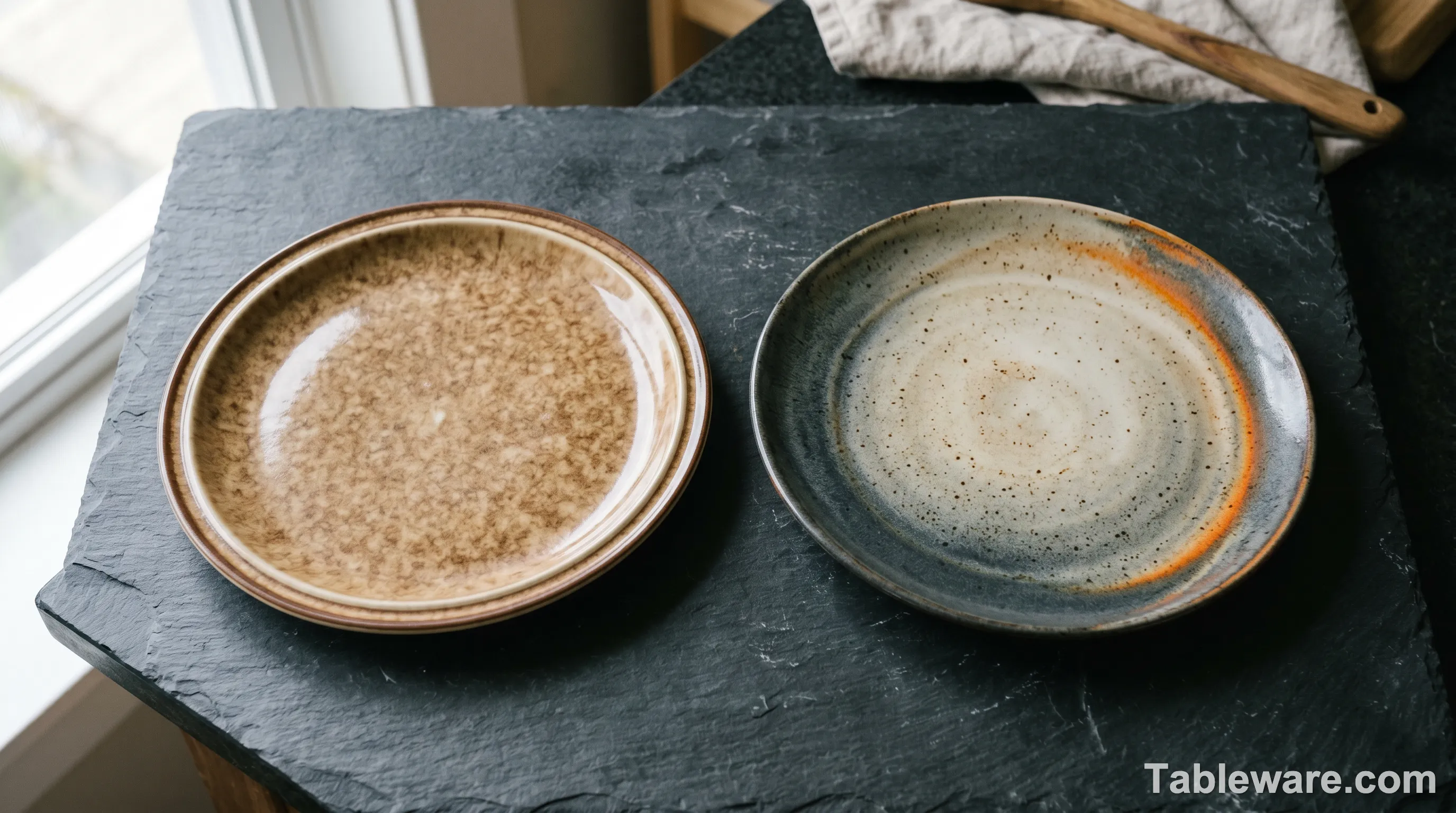
Fig 4. Side by side: a $30 printed tan plate (left) and a handcrafted reactive-glaze plate (right). The flat, repetitive surface on the left is a printed underglaze pattern; the soft cream-to-slate gradient with the orange rutile halo on the right is the chemistry being a little out of control in a controlled way.
Test 1: Pick up two of the same plate. They should not be identical. Real reactive glaze has visible variation across every piece. A printed pattern, by definition, repeats. If the two plates in your hand look like they came off the same print run — same color density, same break pattern, same halo placement — you are looking at a printed underglaze. This is the single most reliable test.
Test 2: Look at the foot rim. Turn the plate over. On a real reactive plate, the foot rim (the unglazed ring on the bottom) is roughly the same color as the unglazed clay body — usually a warm buff or a soft white. On a cheap printed plate, the foot rim is often a slightly different color from the body, because the body and the "reactive" pattern are different materials. Real reactive glaze is a single piece of clay, fired once, with a single glaze chemistry. Cheap printed ware is a piece of clay, fired, with a printed pattern, then a clear glaze, then fired again. The foot rim tells you which is which.
Test 3: Look at the rim in cross-section. If you have two of the same plate and one broke, break one and look at the cross-section. A real reactive plate has a single layer of glaze over the body, 0.5 mm to 1.5 mm thick, with the visible color extending all the way through that layer. A printed plate has a clearly visible printed pattern between the body and the clear top glaze. You can see the print. You can sometimes flake it off with a fingernail.
Test 4: Check the back stamp. Real studios stamp their work — Heath, East Fork, Jono Pandolfi, Mud Australia, Frances Palmer, Sarah Kersten. The stamp is usually impressed (pressed into the clay before firing) and is the same color as the clay body. A printed plate has a printed back stamp, often in a slightly different ink color than the rest of the printing. The stamp test is the easiest one to do when you are in a store.
I want to be fair to the cheap stuff. A $96 16-piece set is not a bad product. The clay is usually fine, the glaze is food-safe, the pieces will survive a normal home kitchen for years. The aesthetic is the lie. You are paying for a $96 set and getting a $96 set. You are not getting reactive ware. The catalog copy is doing the work of justifying a 30% to 50% price premium for what is, mechanically, a printed pattern.
What to Actually Look For If You Are Buying
If you are buying reactive ware for your home, here is what to weight.
Cone 6 vs cone 10. Modern studio reactive glazes are mostly cone 6 (about 1222°C). This is the workhorse temperature because it is achievable on a standard electric kiln and it produces a strong, vitrified body. Cone 10 (about 1285°C) is a gas-kiln temperature and produces a denser, more durable body — but most studios cannot economically run cone 10 in electric. Both are fine. What you do not want is a "reactive" piece fired at cone 04 (about 1063°C) — that is earthenware temperature, and the body will be porous. The cone temperature is usually on the back stamp. If it is not, ask the seller.
Vitrification matters more than the visual. A vitrified body absorbs less than 0.5% water. A non-vitrified body absorbs 3% to 8%. Vitrified ware is dishwasher-safe, microwave-safe, and resistant to thermal shock. Non-vitrified ware will eventually crack from dishwasher heat. Studios that do real reactive work at cone 6 are vitrifying the body as a side effect of the high fire. Studios that print a reactive pattern and fire at cone 04 are not. The visual is not the test. The cone temperature and the body porosity are.
Metal marking is normal. Buy a set of bamboo silverware or use a plastic fork or accept the metal marking. These are your three options. The studios that do reactive work in satin matte are aware of this. They are not going to fix it. The visual requires a slightly porous surface, and a slightly porous surface will pick up metal from your fork.
Mixing sets is fine. If you buy two Heath saucers and four East Fork plates, they will not match. The aesthetic is "I bought these over three years and I like them." That is fine. The "I have a 12-piece matched set" aesthetic belongs to the printed dinnerware world. You are paying a premium to leave that world.
Dishwasher is fine, but. Top rack only, and skip the heated dry cycle if your dishwasher has one. The high heat of the dry cycle, repeated 200 times, is the most common cause of crazing in studio ware. Hand-washing is overkill. Top-rack, no heated dry, and you will be fine for 10 to 15 years.
Why This Matters for Home Cooks
Honestly, most of the reason anyone cares about reactive glaze is aesthetic. The food tastes the same. The plate cleans the same. The plate does not improve the food. I am not going to pretend it does.
But the aesthetic is also the point of home cooking for a lot of people. The 45 minutes you spent on the chicken confit deserves a plate that looks like the chicken confit. A uniform white plate from a $96 set is a uniform white plate. A Heath plate in a soft cream-to-slate reactive glaze is a plate that looks like it was made for that specific piece of chicken. The visual context is part of the meal.
There is also a durability argument that does not get made often enough. Reactive stoneware at cone 6 is one of the most durable materials in domestic ceramics. It survives the dishwasher, the microwave, the oven, the freezer, and the daily use of a family kitchen. A real reactive plate is a 10 to 20 year purchase. A printed $30 plate is a 3 to 5 year purchase before the print starts wearing off. The price per year is similar. The visual per year is not.
The Honest Close
The thing most guides on this topic get wrong is that they treat reactive glaze as a mystical, hand-crafted process that defies industrial reproduction. It is not mystical. It is a controlled kiln schedule, a specific oxide recipe, and a layering technique. It can be taught. It is taught, every semester, in every ceramics BFA program in the US. The "mystique" is the price tag and the waitlist at the studio, not the chemistry.
The other thing the guides get wrong is that they treat cheap "reactive" ware as a budget option. It is not. A $30 set and a $300 set occupy different aesthetic universes. The $30 set is fine. It is also not the same thing. You can spend $30 on a printed tan plate and enjoy it. You cannot spend $30 and get the Heath saucer look. The chemistry is the price. The labor is the price. The slow cool kiln schedule is the price. None of those scale to a $30 set without cutting the chemistry.
I bought that $96 set on Amazon in 2021. I am still using it. The plates are fine. The bowls are fine. The mugs are fine. They are also the least interesting dinnerware in my kitchen. The interesting plates are the four Heath pieces, the two East Fork pieces, and the one Jono Pandolfi salad plate I bought myself for my 40th birthday. They are all reactive. They all have a different recipe. They all have metal marking that I have to clean off with baking soda every few weeks. They are also the plates my friends ask about when they come over for dinner.
That is the test. The plates you reach for are the ones with a personality. Reactive glaze is the personality.