There's a small plate on my desk right now, propped against a stack of books, that I bought in Puebla in 2019 for about $14 from a workshop called Uriarte. It's white, with a cobalt blue rim, a tiny lemon yellow flower in the center, and a black handwritten signature on the back. My friend Sarah has a plate on her wall in Brooklyn that looks almost identical, except hers came from a flea market in Amsterdam, is painted entirely in blue, and cost her $6.
Both plates are tin-glazed. Neither of them, strictly speaking, is "majolica." And this is the kind of conversation that gets ceramics people into arguments at dinner.
If you have ever wandered into a kitchen store, scrolled Etsy, stood in the ceramics aisle of the Met, or tried to figure out why your aunt's "Delft" tile looks nothing like the blue-and-white plates on the cover of every Dutch cookbook — this is the comparison you actually need. Majolica vs Delft vs Talavera is a real question, asked by real shoppers, and the answer is messier than any product listing lets on.
The short version: all three are tin-glazed earthenware traditions that started within about 250 years of each other, share an ancestor in 9th century Abbasid Iraq, and use the same basic trick (suspended tin oxide to make a transparent glaze go milky white). After that, they go in three very different directions. Italian maiolica, Dutch delftware, and Mexican Talavera ended up looking so different from each other that a casual buyer can usually tell them apart in about ten seconds, once they know what to look for.
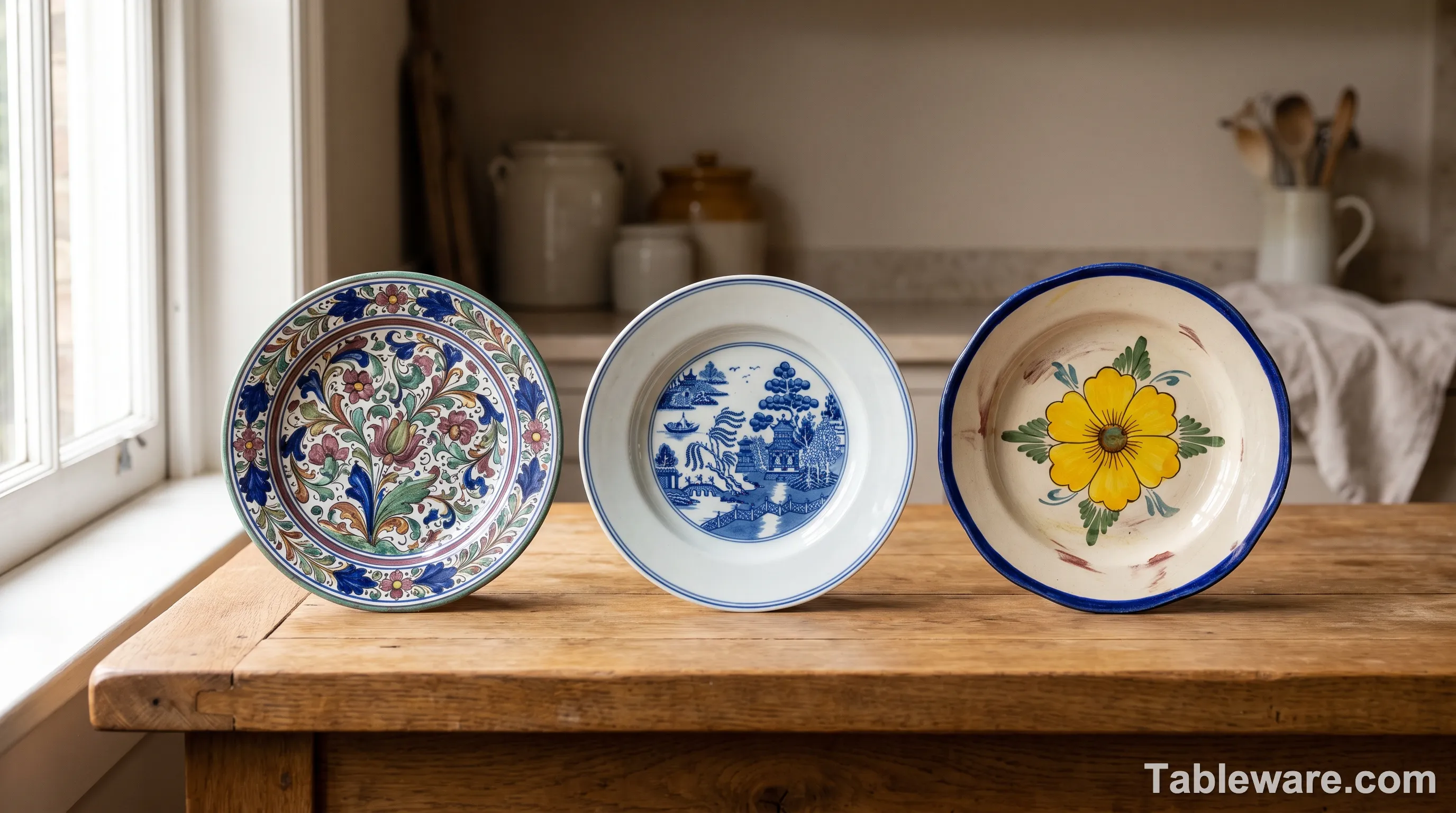
Fig 1. The three traditions, side by side. Same underlying trick (tin-opacified glaze over earthenware), three completely different results. The Italian piece (left) is polychrome. The Dutch (center) is restricted to cobalt blue on white. The Mexican (right) is a brighter, folk-influenced palette.
What all three have in common (and why people mix them up)
The confusion starts with the word "majolica." Walk into a kitchen store and ask for majolica and you'll get pointed at anything painted. The word has done a lot of work over six hundred years, and it means three different things depending on who's using it.
In its original 15th century Italian form, maiolica referred to tin-glazed earthenware from places like Deruta, Gubbio, Faenza, and Montelupo. The name itself is a corruption of Majorca, the Spanish island that was the first major re-export hub for this kind of pottery heading north into Italy. By the time English speakers got hold of the word in the 19th century, "majolica" had expanded to mean almost any brightly colored, lead-glazed Victorian-era earthenware — the kind William De Morgan was making in the 1860s, the kind Minton was putting on the backs of tortoises. Then, in the 1970s and 80s, a third use of "majolica" entered the American kitchen vocabulary: it became a generic term for any heavy, hand-painted, country-style dinnerware, regardless of where it was actually made or whether it was tin-glazed at all.
So the first thing to clear up: Italian maiolica, Dutch delftware, and Mexican Talavera are all tin-glazed, but only one of them is "majolica" in the historical sense, and the other two are only sometimes called "majolica" in the kitchen-store sense.
The shared ancestor: tin-opacified glaze
What they all share is the tin glaze. The trick is older than any of these traditions. By the 9th century, potters in Abbasid Iraq figured out that if you grind tin oxide (sometimes with a little lead oxide to help it melt) into your glaze recipe and fire the kiln to about 950°C to 1050°C, the suspended tin particles stay suspended in the cooled glaze instead of dissolving. The result is a milky white, slightly bluish, opaque layer that sits on top of an otherwise ugly red or buff earthenware body.
Why this matters: earthenware is cheap, abundant, easy to throw, and fires at low temperatures — but it's also reddish brown and (to modern eyes) unattractive. Tin glaze solves that problem in one step. It gives you a brilliant white canvas to paint on, and a glassy surface that holds color. The three traditions that grew out of this single discovery are basically three different answers to the same question: now that you have a white canvas, what do you paint on it?
Why "majolica" shows up in three different places
Italian maiolica is the ancestor tradition, the one that took the tin glaze and ran with it through the Renaissance. Dutch delftware is a 17th century offshoot, born out of a Chinese porcelain shortage and the closure of the Italian tin-glaze import routes during the Dutch Revolt. Mexican Talavera is a colonial descendant, brought to Puebla by Spanish friars in the 1550s and shaped by indigenous Mexican clay, indigenous pigments, and almost five centuries of local workshop practice.
If you've ever typed "is talavera the same as majolica" into a search engine, the short answer is no — same family, different branch, three very different timelines, three very different palettes. Which is what the rest of this piece is about.
A quick history of tin glazing, from Iraq to your cupboard
Tin glazed pottery history is longer than most people realize. It's not a "European" thing at all. The technology moved west in a chain of transfers over about 600 years, and each transfer added something.
9th–13th centuries: Iraq, Egypt, and the Iberian Peninsula
The earliest confirmed tin-glazed pieces come from 9th century Abbasid Iraq — modern-day Samarra and Basra. From there, the technique spread to Egypt (Fustat, the medieval predecessor to Cairo, was a major center by the 10th and 11th centuries), and then across the Maghreb into Al-Andalus. By the 13th century, tin-glazed pottery was being made in centers like Málaga and Valencia on the Iberian Peninsula, and the island of Majorca had become a major transshipment hub for the Mediterranean trade.
The colors on these early pieces are not the soft palette we'd associate with any of the three modern traditions. They're bold, often with copper greens, manganese purples, and iron reds, and the brushwork has a strongly Islamic geometric and calligraphic feel. The Alhambra in Granada, the Met in New York, and the V&A in London all have significant collections of this early material, if you want to see the ancestor pieces in person.
13th–15th centuries: maiolica takes root in Italy
Italian potters in Tuscany and Umbria learned the tin-glaze technique from the Iberian trade, and by the late 13th century they were producing their own versions. The crucial Italian innovation was the use of calcareous clays (clays with high calcium carbonate content, like the local clays from the Tiber valley and the Apennines) and the development of a much wider, brighter color palette. By the 15th century, Italian maiolica was being painted with a full polychrome range — copper green, cobalt blue, manganese purple, antimony yellow, iron red, and a particular orange-red that comes from a special preparation of iron oxide. Renaissance maiolica from Deruta, Gubbio, and Urbino is some of the most technically advanced decorative pottery ever made, anywhere, and a few pieces — like the famous "istoriato" wares painted with full historical scenes — are essentially small paintings fired onto clay.
17th century: Delft fills the gap left by vanishing Chinese porcelain
The Dutch Revolt (1568–1648) cut off the overland tin-glaze trade routes through Antwerp and the southern Netherlands. At the same time, demand for blue-and-white porcelain from China was exploding across Europe, but supplies were inconsistent and expensive. Dutch potters in the city of Delft began producing a local imitation: tin-glazed earthenware painted entirely in cobalt blue, deliberately mimicking the look of imported Ming and early Qing porcelain.
The palette restriction to cobalt blue was not a stylistic choice — it was an economic one. Cobalt oxide was the only stable blue pigment that survived the tin-glaze firing process, and the Dutch workshops had access to good cobalt through their East Indies trade. They couldn't reliably get copper green, manganese purple, or antimony yellow, so they didn't use them. The result is the look that most English speakers think of as "Delft blue" — and it's worth remembering that this is mostly a 17th century invention, not a 1000-year-old Dutch tradition.
16th century onward: Talavera is born in New Spain
Talavera de la Reina in Spain was already a major tin-glaze producer by the 16th century — Spanish potters there had been making tin-glazed earthenware for centuries, and the city gave its name to the tradition. When Spanish friars and settlers brought the craft to New Spain in the 1550s, the workshops in Puebla, Mexico adopted the basic technique and the name, but quickly diverged in three ways.
First, the clay: Puebla potters discovered that blending the local black volcanic clay with the local white clay gave a better body than either alone, and the "black-and-white clay" recipe became a defining characteristic of Talavera.
Second, the pigments: with no access to the same European pigment supply chains, Talavera workshops leaned on local mineral sources and indigenous color traditions, which gave the palette its particular vibrancy — the bright yellow, the deep orange, the blue that leans more turquoise than cobalt.
Third, the iconography: indigenous Mexican motifs (flowers, birds, geometric patterns rooted in pre-Columbian design) gradually replaced European religious and heraldic imagery. By the 18th century, Talavera looked unmistakably Mexican.
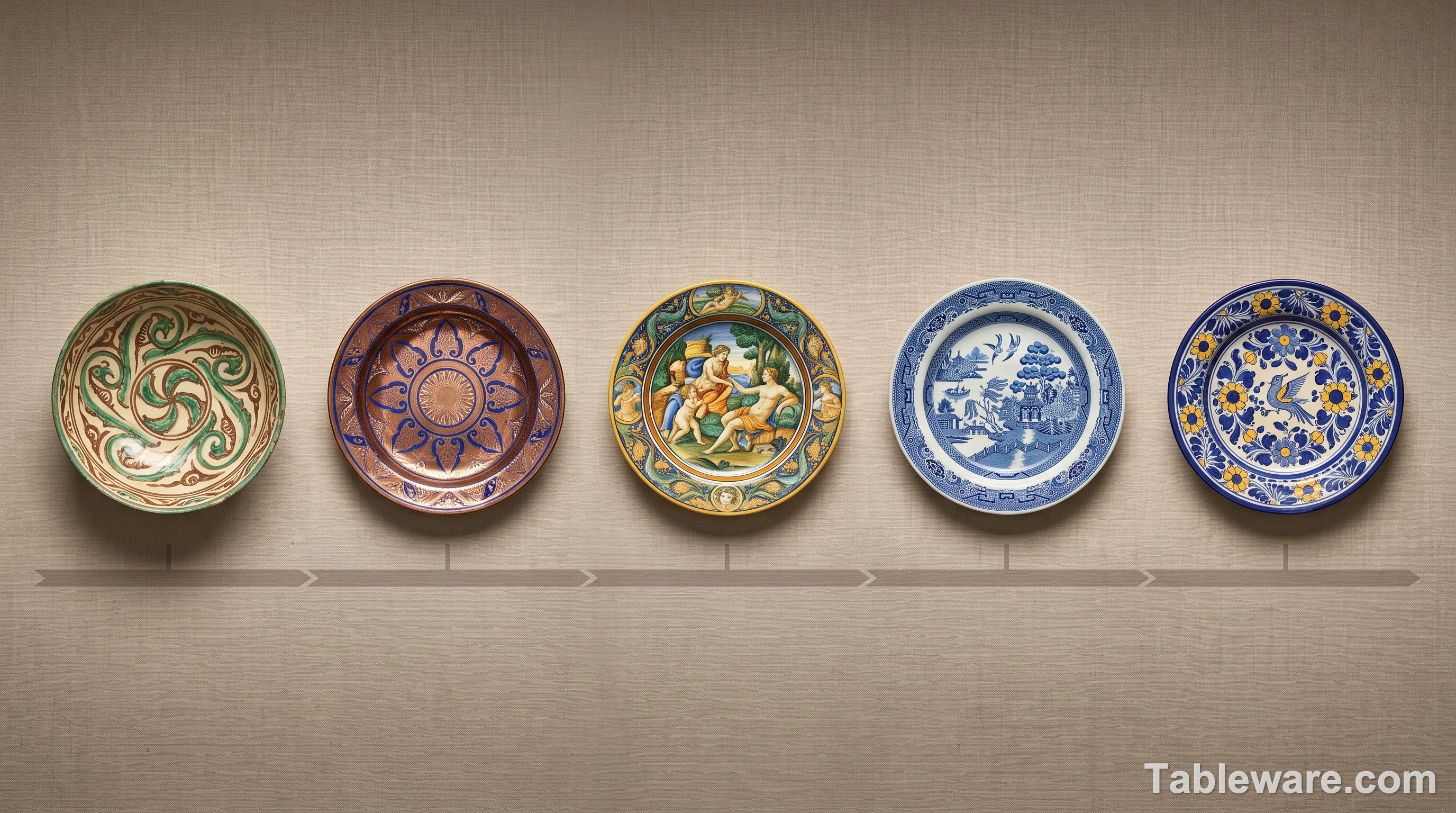
Fig 2. The family tree of tin-glazed pottery, traced from 9th century Abbasid Iraq to the three modern traditions. The technology moved west over about 600 years. Each transfer added something — Italian maiolica added the calcareous clay body and polychrome palette, Dutch delftware added the cobalt-only discipline, Mexican Talavera added the indigenous color and motif language.
Tradition by tradition: Italian maiolica, Dutch delftware, and Mexican Talavera
Now to the actual comparison. The differences are real, visible, and worth understanding before you spend money on any of them. This is the Italian maiolica vs delftware question laid out, with Talavera as the third member of the family.
Italian maiolica — calcareous clay, full polychrome palette
Italian maiolica is the ancestor of the family, and you can still find the tradition alive in places like Deruta, Gubbio, Montelupo, Faenza, and Caltagirone (the Sicilian city that gives the word "calabash" — well, no, but the maiolica tradition there is one of the oldest continuous workshop traditions in Europe).
The body clay is the defining technical feature. Italian maiolica clays are calcium-rich and relatively low in iron, which means the fired body is closer to cream than red. The tin glaze goes on over this, and because the underlying clay is already pale, the glaze can be applied thinner and still produce a brilliant white. Italian maiolica is also typically fired at a slightly higher temperature than the other two traditions — about 1000°C to 1040°C — which gives a harder, more durable glaze surface.
The palette is the full polychrome range: cobalt blue, copper green, manganese purple-brown, antimony yellow, iron red-orange, and occasionally a copper-resist lustre (the famous Deruta lustreware). The brushwork is typically fine, dense, and tightly controlled, with most studio pieces being hand-painted rather than stamped or stenciled.
The downside: a good piece of contemporary Italian maiolica from a Deruta workshop runs $40 to $200+ for a dinner plate, $600+ for a large charger, and significantly more for antique pieces. You're paying for skilled labor and a 600-year-old workshop tradition, not a factory process.
Dutch delftware — buff earthenware, restricted cobalt palette
Dutch delftware, despite the name, is not a single style. There are three distinct phases. The 17th century "Delft" most people picture (blue-and-white, mimicking Chinese porcelain) is the original. The 18th and 19th century "Delft" was a much more varied affair, with a full polychrome palette called Delfts Blauw expanding into other colors and even fully painted pastoral scenes. And the 20th and 21st century "Delft" — which is mostly what you'll find on the market today — is largely produced by a small number of surviving factories (the most famous being Royal Delft / De Koninklijke Porceleyne Fles, founded 1653) and a much larger number of mass-production pieces from places like Makkum and the modern factory reproductions.
The body is buff-colored earthenware, fired to about 1000°C to 1020°C. The clay is iron-bearing but the tin glaze hides it well. The original 17th century Dutch potters used a specific local clay from the Delft region, but most modern delftware is made with a standardized industrial earthenware body.
The palette of genuine Royal Delft is restricted to cobalt blue — by choice, not necessity, since by the 20th century they had access to any pigment they wanted. The blue they use is a particular shade, often called "Delft blue," and it varies slightly across batches because each batch of cobalt oxide behaves a little differently in the kiln.
Mass-produced "Delft" from the 19th century onward is often lighter, thinner, and more uniform than the original. If you're trying to date a piece, look at the backstamp and the body. Real Royal Delft from 1900 onward has a factory mark, and a continuous workshop tradition of hand-painting that you can see in the brushwork.
Mexican Talavera — black-and-white clays blended, vivid folk palette
Talavera de la Reina in Spain was the original; Talavera in Mexico refers specifically to the tin-glazed earthenware made in the Puebla region, with a Denomination of Origin (similar to Champagne or Parmigiano-Reggiano) granted in 1995. Only pieces made in the designated Puebla workshops — Uriarte, Gorky González, Talavera de la Reina Mexico, dozens of smaller workshops — and meeting specific quality standards can legally be called "Talavera."
The body is the signature. Puebla potters blend two local clays: a black volcanic clay and a white clay, mixed in a roughly 50/50 ratio. The black clay gives the body strength and a slightly granular texture; the white clay lightens the body color. The fired result is a warm cream to light buff body that takes the tin glaze well and shows through slightly at the edges and feet of finished pieces.
The palette is the brightest of the three traditions. Cobalt blue is still the dominant color, but it's typically a more turquoise-leaning blue than Delft blue. The secondary colors are a vivid yellow (antimony-based, often called "Talavera yellow"), a deep orange-red, a copper green, and a manganese black for outlines. The iconography leans into Mexican folk tradition: flowers, birds (especially the Talavera-style rooster), geometric patterns, and stylized human figures. Workshop pieces are hand-painted, and the brushwork is looser and more folk-art-influenced than the tighter Italian tradition.
In 2019, the technique of Talavera pottery was added to UNESCO's Representative List of the Intangible Cultural Heritage of Humanity. This is the only one of the three traditions to have that specific international recognition.
How to tell delft and talavera apart (and majolica, too)
You don't need a chemistry degree. You need to look at three things.
Color and palette tells
Italian maiolica tends to be polychrome — multiple colors, with full Renaissance palettes, and a general "painted plate" feel. If a piece has three or more colors in roughly equal weight, you're probably looking at maiolica.
Dutch delftware in its most recognizable form is single-color blue on white. If the piece is entirely blue and white, with a slightly muted, almost dusty blue, and the blue looks slightly watery or uneven in the wash, you're probably looking at delftware.
Talavera is the brightest of the three. The yellow is yellower, the orange is more orange, the blue is more turquoise, and there's a characteristic warm cream-to-buff background showing through at the edges that the other two traditions don't have.
Glaze surface and weight tells
Italian maiolica glazes are typically thick, slightly wavy, and have a hand-painted look. The piece feels heavy for its size.
Dutch delftware glazes are thinner, more even, and have a slightly more industrial finish on the 20th century production pieces. The body is usually lighter than Italian maiolica.
Talavera glazes are thick and slightly uneven (a sign of hand-painting), and the body is the heaviest of the three. A real Talavera piece is noticeably heavier than a Dutch or Italian piece of the same size.
Backstamp, base, and workshop marks
Italian maiolica from reputable workshops is usually signed on the back, often with the artist's name and the workshop location. Antique Italian maiolica may have a heraldic crest or a family device.
Dutch delftware from Royal Delft is signed with the factory mark (a stylized pottery bottle with initials), and modern pieces come with a numbered certificate. The mark has been consistent since 1879.
Talavera from a certified workshop has one of two backstamps: the artist's signature plus the workshop logo, or (more recently) the Denomination of Origin mark issued by the Mexican government. If the piece you're looking at doesn't have either, it's not certified Talavera — even if it was made in Mexico.
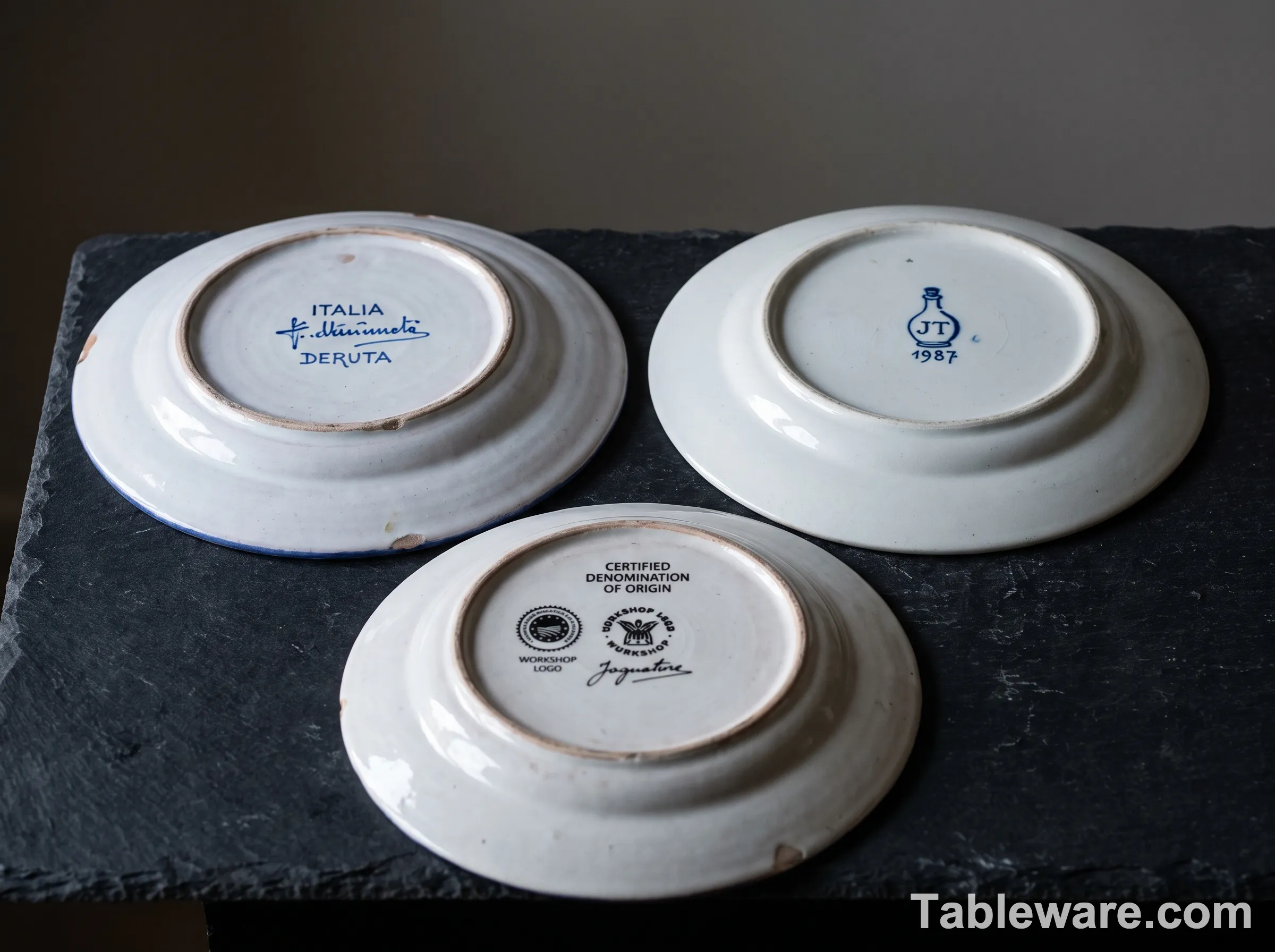
Fig 3. Workshop backstamps from each tradition, side by side. Italian maiolica (top-left) is signed by the artist and the workshop town. Royal Delft (top-right) carries the factory mark of the stylized pottery bottle, unchanged in basic form since 1879. Certified Talavera (bottom) carries the Denomination of Origin mark issued by the Mexican government. If your piece has none of these, you don't have an authentic piece.
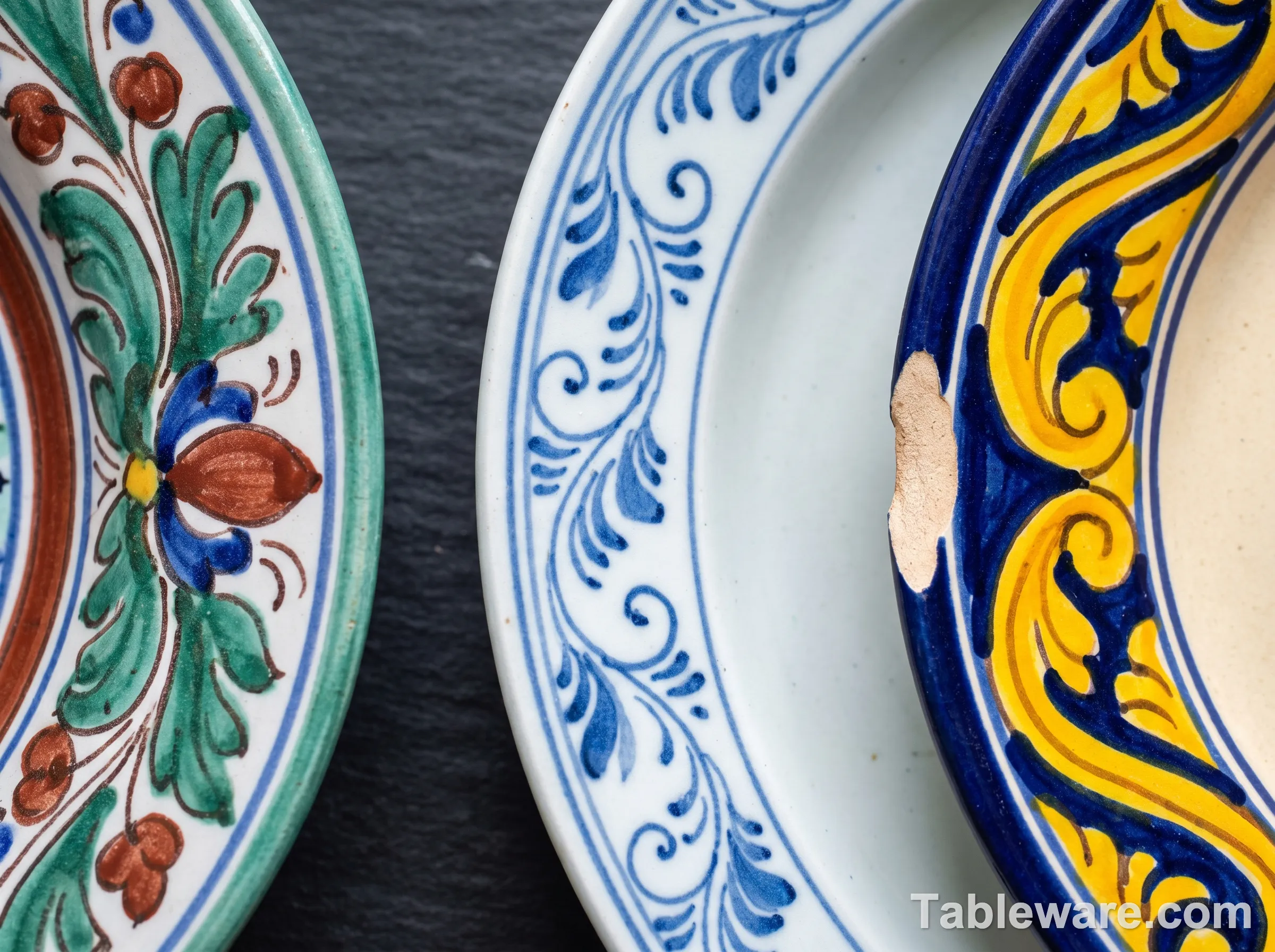
Fig 4. The palette tells. Italian maiolica (left) is polychrome — three or more colors in roughly equal weight. Dutch delftware (center) is restricted to a single, slightly dusty cobalt blue. Mexican Talavera (right) leans into a vivid, almost folk-art palette: cobalt blue, antimony yellow, and a warm cream background.
Buying and living with each tradition today
What to look for in collectible majolica
"Collectible majolica" in the antique market usually refers to 19th century English and European pieces, particularly the high-Victorian output from makers like Minton, Wedgwood, George Jones, and the smaller Staffordshire workshops. If you're shopping for antique majolica, look for signed pieces (most reputable makers marked their work), check for hairline cracks (old majolica is fragile), and be cautious of pieces that have been repainted — the Victorian style lent itself to restoration, and overpainting is common.
Contemporary Italian maiolica from a Deruta or Montelupo workshop is a different category entirely: it's functional, food-safe, and built to be used. A good set of contemporary Italian maiolica dinnerware will run you $800 to $3,000 for a 12-piece set, and it will outlive you.
Authentic vs reproduced Delft: Royal Delft and the imitators
Royal Delft is still producing, and the modern pieces (post-1900) are signed, numbered, and come with documentation. The issue is the 19th and 20th century "Delftware" that came out of places like Makkum, the Boch factory, and various English potteries that made Delft-style tin-glazed ware. Some of this is genuinely good; some of it is mid-quality factory production marked with fictional "Delft" stamps. If the backstamp says "Delft" but doesn't have the Royal Delft factory mark, you're looking at a reproduction or a different factory entirely. The price usually tells the story: a real Royal Delft piece runs $80 to $400+ for a single plate; a generic Delft-style piece runs $15 to $50.
Talavera after the 2019 UNESCO designation
The UNESCO designation has been good and bad for Talavera. Good in that it has helped push the certified workshops to maintain higher quality standards and has given international buyers a clearer marker for what "real" Talavera is. Bad in that it has triggered a wave of uncertified "Talavera-style" pieces from other Mexican states (especially Guanajuato) and from workshops that don't meet the Denomination of Origin requirements. The rule is simple: if it doesn't say "Talavera" and doesn't have the certified workshop mark on the back, it's not Talavera. It might be very pretty; it might be hand-painted in Mexico; it might even be tin-glazed. But it's not Talavera, and it shouldn't be sold as such.
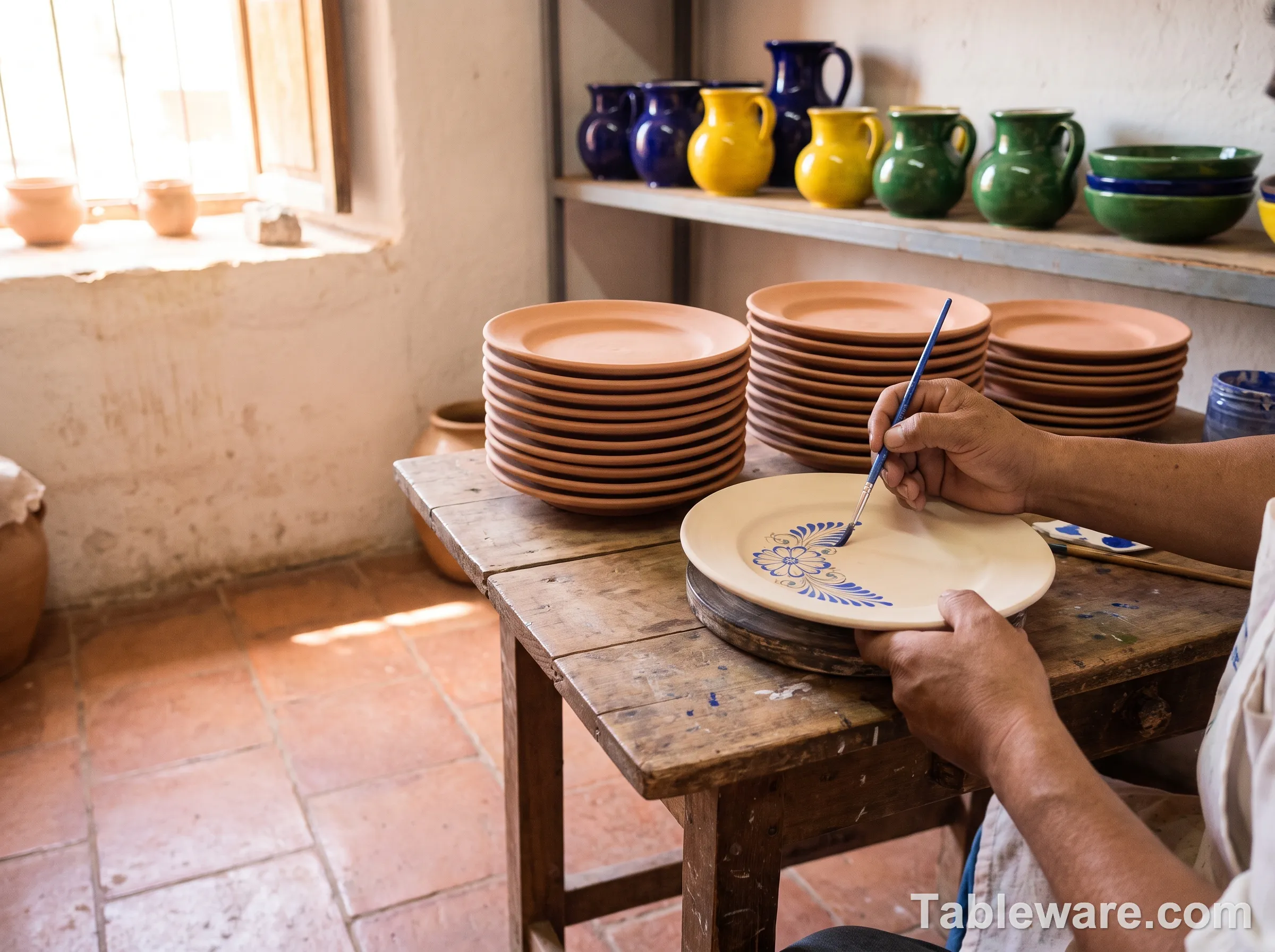
Fig 5. A Puebla workshop in mid-production. The painter is hand-applying cobalt blue to a cream-colored tin-glazed plate. This is what certified Talavera actually looks like before it hits the market: bisque-fired plates, a small workspace, a painter who's been at it for twenty years, and shelves of finished pieces. If you visit Puebla and see this in person, you'll understand why the certified pieces cost what they do.
The price range for certified Talavera is wide: a small plate from Uriarte or Gorky González runs $20 to $60; a large serving platter runs $80 to $250; a complete dinnerware set runs $1,200 to $4,000 depending on the workshop.
Majolica vs delft vs talavera: key differences at a glance (comparison table)
| Italian Maiolica | Dutch Delftware | Mexican Talavera | |
|---|---|---|---|
| Origin | 13th century Italy | 17th century Netherlands | 16th century Puebla, Mexico |
| Body clay | Calcareous, low-iron, cream to white | Buff earthenware, slightly iron-bearing | Black + white clay blend, warm cream |
| Tin glaze | Yes, thin over pale body | Yes, slightly thicker | Yes, thick over warm cream body |
| Firing temperature | ~1000–1040°C | ~1000–1020°C | ~1000°C |
| Typical palette | Full polychrome | Cobalt blue only (traditional) | Cobalt blue, antimony yellow, orange, green |
| Iconography | Renaissance, historical, istoriato | Chinese-inspired, pastoral, geometric | Mexican folk, floral, bird motifs |
| Workshop mark | Artist signature, workshop | Royal Delft factory mark | Denomination of Origin, workshop mark |
| Price (single dinner plate, 2026) | $40–$200+ | $15–$400+ | $20–$250 |
| Best for | Collectors, display, daily use | Display, traditional tablescapes | Daily use, statement tables, gifts |
When to choose which for your table
If you want a versatile, food-safe, conversation-starting everyday set, go with Italian maiolica from a contemporary Deruta workshop or certified Mexican Talavera. Both are built to be used. The Italian pieces will be lighter and more polychrome; the Talavera will be heavier, brighter, and more visually loud.
If you want a single hero piece for a specific table or a wall display, go with Dutch delftware from Royal Delft. The blue-and-white discipline makes it work with almost any table setting, and the Royal Delft factory has the strongest quality guarantee of the three.
If you're collecting antique pieces with resale value in mind, stick to signed Italian maiolica or documented Royal Delft. Talavera's antique market is much smaller and less developed, and the post-1995 Denomination of Origin pieces haven't been on the market long enough to establish a real resale track record.
One final note: if a piece in a shop is labeled "majolica" and it's from Mexico, that's almost certainly Talavera being marketed under the looser American use of the word. It's a small terminological thing, but it's the kind of detail that tells you the seller doesn't really know what they have.
All three traditions are worth owning at least one piece of. They're not interchangeable, they don't really compete for the same shelf space, and the differences between them are the kind of thing that makes a collection interesting rather than redundant. That's the whole point of being a tin-glaze nerd.