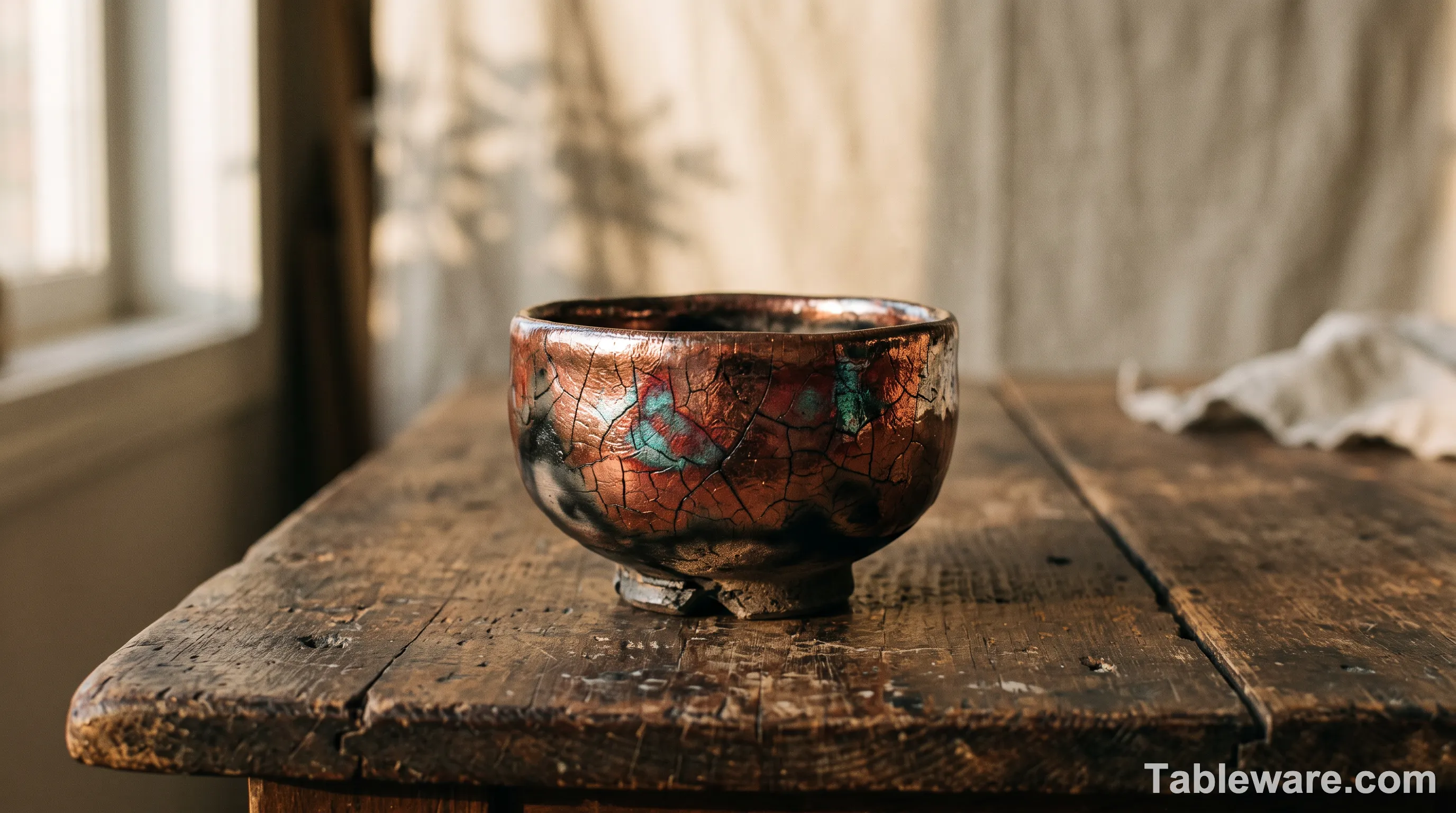
The first time I saw a raku firing in person I was in a parking lot in Santa Fe, New Mexico, in October of 2019. There was a propane tank on a steel cart, a guy in a welding apron pulling a glowing orange bowl out of a small kiln with thirty-inch fireplace tongs, and a metal garbage can full of wet newspaper that he dropped the bowl into. Smoke went everywhere. The bowl came out ten minutes later with a crackle pattern so fine it looked like the glaze had been hit with a hammer. He sold it to the person next to me for $85. I bought one too. It's sitting on my desk right now, ten years of coffee stains and counting. That parking lot was a one-day raku workshop, and the entire history of raku firing — 450 years, two continents, a tea ceremony, a hippie revolution — was sitting in a trash can full of newspaper. This is the story of how that trash can came to exist.
If you have never fired a piece of clay, the idea that you can pull a glowing, 1,800°F ceramic pot out of a kiln and dunk it into a pile of burning paper without it exploding is counterintuitive to the point of absurd. It is, in fact, the central trick of raku firing, and almost everything else about the technique — the Korean tea-bowl origins, the Japanese tea-ceremony families, the 1960s American counterculture adoption — flows from that one moment of pulling the pot hot. This article traces that arc.
What Is Raku Firing? (And the 450-Year Raku Firing History Behind It)
Raku firing is a low-temperature ceramic process in which a glazed piece is pulled from the kiln while still red-hot, then subjected to a sudden temperature drop and a smoky reduction atmosphere, usually inside a sealed container of combustible material. The pull happens around 1,800°F (roughly cone 06). Conventional stoneware and porcelain, by contrast, fire at 2,200°F to 2,400°F and cool down over the course of a full day in a kiln that is never opened. The whole raku firing cycle — load, fire, pull, reduce, rinse — fits inside about 90 minutes.
That is the technical answer. The honest answer is that raku firing is less a "type of pottery" and more a one-hour ritual. It is what happens when you take everything the industrial ceramics industry tells you not to do (open the kiln early, thermal-shock the piece, drop it in newspaper) and do all of it on purpose. The result is a body of work that is structurally weaker than stoneware, microscopically crazed with crackle patterns, and visually unmistakable.
The One Rule That Defines Raku: Pull It Hot, Cool It Fast
Almost every other rule in raku can be bent. Glaze chemistry varies. The reduction chamber can be a trash can, a metal bucket, or a pit dug in the ground. Combustibles can be sawdust, newspaper, dry leaves, or horse manure. The one rule is non-negotiable: the piece comes out of the kiln while it is still glowing, and the temperature has to drop fast.
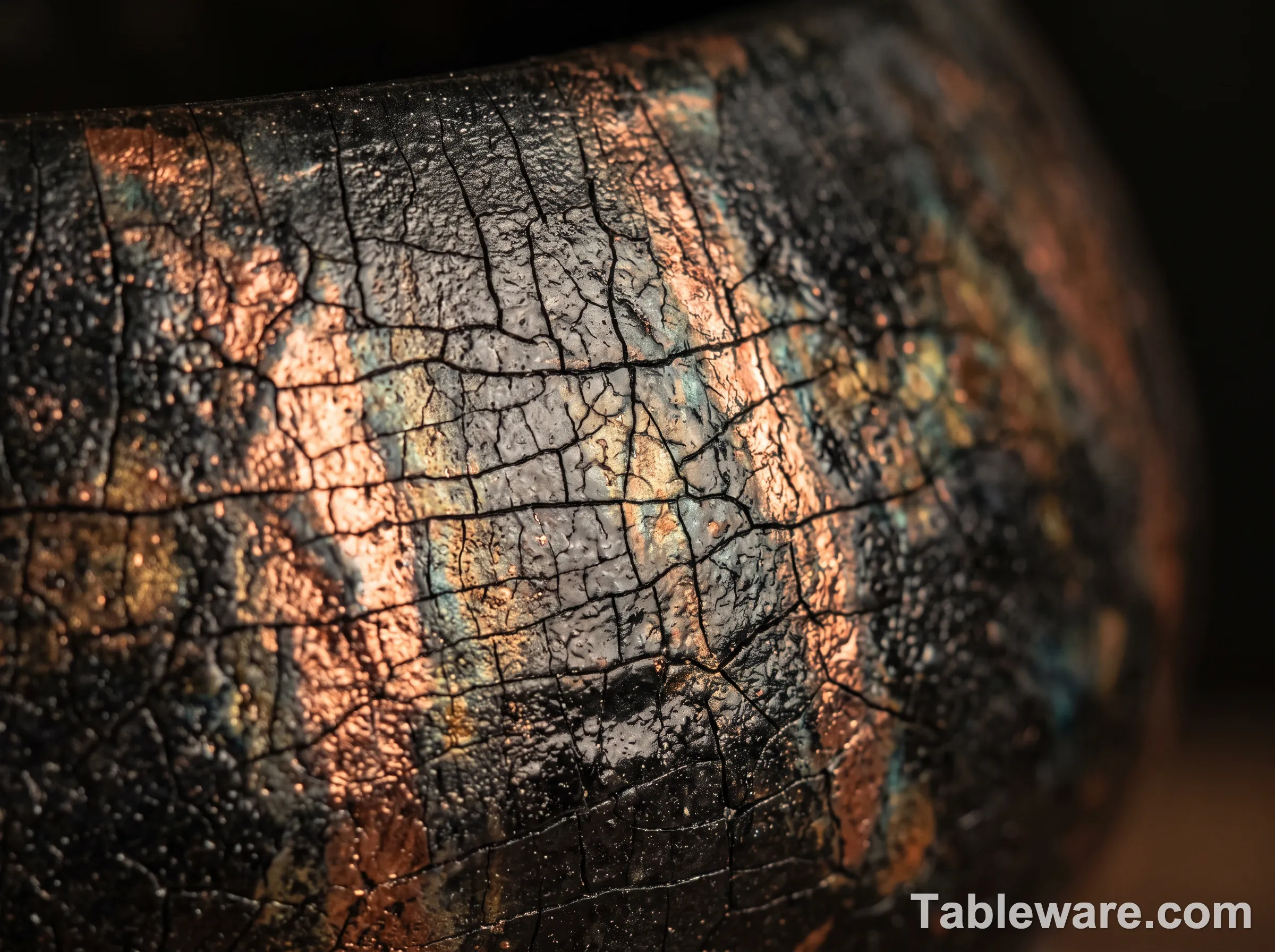
This is the opposite of every other ceramic tradition I have ever studied, and it is the reason raku firing has its own subculture. If you are firing porcelain in a Skutt KM-1027 electric kiln, your worst nightmare is thermal shock — opening the lid at the wrong time will crack a $400 piece. In raku firing, thermal shock is the entire point. The glaze that looked smooth and even in the kiln develops a crackle network over the next ten minutes as the body cools unevenly. The smoke from the reduction chamber then stains those cracks black or copper, depending on the glaze and the combustible. That crackle-and-stain combination is what most people picture when they picture "raku."
Act I — The Korean Tea-Bowl Roots (Pre-1580)
The thing most English-language guides get wrong is the country. Raku firing is, in the popular imagination, a Japanese technique. The first raku pieces were not Japanese. They were Korean.
Chōjirō, the tile-maker whom the Japanese tea master Sen no Rikyū would later elevate to the founder of the Raku family, was making tea bowls in Kyoto in the 1580s. The bowls he made were deliberately rough, hand-pinched, asymmetric, and covered in a thick, lead-fluxed glaze that broke orange and red where it pooled. Rikyū loved them because they embodied wabi-sabi — the tea-ceremony aesthetic of imperfect, transient, austere beauty. He commissioned them for his tea room. He gave Chōjirō a gold seal stamped with the character 楽 (raku, meaning "comfort" or "ease"). That seal, in 1580, is the founding moment of the Raku line.
But the technical vocabulary Chōjirō used — low-fire clay body, thick crackle glaze, fast cycle — was not invented by him. It came up the trade routes from the Korean peninsula, where Buncheong ware and the earlier Punch'ong ware had been firing tea bowls at low temperatures with crackle glazes for at least two centuries. A 14th-century date for the "Raku technique" sometimes appears in older sources, and it is technically defensible: the technique predates the family by 200 years. The 1580 anchor is the founding of the brand, not the invention of the firing method. The slip-based surface work those Korean kilns pioneered is the same family of techniques we cover in the sgraffito tradition, and a 1580 Raku bowl and a 14th-century Punch'ong piece will look more like each other than either one looks like a 1750 Meissen plate.
Why Korea, Not Japan? The 1580 Origin Story
Three things converged in 1580. First, Sen no Rikyū had codified the wabi tea ceremony around 1570 and was looking for bowls that looked more austere than the imported Chinese Tenmoku wares that the rich tea drinkers were using. Second, the Japanese invasions of Korea (1592 and 1597) had not yet happened, but there was a brisk pottery trade between Korean Buncheong kilns and Japanese tea masters, and Korean potters were active in northern Kyushu. Third, Kyoto tile-makers like Chōjirō were already experimenting with local clay bodies that fired lower than the Seto or Tokoname traditions.
What Chōjirō made, then, was a hybrid. The clay was Japanese. The firing discipline was Korean. The aesthetic was Rikyū's. The seal was a marketing decision by a tea master. By 1590, the Raku family was making tea bowls for the wabi ceremony, and they have not stopped since. The current head of the Raku family, Raku Kichizaemon XV, was designated in 2021. Fifteen generations. Five hundred years. The technique has changed, but the lineage has not.
Act II — The Raku Family and the Japanese Tea Ceremony (1580–1900)
For three hundred years, "raku" in Japan meant one thing: a tea bowl made by the Raku family for the tea ceremony, full stop. The bowls were not sold. They were commissioned, made one at a time, and used in tea rooms where they were held with both hands, looked at obliquely, and rotated 45 degrees before the lips touched them. The crackle was considered a flaw until the Raku family turned it into a feature.
The key insight, which the third-generation Raku potter Dōnyū (1599–1656) is generally credited with, was that the crackle network on a Raku bowl was not damage. It was patina. Dōnyū started deliberately favoring glazes that crazed, and he started leaving the bowls unglazed on the foot ring so the red clay body was visible. The combination of crackled black glaze, exposed red clay, and a hand-pinched asymmetry was the template for almost every Japanese tea bowl made in the next three centuries.
Why a Tea Master, Not a Potter, Owns the Name
This is a detail I think about a lot. The Raku name is a seal given by a tea master, not a self-applied brand by a potter. Rikyū owned the aesthetic. Chōjirō executed it. The Raku family is, in effect, the longest-running commissioned-artist workshop in the world. By the 18th century, the family was making bowls for the imperial court and for the Urasenke and Omotesenke tea schools, both of which still exist.
What this means for the rest of the article is that the Western idea of raku firing — the parking-lot workshop, the propane tank, the trash can of newspaper — is a 20th-century American reinvention. The original technique was Japanese but never reached outside the tea room. It took a 1960s American to put raku in a garbage can. The raku firing history from 1960 forward is really the history of technique accessibility — every tool Soldner democratized was something a single artist in Japan had guarded for three centuries.
Act III — Paul Soldner and the American Raku Revolution (1960–1990)
Paul Soldner was a graduate student at the Otis Art Institute in Los Angeles in 1953 when he first saw a copy of Tea Ceremony by the Japanese art historian Sōetsu Yanagi. He was hooked. By 1960, he had gotten a Fulbright to study pottery in Japan, and he had brought back a small kiln and a set of Japanese tea bowls. He started teaching at the Anderson Ranch Arts Center in Snowmass Village, Colorado, in 1966.
The story of how Soldner reinvented raku is one of the more interesting accidents in 20th-century craft. He was teaching a summer workshop at Anderson Ranch in the summer of 1960. A student pulled a piece too early. Soldner, improvising, dropped it into a trash can full of crumpled newspaper. The next morning the piece had a crackle pattern unlike anything he had seen in Japan. The smoke from the burning paper had reduced the copper in his glaze to a metallic black, and the rapid cooling had set the crackle deep into the body. He spent the next thirty years figuring out why it worked and, more importantly, how to make it work on purpose.
The Soldner version of raku firing had three innovations the Japanese tradition did not have. First, the combustibles were variable — sawdust, newspaper, dry leaves, even horse manure from the ranch next door. Each one produced a different reduction atmosphere and a different crackle pattern. Second, the kiln was a small, portable, propane-fired piece of equipment that could fit in a parking lot or a garage. Third, the technique was democratized. Soldner taught it to anyone who took a workshop. By 1980, there were raku firings in almost every art school in the United States.
The Combustible Trick: Sawdust, Newspaper, Leaves
I have used all three, and they are not interchangeable. Sawdust gives the deepest, blackest crackle, but the smoke is acrid and you need a respirator. Newspaper gives a medium crackle with a softer gray smoke pattern, and the paper burns fast enough that you only need five or six sheets. Dry leaves give a beautiful light crackle and the smoke smells like autumn, but you need a lot of them and the burn is uneven. None of these is "right." They are all raku firing.
The Three-Step Raku Pottery Technique Explained
A standard raku pottery technique cycle, from load to finished piece, takes about 90 minutes. Here is the actual sequence I use in my own work, with the temperatures and times I have found most reliable.
Step 1 — Bisque and Glaze to Cone 06
You start with a bisque-fired piece (already fired once to about 1,830°F to harden the clay) and apply a commercial raku glaze or your own recipe. The most common raku glaze is a 90% Gerstley borate / 10% copper carbonate mix, which fires to a metallic copper red in oxidation and a black metallic in reduction. You let the glaze dry — usually 30 minutes to an hour — and you load the piece into a cold or pre-warmed kiln. I prefer pre-warmed, because it cuts the total cycle time by about 20 minutes.
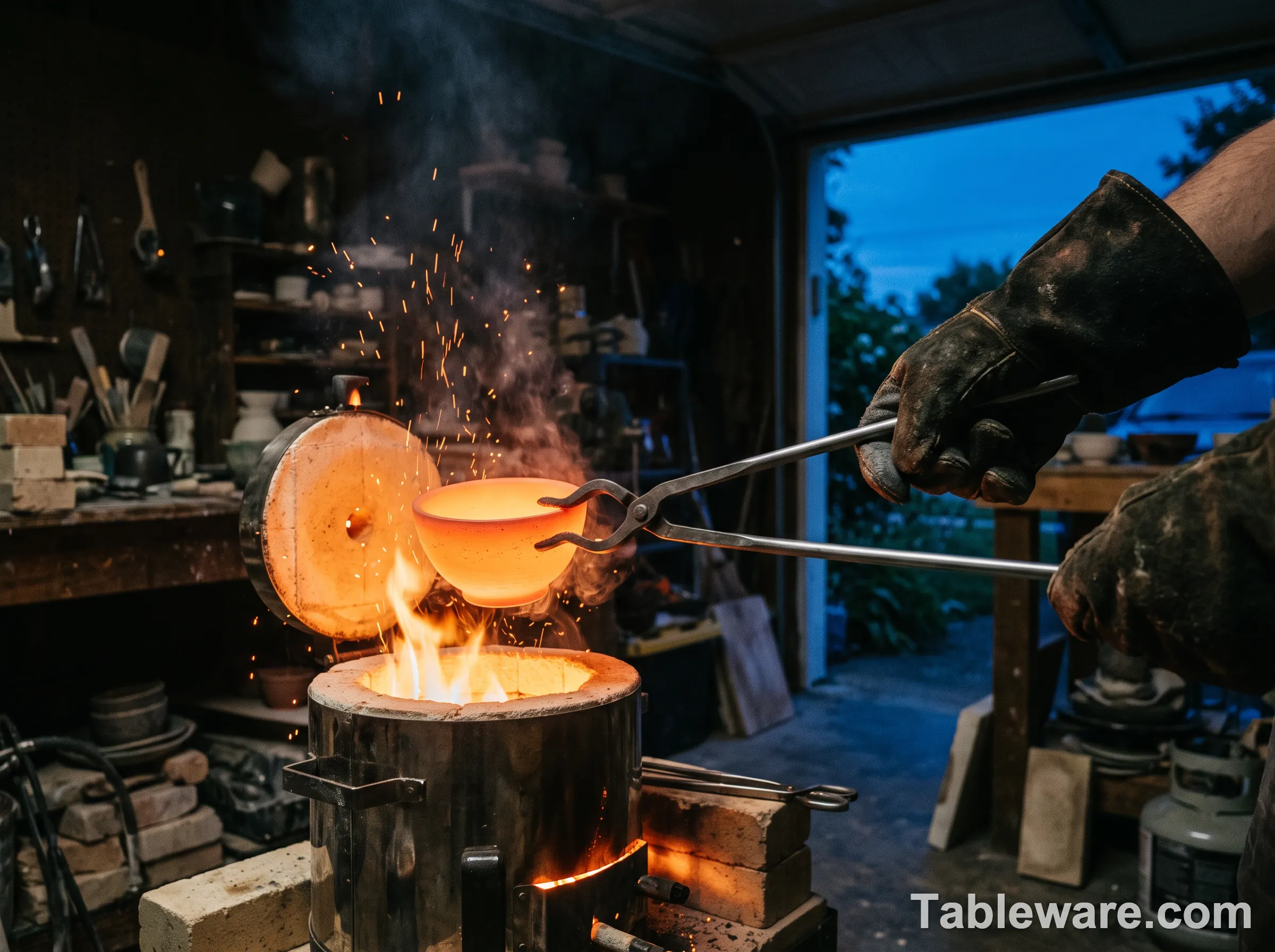
Step 2 — The 1,800°F Pull (with Tongs)
The kiln ramps to about 1,800°F over 35 to 45 minutes. The glaze is now fully melted and the piece is glowing dull orange. You open the kiln (yes, really), grab the piece with 30-inch fireplace tongs, and pull it. You have about ten seconds before the thermal shock starts to crack the body. Move fast. The first time I did this I burned through two pairs of leather gloves. The third pair I still have. They are full of tiny burn holes from the tongs slipping.
Step 3 — The Reduction Chamber
You drop the piece into a metal container full of combustible material and close the lid. The heat from the piece ignites the combustible, the available oxygen runs out, and the copper (or silver, or cobalt, depending on the glaze) reduces to its metallic form. The temperature drops from 1,800°F to about 200°F in ten minutes. You open the lid, rinse the piece under cold water to stop the reaction, and you are done.
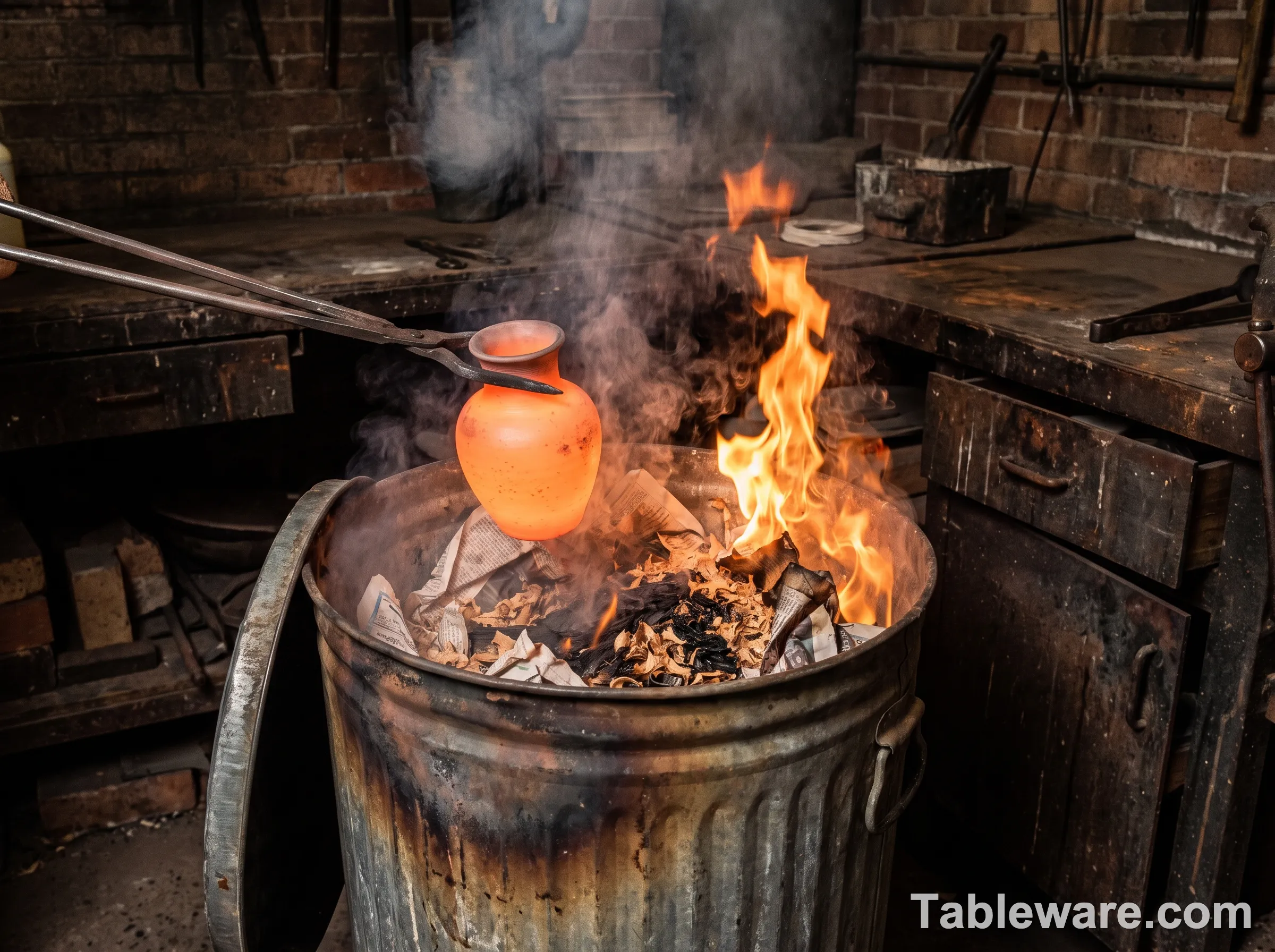
The crackle pattern you see in the final piece comes from two different mechanisms working at once. The thermal shock creates fine cracks in the glaze as it contracts faster than the clay body. The reduction atmosphere stains those cracks with carbon. The result is a piece that is, structurally, weaker than a stoneware equivalent fired at 2,200°F. It will not survive a commercial dishwasher. It will, however, look like nothing else on your dinner table.
Naked Raku Technique — When the Slip Peels Off to Reveal Smoke
The naked raku technique solves one of the central aesthetic problems of regular raku firing: how do you show the smoke pattern, not just the crackle? The answer is you don't use a glaze at all. Instead, you coat the bisque-fired piece in a thick layer of slip (a liquid clay mixture), let it dry, then put a thin coat of wax resist or hair conditioner on the parts you want to keep. You fire the piece to 1,800°F as usual, pull it hot, and drop it in the reduction chamber.
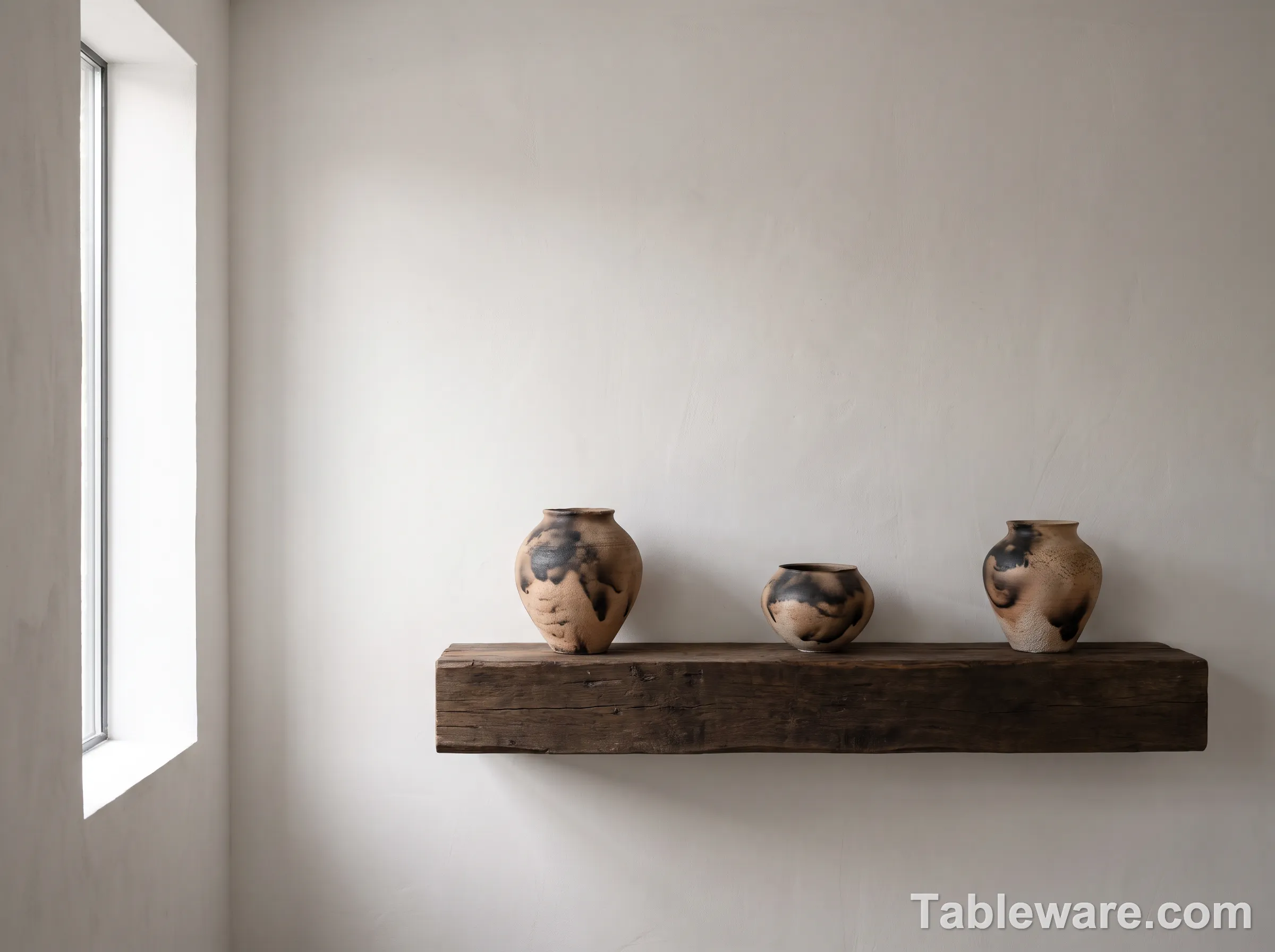
When you rinse the piece under cold water afterward, the slip layer — which has been carbon-stained by the reduction smoke — peels off the surface like a snake shedding its skin. What is left is a bare clay body, marked with a smoke pattern that is, in my opinion, the most beautiful thing raku firing produces. The pattern is unique to that piece and that firing. No two naked raku pieces look alike, because the slip never cracks in the same place twice.
I should note that naked raku is the technique most likely to be done badly. The slip thickness has to be uniform. The wax resist has to be applied at the right temperature. The reduction time has to be long enough to stain the slip but not so long that it fuses to the body. I have done naked raku seven times. Three pieces came out well. Two were acceptable. Two are in a box in my garage that I keep meaning to throw out.
The Raku Revival: Why Studio Potters Are Going Back to Fire (2010–Today)
For about twenty years after Soldner's death in 2011, the American studio pottery world treated raku firing as a teaching exercise, not a serious art form. Then something changed. Around 2018, a cohort of younger studio potters — most of them women, almost all of them with MFA degrees from programs like Cranbrook, Alfred, and RISD — started making raku work that was not decorative. It was sculptural. It was political. It was about the smoke pattern, not the crackle.
The signature of the raku revival is a return to the reduction chamber as the primary aesthetic surface. In Soldner-style raku, the reduction was a side effect. In contemporary raku, the smoke pattern is the piece. The crackle is just the canvas.
From Workshop Hobby to Gallery Wall
The market signal is clear. A 2024 exhibition at the Museum of Contemporary Craft in Portland, titled Raku: 1960–2024, included 47 pieces by 22 artists. About a third of them sold for over $4,000. A single naked raku vessel by the Brooklyn-based potter Ayesha Khan went for $11,500 at the same show. This is not workshop-hobby pricing. This is gallery pricing. If you are a serious collector of contemporary ceramics in 2026, you should be paying attention to who is making raku, because the secondary market is moving fast and the primary market is not yet priced for the institutional demand.
How to Buy (or Try) Raku Without Becoming a Potter
If you are reading this and you are not a potter, you do not need to become one. The supply side of raku pottery for beginners has gotten much better in the last five years. Here is what I would actually do, in order.
Etsy, Galleries, and the $30 Raku Bowl
Start on Etsy. Search "raku bowl" and you will get about 12,000 results. The pricing clusters in three bands. Under $40 is workshop-and-student work, which is often better than it has any right to be. $40 to $200 is mid-career studio potters selling directly. Over $200 is either a serious contemporary artist or a Raku-family descendant, and you should ask for a certificate of authenticity. I have bought pieces in all three bands. The $85 parking-lot bowl I mentioned at the start of this article was in the middle band, and I think the artist was a former Soldner student working out of a garage in Taos.
For galleries, the safest move is to go to one of the summer craft fairs — the Anderson Ranch auction in August, the Cherry Creek Arts Festival in Denver, or the Philadelphia Museum of Art Craft Show in November. You will see 50 to 100 raku pieces in person and you will develop a much better eye than any online search can give you.
One-Day Raku Workshops Near You
If you want to try the technique yourself, almost every community college art department and most ceramics studios offer a one-day raku workshop for $150 to $300. You will make two or three pieces, you will burn yourself at least once, and you will come home with a piece you made. I have sent friends to workshops at the Santa Fe Clay, the Archie Bray Foundation in Helena, Montana, and the Mudflat Studio in Somerville, Massachusetts. All three are reputable. Do not sign up for a workshop that uses a "raku kiln" you cannot see the inside of — the propane-tank setup is standard, but the reduction chamber should be a real metal container, not a cardboard box.
One last thing. If you buy a raku bowl, do not put it in the dishwasher. Do not microwave it. Do not leave it on a windowsill in January. The crackle will get fuzzy, the smoke pattern will fade, and the piece will slowly look less like a piece of art and more like a garage-sale item. Hand-wash it, dry it, and put it away. If you do that, a raku piece will outlast you. The clay body is weak. The glaze is crazed. But the smoke pattern, sealed under that crackle, is essentially permanent. It is one of the few ceramic techniques that gets better with age instead of worse. The Japanese knew that in 1580. Paul Soldner figured it out in a parking lot. You can buy the result today for the price of a nice dinner.