Stop Buying Serving Ware You'll Never Use in 2026
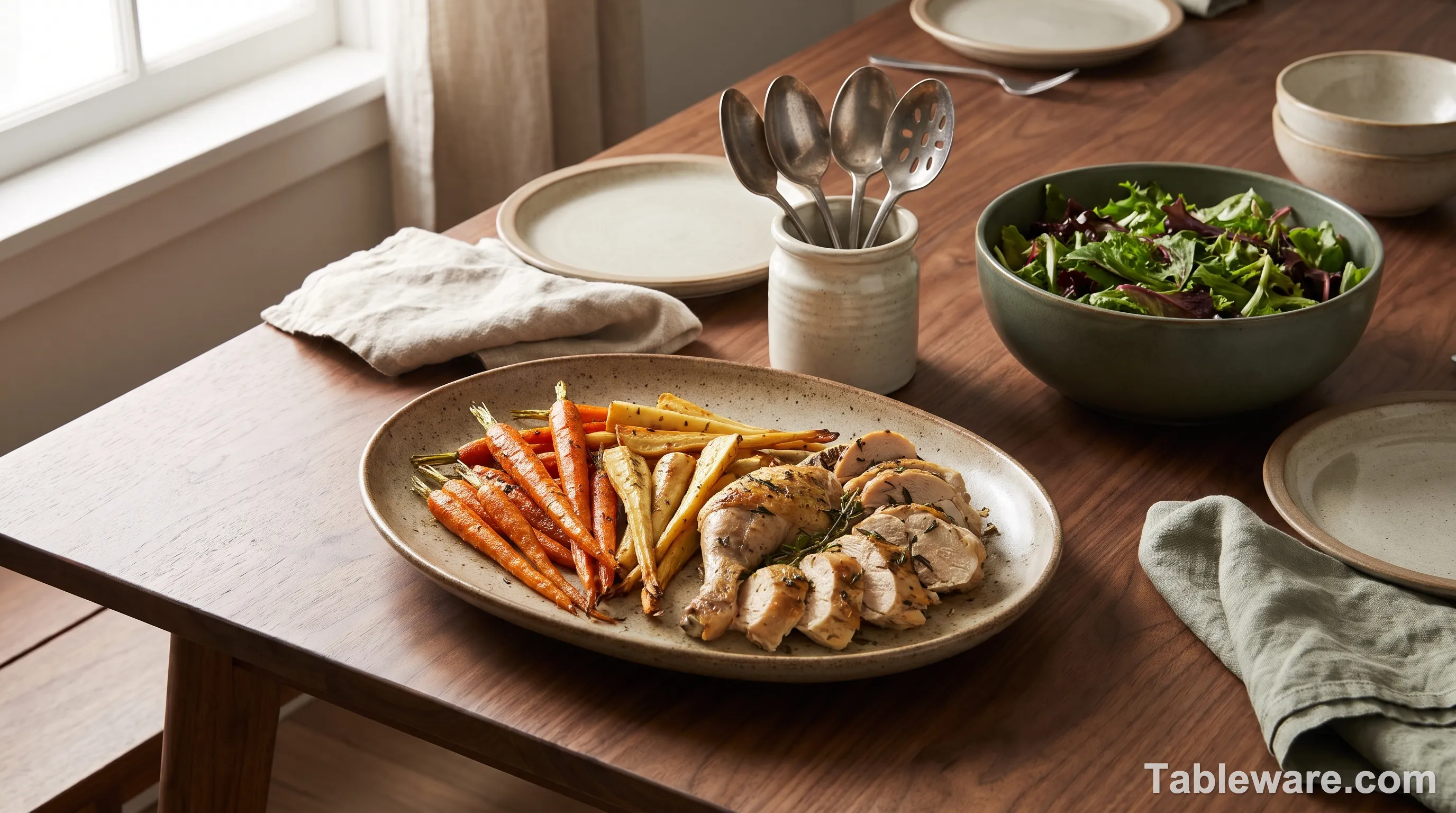
Fig 1. A working table: one oval platter, one deep bowl, a crock of serving spoons. That is most of what a home kitchen actually needs.
My sister has a serving ware problem. Not a lack of it — a surplus. Two tureens with lids that have never been off the box, a 12-piece stainless hostess set she paid $140 for in 2019, four serving spoons of slightly different lengths, and a pie server that has lived in a drawer since her wedding. When she hosts eight people for Easter, one oval platter does the work. Everything else stays in the cupboard.
I bring this up because I have watched a lot of people do this, and I have done it myself. We buy serving ware the way we buy dinnerware: as a set, in one go, because a set looks complete in the store. Then we discover that a complete set of serving pieces is mostly a complete set of pieces you will never touch.
So this is a buying guide for the middle of the table. The platters, bowls, and serving utensils that earn their space in a normal kitchen — and the four categories worth skipping entirely.
Here is the thing nobody tells you at the point of sale. Serving ware is not bought for a matched set. It is bought for the food. A 13-inch oval platter handles roast chicken and a dozen bruschetta with the same confidence. It does not care that the pattern on the rim does not match the bowl you already own, and neither should you.
The Serving Ware You Actually Use (and 4 You Can Skip)
Let me get concrete about what to buy first, because the "how do I start" question is where people get stuck. If you own nothing else, buy these seven things. Between them they handle 90% of the meals a home kitchen will ever serve.
- One large oval serving platter, 14 to 16 inches. The workhorse. Roast chicken, a whole fish, a sheet-pan of vegetables, an antipasto spread. Oval beats round here because it gives you a long axis for things that are long.
- One medium rectangular serving platter, 12 to 14 inches. Sliced meat, cheese, bruschetta, a dozen deviled eggs. The rectangle's straight edges make grid arrangements look deliberate rather than accidental.
- One deep serving bowl, roughly 3 to 4 quarts. Pasta, salad, a big batch of beans. Depth matters more than width — a wide shallow bowl dries out, a deep bowl stacks.
- One shallow wide bowl, 8 to 10 inches. Salad greens, cut fruit, potato salad. This is the bowl that looks generous because it's wide, and it gets used at every single meal.
- One small platter or board, 8 to 11 inches. Bread and rolls, sliced cheese, a pile of pastries. Small ones earn their space more often than people expect.
- One solid serving spoon and one slotted spoon. That is the minimum. Two spoons handle everything from mashed potatoes to a tray of roasted vegetables, and a three-piece serving spoon set covers it.
- One salad server. A wide, flat spoon or a slotted turner works. If you already own a big spoon with a flat head, this is the one you can skip.
Seven pieces. A decent set of those runs somewhere between $120 and $300 if you mix materials sensibly — which is exactly the kind of arithmetic that matters, so let's do it properly.
Now the four categories you can skip. These are not bad products. They are good products solving a problem you do not have.
Skip the 12-piece hostess set. Here is what is actually inside one: three serving spoons in three sizes, a slotted spoon, a serving fork, a cake server, a fish server, a butter knife, a sugar sifter, and a small spoon for salt. You will use the serving fork maybe twice a year. You will never use the fish server unless you cook whole fish with the head on, which is a decision you have probably already made against.
Skip serving utensils made of acrylic or painted resin. They photograph beautifully on a shelf and they turn cloudy after six dishwasher cycles. Acrylic has no repair path. Once it goes, it goes.
Skip melamine serving pieces. Melamine is fine for a kid's birthday party, full stop. It is not fine as a piece you hand to a guest, because it stains permanently — tomato sauce, turmeric, beetroot, red wine. And it does not go in the oven or the microwave, which rules out a huge share of what serving ware is for. If you want a plastic serving piece, buy a plastic serving piece for $6 at a warehouse store; do not pay $30 for a melamine one that pretends to be ceramic.
Skip the "serveware collection" sold as a department store set. A 4-piece ceramic serveware set with a bowl, a platter, a gravy boat, and a lid for $80 at Target is three useless objects and one bowl. You are paying a set premium for the privilege of matching something you already own.
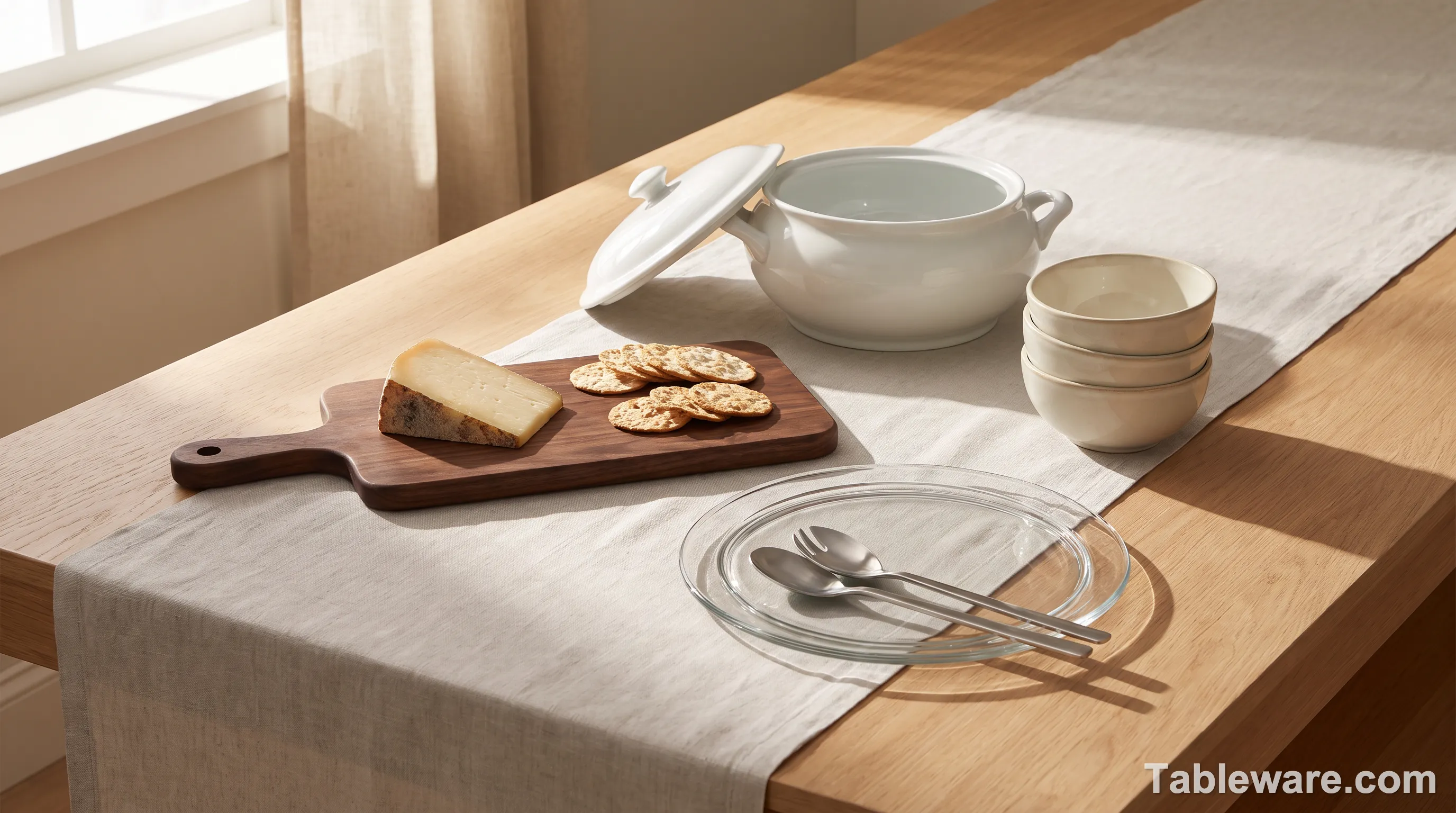
Fig 2. A realistic collection: one board, one covered dish, a stack of small bowls, one glass platter, two servers. Notice how little of this is a set.
Serving Ware: Serving Platter Sizes, Shapes, and Materials
Once you own the right pieces, the details stop being complicated. There are three variables — size, shape, material — and each has a short answer.
Start with the serving platter, because it is the piece you will reach for most. The right serving platter is not the biggest one you can fit on the table; it is the one that matches the food and the number of people sitting down.
Serving platter sizes for 4 to 12 guests
Platter sizes are not standardized, which annoys people who like standardized things. But the retail market has settled on some useful conventions, and the numbers are roughly these:
- 8 to 11 inches — small. A block of cheese with crackers, butter, lemon wedges, a batch of cookies. Perfect for a table of two to four.
- 12 to 15 inches round, or 14 to 18 inches rectangular — medium, and the one to buy first. This is the range that handles six to eight people, a whole roasted fish, sliced steak, or a family-sized portion of vegetables.
- 16 to 19 inches — large. A turkey up to 12 pounds, a big charcuterie spread, a main course for eight to twelve.
- 20 inches and up — holiday-only. A 14-pound-plus turkey, a crown roast, or an appetizer table for fifteen people.
The rule that matters for turkey: count the bird, not the guests. A 20-pound turkey is physically 20 inches long including the drumsticks. No platter that fits on a normal table is going to hold it, which is why the biggest platters are essentially seasonal storage pieces.
The other sizing error people make is buying large because large looks generous. A 20-inch platter on a 4-person table leaves no room for serving spoons, candles, or elbows. It reads as awkward rather than abundant. Buy the medium one. It will get used fifty times; the extra-large one will get used twice.
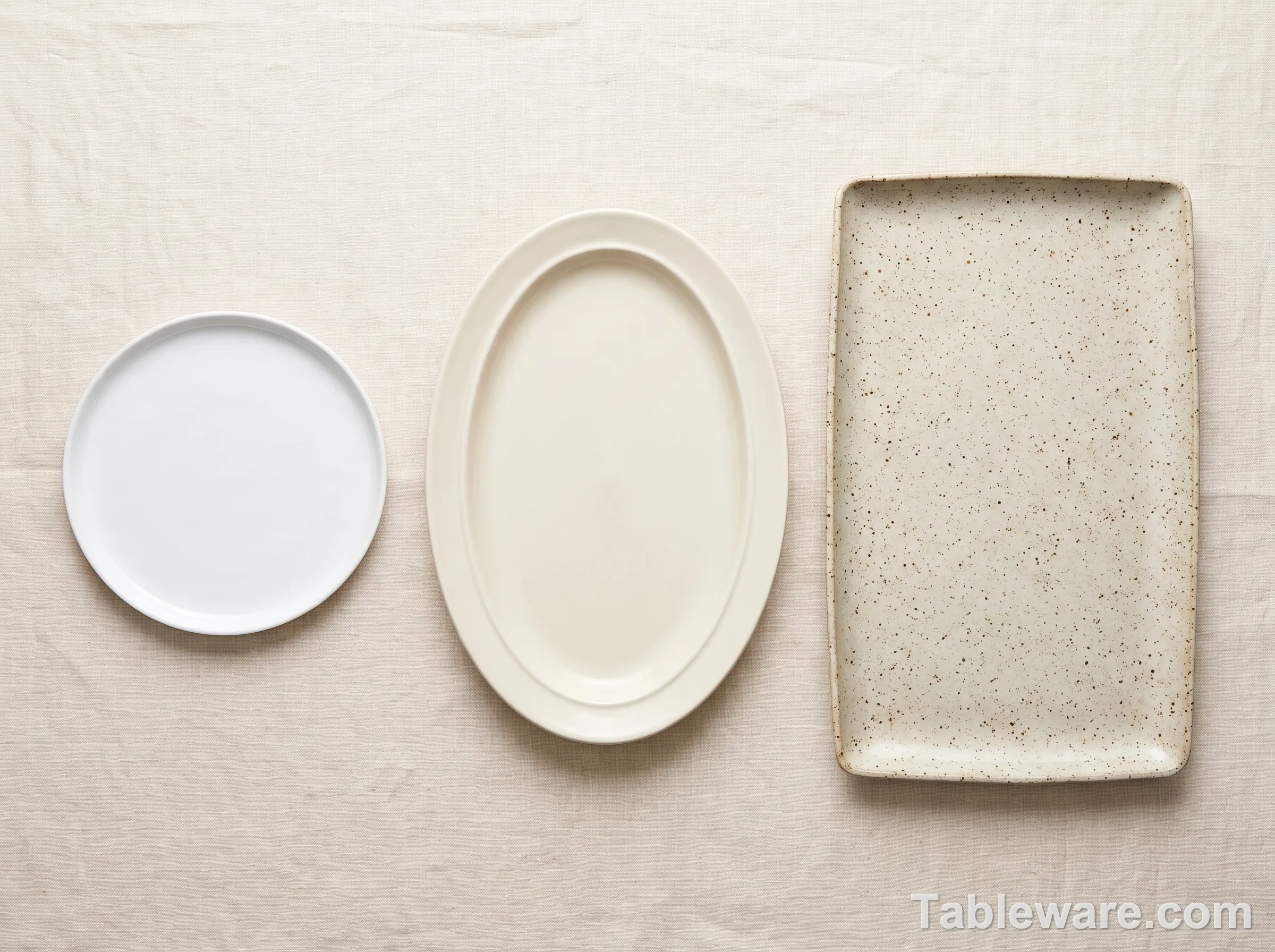
Fig 3. The same three sizes you would actually buy: 9-inch round, 14-inch oval, and 19-inch rectangular. The middle one is the one to start with.
Stoneware vs porcelain vs glass for hot food
Here is where it gets worth being careful, because the marketing for these three materials actively lies.
Stoneware fires around 2,160 to 2,330°F. The clay vitrifies and the body stays fairly opaque and dense. It absorbs a small amount of water, which means it holds heat noticeably longer than porcelain — a genuinely useful property when you are carrying a hot dish down a hallway. It is also the most forgiving material on the shelf. A stoneware platter that gets bumped does not chip into a sharp flake; it scuffs. Stoneware is also where the handmade character lives: a speckled cream glaze, a slightly irregular rim, a thumbprint where the maker pulled the piece off the wheel. Our guide to stoneware goes deeper on where the line between stoneware and earthenware actually falls.
Porcelain fires higher, around 2,300 to 2,550°F. That higher temperature vitrifies the body almost completely, which means it is non-porous, it does not absorb odors or stains, and it is thin and translucent in a way stoneware never is. A fine porcelain platter is the most elegant thing you can put on a table. It is also the most brittle at the rim. Porcelain dinner plates take a beating; a large porcelain platter, because it is big and thin and cantilevered out over the table edge, is more fragile than it looks. If you have a heavy hand or a house with a lot of edges, stoneware is the safer buy. For the difference between commercial and studio grades, read our guide to professional porcelain.
Tempered glass — the Corelle Vitrelle style, three laminates of glass fused together — is a different proposition entirely. It is roughly two-thirds the weight of porcelain, it shrugs off impacts that would shatter ceramic, and it will usually take a dish from freezer to a 500°F oven. Our Corelle Vitrelle review covers the testing. What you give up is weight in the hand and any sense of craft: a glass platter has no handmade variation because it is not handmade.
Enamelware takes a third path — a glass-like enamel fused onto steel, which chips instead of cracking and holds heat far better than any ceramic. Our vitreous enamel vs ceramic guide covers the trade-offs.
The practical takeaway for the stoneware vs porcelain question: buy stoneware for everyday hot food, buy porcelain when the food is cold or room temperature and the look matters, buy glass when you want something light, chip-resistant, and oven-to-fridge capable. For the deeper bone china vs porcelain comparison, including translucency and glaze performance, our material-science guide runs the numbers.
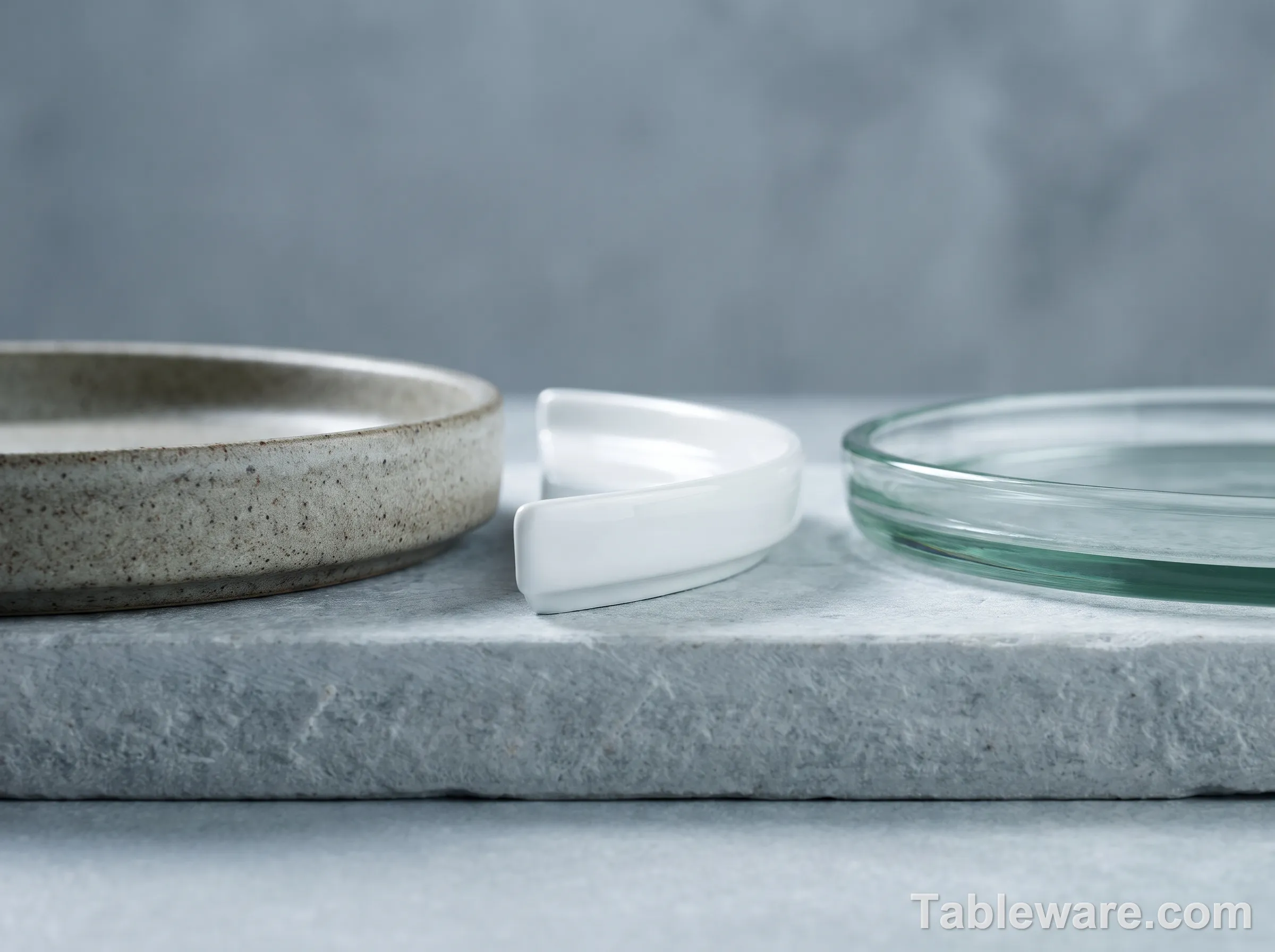
Fig 4. The three materials at the rim: thick matte stoneware, thin glossy porcelain, and clear tempered glass. Weight, gloss, and thickness all change what happens when you drop it.
Hand-thrown, slip-cast, or pressed
Serving platters get made three ways, and the method explains most of the price differences you will see.
Slip-cast is the industrial default. Liquid clay pours into a plaster mold, and a hundred identical platters come out of it. Uniform, cheap, predictable. Most mass-market stoneware and porcelain serving ware is slip-cast, including a lot of what is sold as handmade.
Pressed uses a machine die under pressure. Faster and thinner-walled than slip-casting. Common on rectangular and square pieces, and on thinner porcelain.
Hand-thrown means a potter shaped it on a wheel. For a platter, that limits the piece to roughly round or oval — a rectangle cannot be thrown. Hand-thrown platters also cost real money, typically $80 to $250 each from an independent studio, because a person made that one.
The honest assessment: hand-thrown is worth it when you like the specific piece and the maker, and when the imperfection is the point. It is not worth it as a strategy for building a working set, because the sizes will not match and you will be storing three weird ovals that do not stack. If you want handmade character at a sane price, look at hand-thrown at a market and slip-cast or pressed for everything else. Our hand-thrown vs slip-cast vs pressed explainer covers how to tell them apart in a shop, and how to read pottery marks helps you identify what you have picked up second-hand.
Serving Bowls: Sizing by Course, Not Guest Count
Serving bowls are where people get a number wrong most often, because bowl capacity gets advertised in two incompatible units and nobody explains the conversion.
Ounces (oz) measures liquid volume, up to about 16 oz per cup. A bowl listed at "24 oz" holds about 1.5 quarts of liquid.
Quarts (qt) measures volume directly. One quart is 32 oz, or 2 pints.
Cubic inches (cu in) appears on the better-made American pieces and is the unit to actually trust for comparing two bowls side by side, because it does not care whether the contents are liquid or solid.
Here is where people go wrong: they size a serving bowl by guest count, and then find out it cannot hold a full batch. A single serving of pasta is roughly 1.5 to 2 cups. For six people, that is 9 to 12 cups — about 2.25 to 3 quarts. So a "12 oz" bowl is one portion, not a serving bowl, and a 2-quart bowl feeds four comfortably.
When sizing serving ware for a family meal, one number matters more than any other: capacity. The rule of thumb: you want roughly one quart of serving bowl capacity per four guests. Ten people, three quarts. A big shallow salad bowl can run a quart larger, because salad takes up more air than pasta and nobody minds. If pasta is your main event, our pasta bowl specs guide has the diameter and depth numbers that decide whether a bowl actually holds a full batch.
Depth is the other half. A bowl 2 inches deep and 12 inches wide looks impressive and holds almost nothing — it is a display piece for a handful of cherry tomatoes. A bowl 4 to 5 inches deep holds what you need and looks properly generous. Most people under-buy depth because they associate depth with soup.
Nesting sets and cabinet space
This is where serving bowls quietly eat your kitchen, so think about it before you buy more serving ware.
Bowls nest in one direction only, and they only nest if their diameters step down in a matched series. Three bowls from the same line nest perfectly. Three bowls from three different lines nest into a stubborn stack that never quite closes, and you end up with a drawer of bowls that rock.
Buy nesting bowls as a set if you can. Buy different sets if you want them to stand apart on the shelf — which is fine, and honestly looks better, but accept that they will not stack.
The other storage trap is the giant shallow bowl. A 14-inch salad bowl will not fit in a standard cabinet with the door closed. Measure your cabinet opening before you buy, not after.
Serving Ware: How Many Utensils You Actually Need
How Many Pieces in a Serving Spoon Set
A serving spoon set is the easiest serving ware purchase to get wrong, because the sets are usually sold by piece count and piece count rewards uselessness. The best serving spoon set for a home kitchen has three pieces in it, not twelve.
A typical "6-piece serving set" is: two large spoons, one slotted spoon, one serving fork, one butter knife, one slotted turner. That is a sensible six. A "10-piece" set adds a cake server, a fish server, a pasta server, and a small spoon for serving condiments. Four of those additions will live in a drawer.
Two spoons and one fork covers essentially every home meal. Solid spoon for dense food — potatoes, rice, beans, mashed things. Slotted spoon for vegetables, pasta, anything with liquid. Fork for salad and for lifting pieces that a spoon would tear.
Now material, because this is where the money is and the quality gap is widest.
304 stainless steel is the standard for serious serving utensils and it is the right answer for almost everyone. It resists rust, it takes a beating, it goes in the dishwasher, and it does not absorb odors. You will see 18/10 and 18/8 on some pieces — those are the chromium and nickel percentages, and for serving utensils the difference is not worth paying for. The same steel logic behind how to buy flatware that lasts 20 years applies here, including the weight-and-balance checks that catch a cheap set.
Silicone heads on a stainless core are worth it if you plan to serve anything sticky — pasta, risotto, soft salad, mashed potatoes. Silicone will not scratch a nonstick pan if you use the utensil in the pan, and it will not scratch a fine porcelain platter. Look for a stated shore hardness around 40A to 50A; anything softer than that flops.
Bamboo handles look good and feel good in the hand. They also have a real weakness: bamboo is organic, so it swells, cracks, or molds if it sits wet. Buy bamboo-handled serving spoons if you like them, hand-wash them, and dry them standing up. Do not put them in the dishwasher, and do not leave them soaking in a sink full of water while you do other dishes. Vintage Pyrex care has the same wood-and-water principle if you also collect old wood-handled tools.
Wooden spoons — solid wood, not bamboo — are for serving dry, room-temperature food. They cannot go in the dishwasher, and they are not for anything hot.
One more thing on the serving spoon set, and it is the detail that separates a $15 set from a $60 set: how the spoon meets the handle. Look for a single piece of steel, or a solid rivet or full weld. A thin glued or spot-welded joint is where cheap serving spoons bend, right at the bowl, the first time you scoop something heavy. A $60 set will have noticeably heavier gauge steel and a thicker handle.
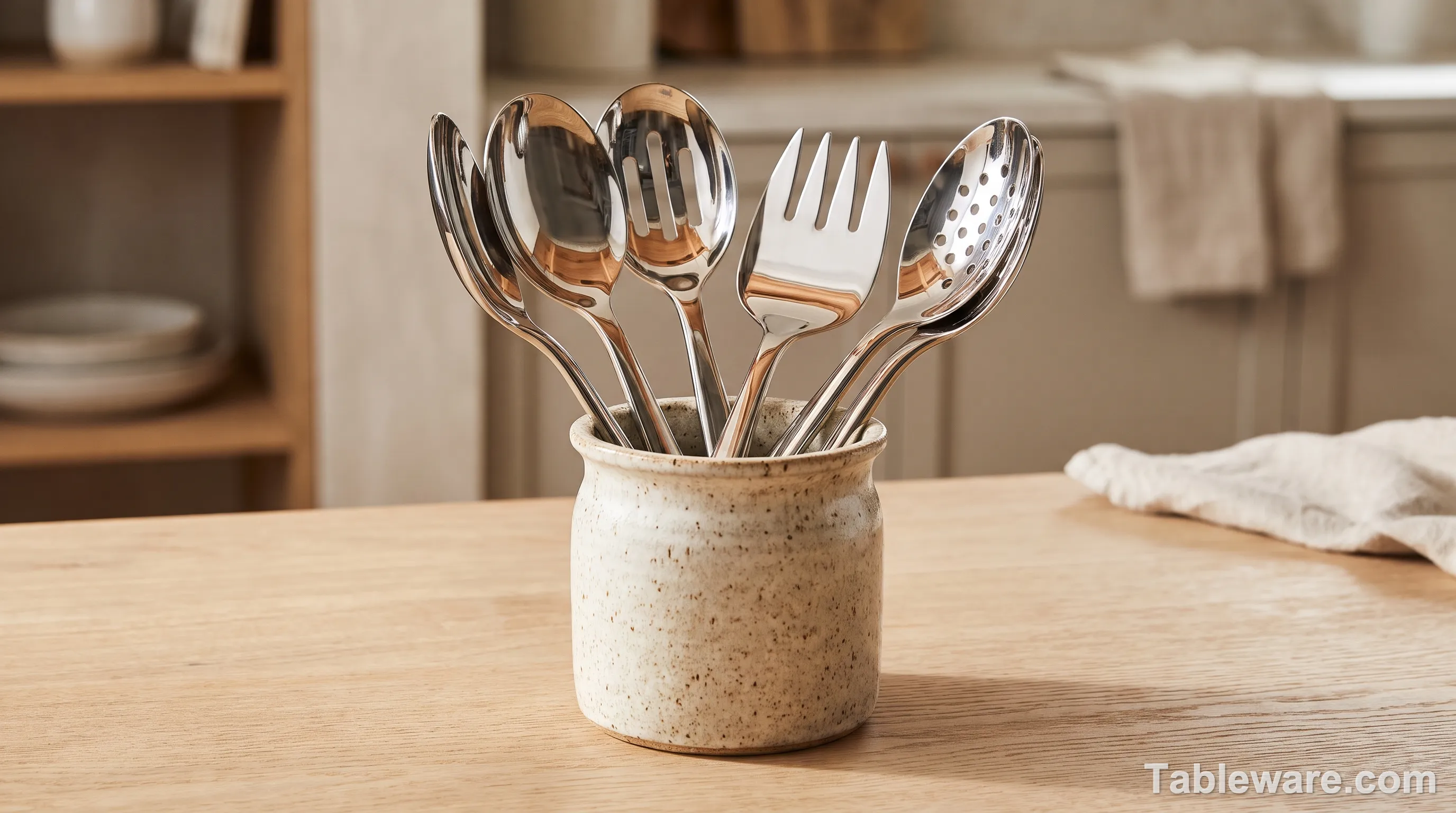
Fig 5. Two spoons, a fork, and a crock. If the handle feels light and the joint where the bowl meets the handle has a visible crease, it will bend there.
Tureens, Gravy Boats, and Pie Servers
Three pieces that get romanticized. Let me be honest about each.
Tureen. A covered serving dish for soup, stew, or pasta. It is a genuinely good piece of equipment — a ceramic tureen holds heat better than any bowl because of the lid, and it keeps a braised dish from forming a skin while it waits for the second course. If you make soup or stew more than once a month, a tureen earns its place.
But a large stoneware bowl with a matching ladle does the same job for roughly a third of the price and takes up half the cupboard. The tureen wins on heat retention and on the fact that it looks like you tried. That is a real benefit. Just know which one you are buying.
Gravy boat. A small pitcher with a lip and a handle, for pouring gravy. It works. So does a small measuring cup with a spout, which does the same job, pours more evenly, and stores in a drawer instead of taking up a shelf. Gravy boats are also notoriously fiddly to wash because of the narrow spout.
Pie server. A flat, angled, triangular blade on a handle. Its entire advantage over a regular spatula is that it cuts a clean wedge and can slide under a slice without the whole thing collapsing. A wide, thin, flexible spatula with a flat edge does that. A wooden spatula does that. A pie server is a nice object. It is not a necessary one.
My rule for all three: buy the version that solves a problem you currently have. If you make soup weekly, buy the tureen. If you are not sure, buy the bowl and the ladle, and move on.
What to Skip
Two more categories, both expensive mistakes.
Do not buy serving ware to match a dinnerware set. This is the same trap as the open stock vs full set dinnerware math, and it is worth an extra look because serving ware is where the damage is worst — this is where serving ware budgets go wrong fastest. Matching pieces are usually more fragile than the everyday plates, cost more per piece, and get replaced in a set rather than individually. If your set breaks in 2029, you will almost certainly not be able to buy the matching oval platter anymore — the pattern will be discontinued. Buy serving ware for the food and for your hand.
Do not buy the whole set at once. Start with the large oval platter and the two spoons. Use them for a season. Then notice what you actually reach for. I promise you will add a deep bowl before you add anything else, and the thing you thought you needed in month one will still be unwrapped.
Where to buy serving ware matters less than people think. Department store house brands like Threshold and Crate & Barrel's own line are fine for stoneware and porcelain in the $8 to $35 range per piece. Restaurant supply stores are where professionals buy, and they sell plain white porcelain and stainless at genuinely lower prices — though the shipping on a single platter can eat the difference. Costco sells stoneware that is hard to beat on price and quality. If you are still deciding between stoneware vs porcelain for a piece you will use weekly, go with the denser one — stoneware wins on heat retention, porcelain on looks. If you want to see how to compare the cost of buying a full set versus piecing it together, the 3-phase set building guide covers that math in detail.
Care and Storage So Serving Ware Lasts
Serving ware is more fragile than dinnerware in one specific way: it is big. A dinner plate drops and breaks a small piece. A 16-inch platter drops and is gone.
Dishwasher Safety
Stoneware and porcelain are generally fine in a dishwasher on a normal cycle, with two caveats. First, if your platter has a metallic trim or a hand-painted band, hand-wash it — the dishwasher strips metallic decals over time and fades hand-painted decoration. The hand-painted vs decal explainer covers why the two behave so differently in a hot cycle. Second, put large pieces on the bottom rack, where they do not get knocked by the spray arm. Our dinnerware care guide has the full routine.
Heat Shock
This is the one that actually breaks things. A stoneware platter that has been sitting in a cold fridge and goes straight into a 425°F oven can crack. Let pieces come to room temperature first, especially if they are cold and wet. The engineering behind this is covered in our oven-to-table bakeware piece.
Crazing: Cosmetic or Dangerous?
Fine hairline cracks in the glaze are a cosmetic issue, not a safety one, and they are common on any glazed ceramic — more so on stoneware, which absorbs slightly more water. Dense ironstone crazes for the same reason and more often, which our ironstone explainer covers in detail. The crazing explainer covers when it is genuinely worth worrying about, and the short version is: if the cracks do not go all the way through to the body, it is fine.
Stacking. Platters stacked flat will chip each other over years. If you must stack them, put a paper towel or a square of felt between each layer — genuinely, a felt square. Or store them on their edge in a divider rack, which is what a restaurant kitchen does and it works.
Wood. If you buy a wooden serving board, oil it every few months with food-grade mineral oil. Never soak it, never put it in the dishwasher, and never let it sit in a sink of water. For imported ceramic pieces, our lead and cadmium glaze safety guide covers what to test for and what to leave alone.
Do not put serving ware on the stove. I have watched people try to warm a platter directly on a burner. Ceramic does not conduct heat, so it heats unevenly and can shatter. Use the oven, or the microwave if the material allows it.
The Short Version
If you want the practical version, here it is.
Buy one large oval platter between 14 and 16 inches. Buy one deep serving bowl around 3 quarts. Buy one shallow wide bowl, 8 to 10 inches. Buy a three-piece serving spoon set — one solid spoon, one slotted spoon, one fork — in decent gauge stainless steel. Add a small platter or a board for bread and cheese. Add a salad server if you do not already own a wide flat spoon.
That is the working set. Everything else is optional.
For material, default to stoneware for anything hot and everyday, porcelain for cold food where the look matters, and tempered glass if you want it light and chip-resistant. Skip melamine, skip acrylic, skip the 12-piece hostess set, and skip department store serveware "collections" sold as sets.
Buy open. Buy for the food. And buy fewer pieces than you think you need — then let a year of actual dinners tell you what the next piece should be.