Yeti vs Stanley vs Owala vs Hydro Flask: Which Insulated Stainless Steel Tumbler Is Worth It?
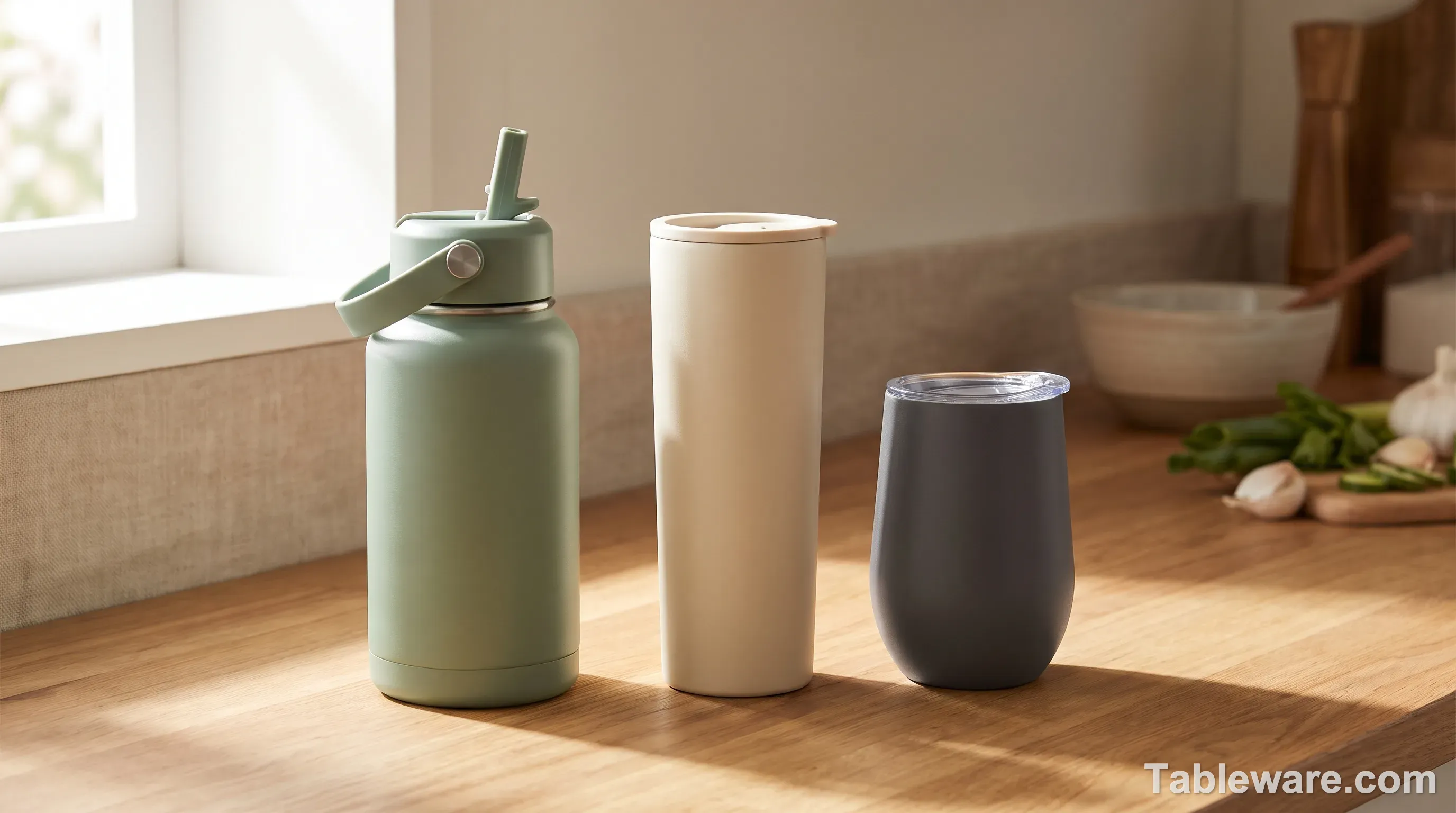
Fig 1. Three of the four. From left: a handled tumbler with a straw lid, a tall slide-lid cup, and a short spout-lid tumbler. They look like different products. They are the same category, roughly the same price, and mostly the same object.
Four tumblers sit on my kitchen counter right now. A YETI Rambler that has survived a garage, a Stanley Quencher H2.0 that my sister bought in a fit of 2024 enthusiasm, an Owala FreeSip that arrived as a birthday gift, and a Hydro Flask I inherited from a former colleague.
They cost $30 to $55 each. All four are vacuum-insulated stainless steel. All four keep drinks cold for most of a working day. And yet people will argue about which one is "best" like it's a matter of settled fact.
It isn't. I've tested enough of these to have opinions, and none of them are neutral.
We wrote about everyday glass drinkware on this site already, and that guide ended the same way — there is no universally best tumbler, there is only the one that fits your car, your hand, and how often you are willing to wash the lid. This is the stainless steel version of the same argument.
Here's the short version before I make the case: buy the YETI if you're hard on your drinkware, buy the Owala if you want the lid design and the colors, buy the Hydro Flask if you're buying a bottle rather than a tumbler, and buy the Stanley Quencher if you want the one everyone recognizes — with one safety caveat I'll get to, because it's the part most reviews skip.
The category is exploding, by the way. The global reusable bottle market was roughly $9.7 billion in 2024 and is projected to approach $12.6 billion by 2030. Four brands own most of the shelf space, and all four are worth an actual comparison.
Quick Verdict: Who Wins Which Category
Let me put the answers up front so you can skip ahead if you want.
| Category | Winner | Runner-up | Why |
|---|---|---|---|
| Durability and hot drinks | YETI Rambler | Stanley Quencher H2.0 | Thicker steel, lid that seals for hot liquids, built like a tool |
| Lid design and one-hand use | Owala FreeSip | Stanley Quencher H2.0 | The sip-or-swig spout genuinely works; no straw to lose |
| Bottles (narrow mouth, no straw) | Hydro Flask | YETI Rambler | Better for hot coffee you carry upright |
| Color drops and gifting | Owala | Stanley Quencher | Nobody else designs releases like Trove Brands does |
| Cupholder fit at 40 oz | YETI Rambler 30 oz | Owala 30 oz | Most 40 oz tumblers simply do not fit |
| Lead-free construction | Owala | Hydro Flask | No solder pellet in the base, so no lead question at all |
| Price per unit | Any of them | — | Under $40 across the board in 2026 |
Now the details.
YETI Rambler vs Stanley Quencher: The Durability-vs-Culture Showdown
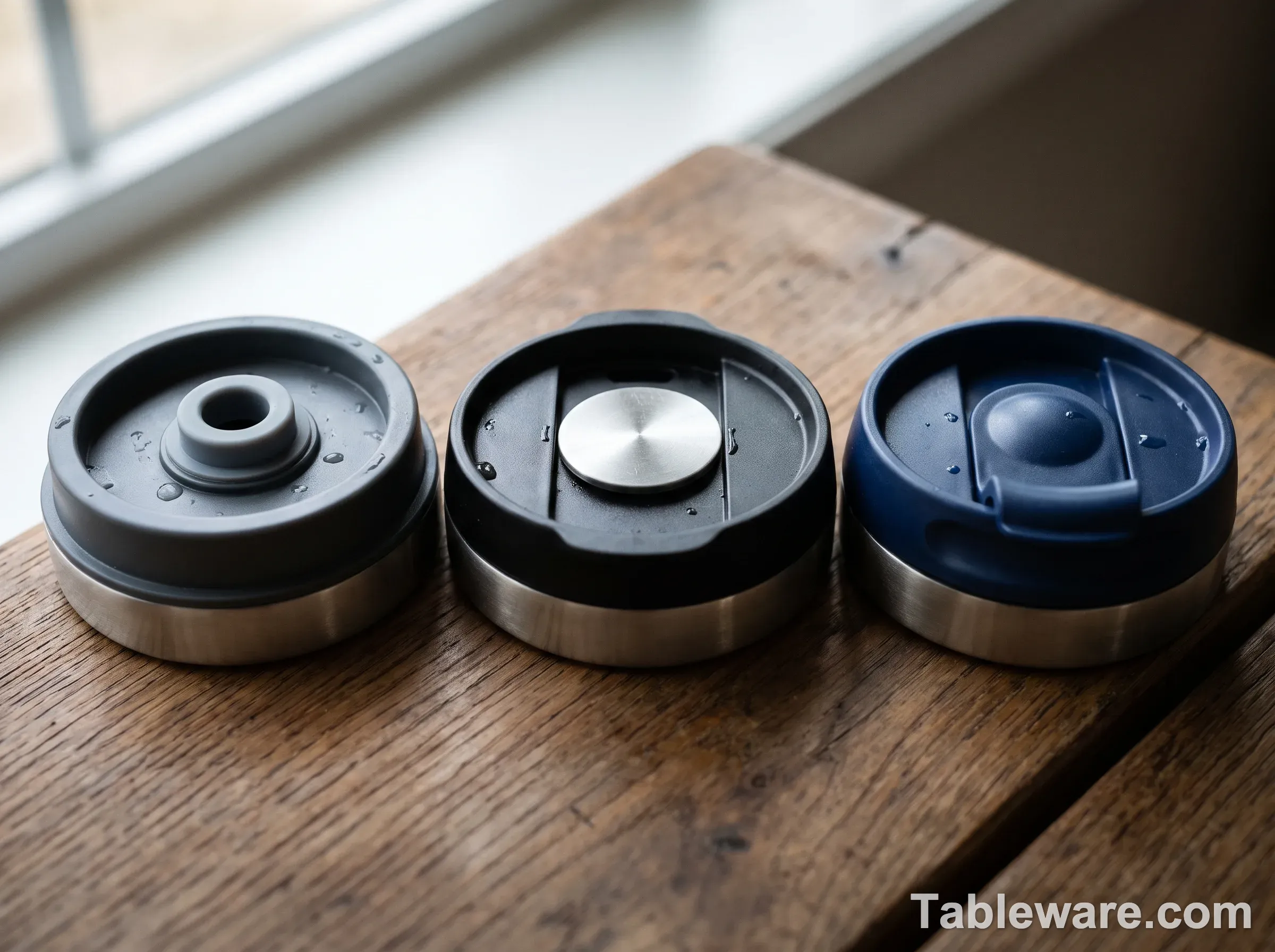
Fig 2. Three lid philosophies in one frame. The difference between these lids is the difference between drinking through a straw, sliding a cover aside, and flipping a spout up with your thumb.
These two get compared constantly, and the comparison is unfair to both.
Most "yeti vs stanley tumbler" searches are really asking one question: which one survives my car, my gym bag, and my dishwasher for three years? Both do. The rest is preference, which is why this comparison keeps running instead of settling.
The YETI Rambler is a tool. The 20 oz and 30 oz MagSlider versions have double-wall vacuum insulation, a magnetic sliding lid that you can open one-handed with a magnet, and an 18/8 stainless steel body with a DuraCoat finish that shrugs off scratches. In testing, a 30 oz Rambler held 155°F (68°C) after 50 hours with the MagSlider lid on. That is not a marketing number — that is a measured result, and it remains the best hot retention in this group.
The Stanley Quencher H2.0 wins on something different. It is the tumbler that turned a drinkware company into a cultural object. Quencher launched in 2016; by 2024 Stanley was moving 7.36 million units on Amazon US from January through September, up 107% year over year, and the Quencher had a 150,000-person waitlist. There was a record 150,000-person waitlist for the Quencher H2.0 relaunch.
That's a real thing to acknowledge. It is not the same as being the best cup, but it means the thing you buy is instantly recognizable, and it means reselling one costs you nothing.
Insulation Hours and Ice Retention, Tested
Here is where I get more skeptical of marketing copy than of anything else.
Measured hot retention, in a controlled test: the YETI Rambler 30 oz reached 155°F at 50 hours. The Owala FreeSip 40 oz reached 142°F (60°C) at 48 hours with a perfect seal. The Hydro Flask 40 oz Travel reached 145°F (63°C) at 52 hours but failed the test on the leak front, with minor drips from the straw opening, minor scuffing on the powder coat, and a small dent.
The physics behind it is the same reason oven-to-table bakeware fails in specific ways rather than random ones. Vacuum insulation is a solved problem with a predictable failure mode — the vacuum seal, not the steel.
On the cold side, the differences shrink to the point where it stops mattering. Owala claims 24 hours cold on the 20 oz SmoothSip and the 24 oz. The Hydro Flask All Around 32 oz measured 28 hours cold and 10 hours hot. The Owala 24 oz came in at 24 hours cold and 6 hours hot.
Read those numbers carefully. In practice, the gap between 24 hours and 28 hours of cold retention is the gap between "still cold" and "still cold." You will not notice it. You will absolutely notice the difference between a lid that leaks and one that does not.
Lids, Straws and the Leak Point
This is the real fault line, and it is worth being blunt about it.
The Stanley Quencher H2.0 has a FlowState lid with three positions — straw, sip, and a full-lid position that closes down over the straw opening. The lid rotates on a double-threaded design so you can turn the straw toward yourself and the handle stays on the comfortable side. It is left-handed friendly, which is a small thing that shows someone actually thought about it.
But the Quencher is not leakproof with the straw in place. Stanley sells it as leak-resistant with the lid locked; insert a straw and it is a straight-sided cup with a hole in the top.
The Owala FreeSip is the leakproof answer. Its patented FreeSip spout lets you drink upright through an integrated straw or tilt the bottle back and take a larger swig through a wider opening. The whole thing is leakproof when locked. The lid comes apart completely — lid, straw, slider, gaskets all separate — which makes it the easiest of the four to actually clean properly.
The YETI Rambler sits in between. The MagSlider lid is a sliding disc over the opening; it is not a straw system and it does not pretend to be. It just seals very well and opens one-handed.
Hydro Flask's press-in straw lid is the least interesting of the four and the one that most often produced drips in testing.
Owala vs Stanley: Same Price, a Very Different Daily Driver
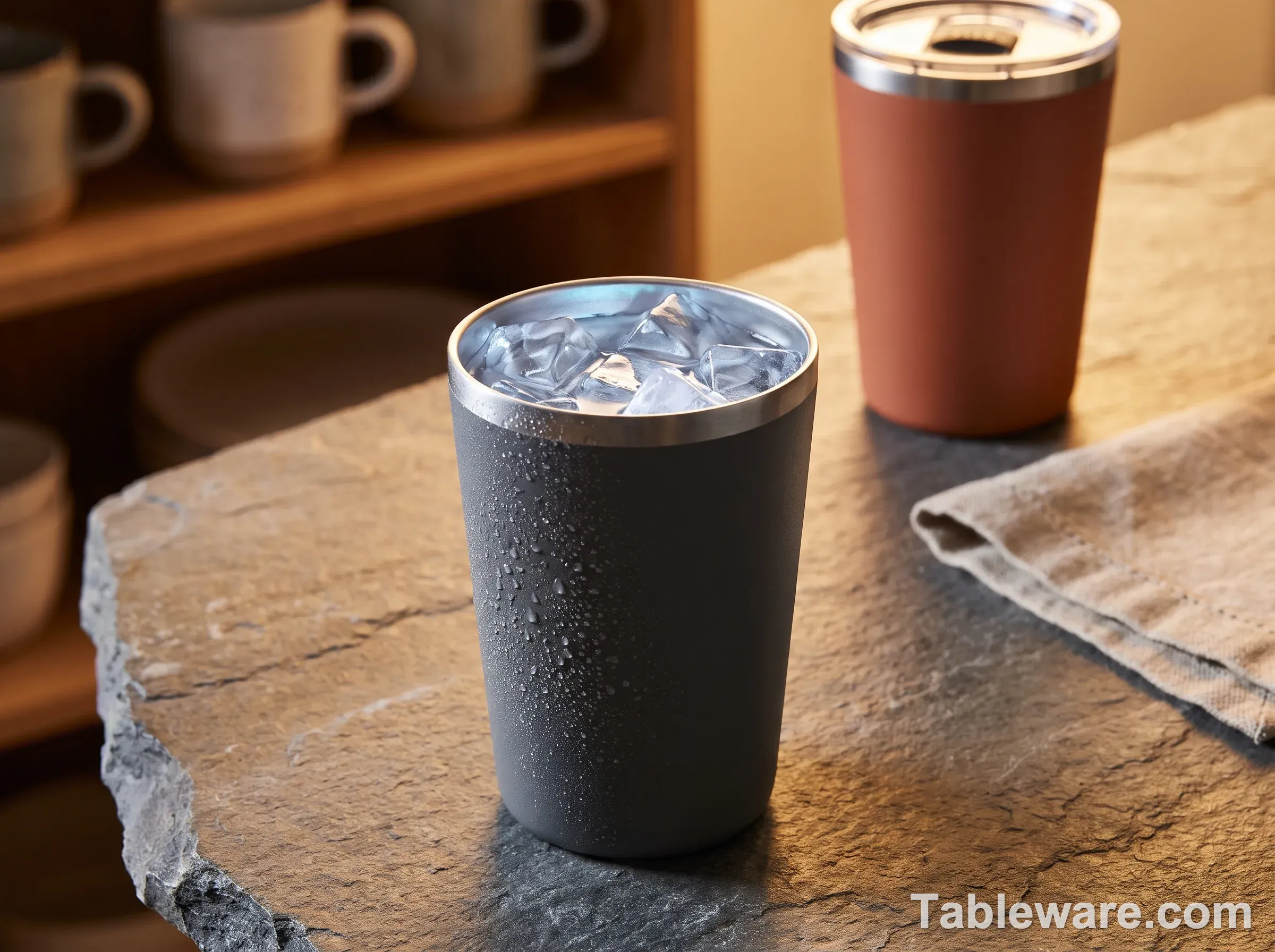
Fig 3. The test that actually matters. Fill it, leave it, and check back at hour six. Most of these hold cold fine. The failure shows up in the lid, not the steel.
Owala and Stanley Quenchers cost nearly the same — the 40 oz Owala FreeSip Tumbler and the 40 oz Stanley Quencher H2.0 both land around $39.99, and the 30 oz versions around $29.99. Owala's average selling price sits around $37.
The "owala vs stanley tumbler" question comes down to the lid and the color, not the steel. The Owala FreeSip vs Stanley Quencher split runs straight down the middle: one gives you a sealed spout and a straw you can drink cold coffee through, the other gives you a rotating lid that lets you drink from the same opening without a straw at all. What you get for that money is a completely different object.
Steel Grade and Build Quality
Owala is a Trove Brands company, based in Lehi, Utah, and it also owns BlenderBottle. Owala launched in March 2020 with the FreeSip bottle after seven years of development — including one failed launch under the BlenderBottle brand. The FreeSip spout was invented by Steve Sorensen after noticing people were using BlenderBottle shakers as everyday water bottles. TIME named it to its Best Inventions of 2023 list.
If you are wondering about the Owala tumbler stainless steel grade specifically: the bodies are 18/8 (304) food-grade stainless, the same grade used across this category. The difference is in the cup wall and the base, not the alloy.
Stanley, by contrast, is owned by Pacific Market International (PMI WW Brands), which bought the Stanley brand in 2002 and moved production to China. Stanley has been making vacuum bottles since 1913, when William Stanley patented the double-wall design.
The practical difference is in the cup wall and the base. YETI and Stanley tend to run thicker-gauge steel and a more robust vacuum seal — Stanley's own filing describes the seal at the base as using an industry-standard pellet covered by a stainless steel layer. Owala and Hydro Flask run lighter walls with a powder coat over 18/8 stainless.
All four use 18/8 (304) stainless, which is the food-contact grade you want: at least 16% chromium and about 8% nickel. What you want to avoid is 201 stainless, which is magnetic, rust-prone, and can leach metals. Cheap unbranded tumblers from marketplaces are where 201 shows up.
Owala's wall is thinner, and you can feel it. The Quencher feels like a slightly more substantial object in the hand. But Owala's lid engineering more than makes up for it.
Cupholder Fit and One-Hand Use
Here is where people get genuinely upset, so let me be precise.
If you are searching for a tumbler that fits in cupholder, this is the paragraph that matters. The Owala 24 oz body measures about 3.12 inches in diameter. The Stanley Quencher measures about 3.15 inches. Most car cupholders accept roughly 3.1 inches. So the 24 oz Owala fits some vehicles where the Quencher does not — owners of a Nissan Rogue report the Owala fitting and the Stanley not, with a RAV4 taking both.
Then the sizes get ugly. Owala's 32 oz and 40 oz do not fit most car cupholders. Neither does the Stanley Quencher 40 oz. If you are buying a 40oz tumbler with handle for the car, assume you are buying a desk cup or a bag filler, not a cupholder tumbler. The best 40oz tumbler with handle is a YETI Rambler 42 oz with a cupholder-compatible handle — and even that is heavy enough that fully loaded you are carrying close to 4 lbs.
The 30 oz YETI Rambler is the practical answer for the car, and the Owala 30 oz also fits most vehicles.
One-hand operation is where Owala clearly wins. The push-button lid opens with a thumb, the FreeSip spout lets you drink without tilting the bottle, and the carry loop doubles as a lock so you can hang it on a backpack strap.
The Price Ladder: Where Hydro Flask Still Wins
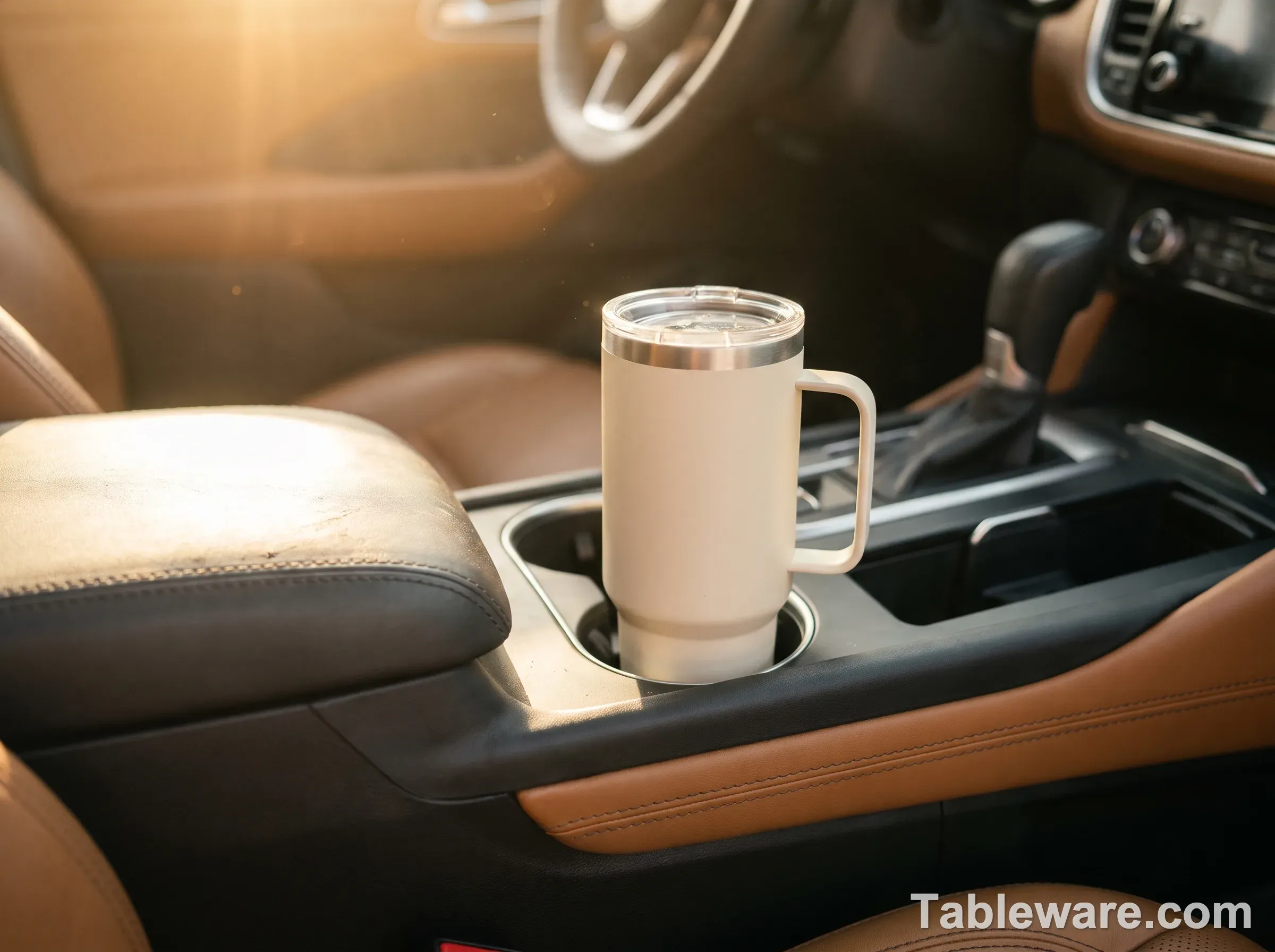
Fig 4. A 30 oz tumbler in a real cup holder. Get this right and it decides the purchase. Get it wrong and the 40 oz you paid more for sits on the passenger seat all day.
Current US pricing, roughly:
- YETI Rambler 20 oz MagSlider — about $30-$35
- YETI Rambler 30 oz MagSlider — about $40
- Stanley Quencher H2.0 30 oz / 40 oz — $29.99 / $39.99, with the FlowState version of the 40 oz at $45
- Owala 20 oz / 30 oz / 40 oz — $25-$35 / $29.99 / $39.99
- Hydro Flask 32 oz All Around / 40 oz Travel — $35 / $40-$50
The $45 Stanley FlowState 40 oz is the one that stings. You are paying a premium for a lid mechanism, and the wall is the same.
Hydro Flask wins when you want a bottle, not a tumbler. The 32 oz All Around is a narrow-mouth bottle that fits a cup holder cleanly, keeps coffee hot for about 10 hours, and stays cold around 28. It is a genuinely better object than trying to drink coffee out of a straw tumbler, and it is what I would hand someone whose entire day is one desk and one coffee.
Hydro Flask also owns the one category none of the other three really serve: a pot. Our teapot buying guide covers the same double-wall vacuum logic in a different shape, and the failure points are identical — a bad seal at the base, not a bad body.
If you are weighing glass instead, 4 types of glass for drinking glasses covers why glass never picks up a metallic taste and why it stays out of the vacuum-insulated conversation entirely. It is a different problem, and for some people a better one.
One business note that affects long-term availability: Hydro Flask is owned by Helen of Troy, which took $414.4 million in non-cash impairments in fiscal Q1 2026. That does not mean the brand is going anywhere. It does mean the parent company's finances are worth watching if you plan to buy in three years.
Hot Drinks: The Best Insulated Tumbler for Hot Drinks, Ranked
If you are putting hot coffee in a tumbler with a straw, stop and reconsider. That is a bad idea for reasons that have nothing to do with insulation.
Asking for the best insulated tumbler for hot drinks is a shorter list than most people expect, because hot liquid rules out a whole category. Narrow it down and the answer gets straightforward.
The one that holds heat best is the YETI Rambler — 155°F at 50 hours measured, and the 20 oz is specifically noted as the pick for people who want coffee still drinkable three hours later. Chug lids (YETI Rambler) work best for hot drinks; flip lids (Stanley ProTour) are the most leakproof.
But hot plus straw is a bad combination generally. The Stanley Quencher H2.0 in particular should not get hot liquid with the straw installed. If you want hot coffee to travel, you want either the 20 oz YETI with its MagSlider lid, or a proper narrow-mouth Hydro Flask.
Hot drinks also narrow the field on lids. Slide lids and flip spouts are easy to drink from hot. Straw lids on a 40 oz tumbler make the whole thing heavy, awkward, and prone to sloshing.
If you want the ceramic version of this problem solved, we tested six in 6 coffee mugs tested. Same question, different material.
Are Stanley Cups Safe to Drink Out Of? The Lead Pellet and the Recall
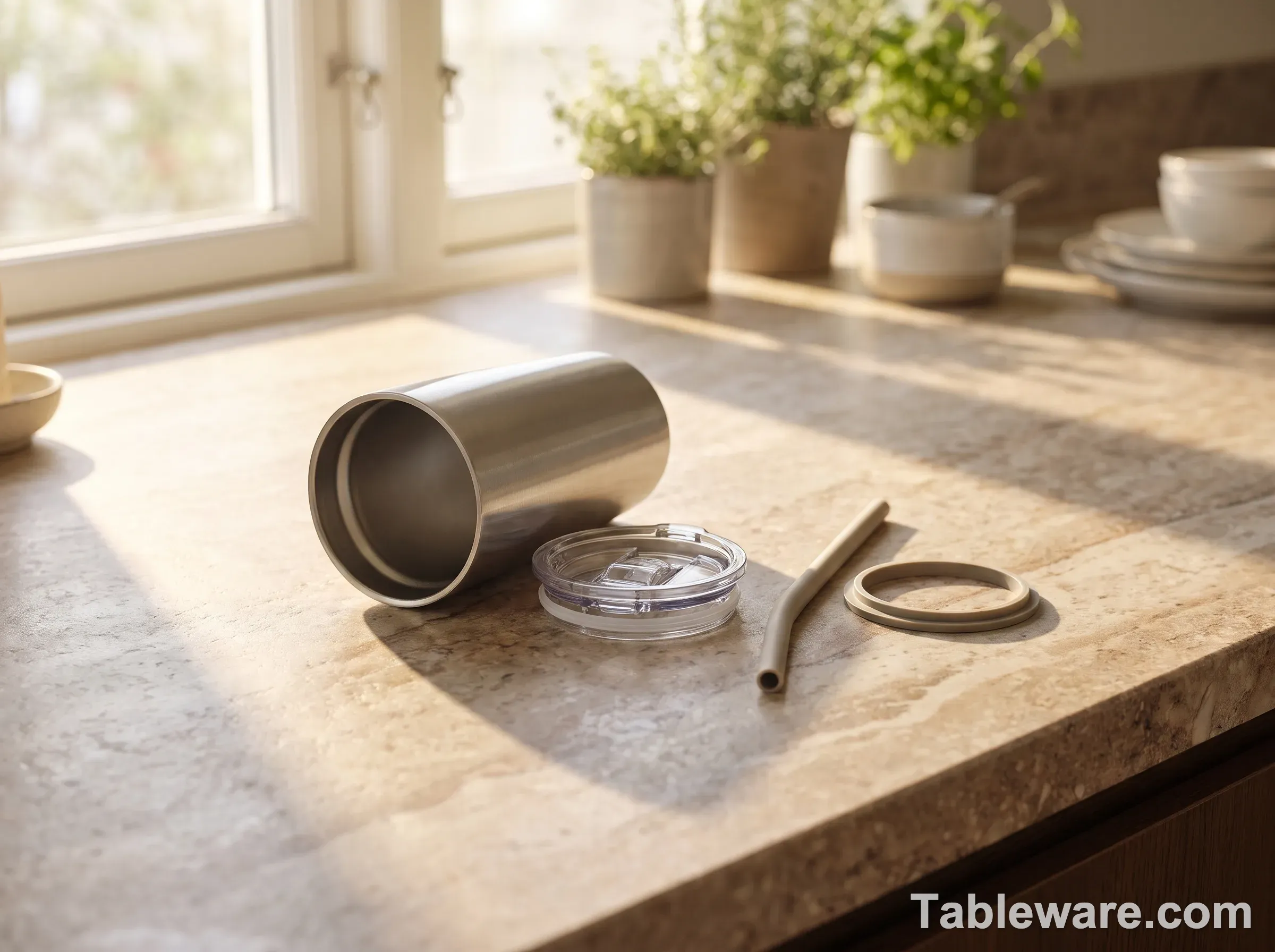
Fig 5. Take it apart. The pieces that actually touch your mouth are the pieces you wash. A tumbler you cannot get into is a tumbler you will not clean properly.
This section is the one most "best tumbler" roundups leave out, so I want to be careful and precise rather than alarming.
In January 2024, dozens of Stanley customers reported detecting lead in the base of their tumblers using at-home test kits. Stanley's response was that their manufacturing process uses an industry-standard pellet to seal the vacuum insulation at the base, that the sealing material includes some lead, and that it is covered by a stainless steel layer making it inaccessible to consumers — no lead contacts the surface or the contents. Third-party testing by SGS confirmed no detectable lead on surfaces a drinker touches.
So: an intact Stanley tumbler does not put lead in your coffee. That is the accurate statement.
The exceptions are worth knowing. If the base disc is loose, dented, or missing, stop using the tumbler. And this is the part people miss: a vacuum-insulated tumbler with a damaged base is a different object from an intact one, and the exposure question only becomes real at that point.
Then there are the recalls. In December 2024, Stanley recalled 2.4 million tumblers over lids detaching, and separately recalled 2.6 million Switchback and Trigger Action travel mugs due to a burn hazard — 91 reports worldwide, 38 burn injuries, and 11 instances requiring medical attention. That travel mug recall was about heat and burn risk, not lead. Note what was and was not involved: the Quencher tumbler was not the subject of a lead recall.
Genuine lead-exposure recalls have targeted children's cups — LAOION and PandaEar in 2024, and Green Sprouts stainless bottles in 2022 — where the solder bead was physically accessible rather than enclosed. That is a different failure from Stanley's enclosed pellet, and lumping them together does neither any of them a favor.
The Stanley Black & Decker v. PMI lawsuit over the "Stanley" name, filed in February 2025 in the District of Connecticut, was dismissed with prejudice on December 24, 2025. Separately, PMI filed suit in SDNY in 2026 (26-cv-03470) against sellers of knockoff Stanley products, with a trademark and design-patent focus including the Quencher and the bear logo. If you buy a suspiciously cheap Stanley, that lawsuit is probably why.
The Lead-Free Rivals
Is Stanley lead free? Not entirely, and the honest answer is more useful than the marketing on either side. Owala, Hydro Flask, Klean Kanteen, and Sigg have publicly stated they do not use lead in manufacturing their drinkware. Klean Kanteen specifically uses a noncrystalline silica bead instead of solder. Owala's stated advantage in the market is precisely its no-lead positioning.
If "no lead anywhere in the construction" is your deciding factor, Owala and Hydro Flask are the clean answer. If you already own a Stanley and the base looks intact, there is no emergency.
One practical check, if you want one: look at the base. A smooth, sealed bottom is good. A raised dot, a removable disc, or a plate that wiggles is worth a phone call to the manufacturer before you keep using it. And check the rim for chips — worn or chipped finishes are a bigger day-to-day concern than the base pellet.
If you want the fuller picture on metals in tableware, we covered the glaze side of it in lead and cadmium in ceramic glazes. The same logic applies here — the question is never "does this material contain lead," it is "does anything you touch get it into your drink."
Care and Cleaning: What Actually Breaks an Insulated Stainless Steel Tumbler
The insulated stainless steel tumbler is not fragile in the way a plate is. It is fragile in specific, predictable ways, and almost all of it comes down to the lid.
Nine of the ten tumblers in one lab test group were dishwasher safe, and Stanley, Tervis, and Owala are all rated dishwasher safe including lids. So to answer the direct question — are Owala tumblers dishwasher safe? Yes, the FreeSip and the tumblers both are. But dishwasher safe does not mean dishwasher immortal.
What breaks:
- Straws. Straws wear out. Replace them rather than nursing a cracked one. They also get brittle and can shed fragments into the drink.
- Gaskets. The silicone seals are the first thing to stretch and the first thing to leak. Replacement lids and gaskets are cheap and available for all four brands.
- Lid disassembly. Owala is the best here — lid, straw, slider, and gasket all come off. A YETI MagSlider lid is easy. A Hydro Flask press-in lid is fiddly. Clean what you can reach, or you will get a smell.
- Scratches on the powder coat. Cosmetic. It does not affect safety or function.
- Base dents. This is the one that matters. A dent near the base seal on a vacuum-insulated tumbler is a reason to stop using it.
Hand washing the stainless body with mild soap is the gentler path for the powder coat. Do not store juice or soda in a stainless tumbler long-term — acidity is the one thing that actually attacks stainless — and give the lid a proper clean at least weekly.
The same "what actually breaks it" logic shows up in 7 dinnerware care mistakes and it applies to drinkware too. The expensive object is rarely replaced. The part you never clean is.
So Which Insulated Stainless Steel Tumbler Should You Actually Buy?
Here is how I'd decide, in order.
Buy the YETI Rambler 20 oz or 30 oz if you are hard on your drinkware, if you want one cup that works for both hot and cold, or if you want the simplest possible object that will still work in ten years. The 30 oz fits a car cup holder. The MagSlider opens one-handed. The measured hot retention is the best in the group. YETI backs the Rambler with a limited lifetime warranty, which is a real, transferable asset.
Buy the Owala FreeSip if your day involves a lot of drinking and a lot of commuting. The leakproof lid, the sip-or-swig spout, the fully disassemblable parts, and the color releases make it the most pleasant object to own. It is also the one you are most likely to replace with a different color rather than the same color, which is a problem you will enjoy.
Buy the Hydro Flask if you are buying a bottle, not a tumbler, and especially if it is for hot coffee you carry upright. The 32 oz All Around is an excellent, under-discussed object.
Buy the Stanley Quencher H2.0 if you want the most robust straw-and-sip setup in the category, if you are buying for someone who will absolutely recognize it, or if you find the FlowState lid worth $45. Skip it if you need true leakproofing with a straw, if you need it in a car cupholder at 40 oz, or if you want to avoid lead entirely.
And if you are still deciding: the Stanley H2.0 40 oz and the Owala FreeSip 40 oz cost the same $39.99, both hold cold for about a day, and both are 40 oz that will not fit your cupholder. Choose on the lid and the color, because the steel is basically equivalent.
Buying Notes: Warranty vs Replacement Lids vs Resale
A few things that change the math beyond the sticker price.
Warranty. YETI's limited lifetime warranty on the Rambler is the strongest of the four. Stanley and Owala warranties exist but are narrower. Hydro Flask's depends on the parent company's condition right now. A warranty is worth real money on a $40 object you will use daily for years.
Replacement parts. Budget for a spare straw and a spare gasket. Owala sells both. Stanley sells both. This is not a consumer problem to be embarrassed about; it is a two-minute fix that costs less than a cup of coffee.
Resale. The Stanley Quencher has the strongest resale market by a distance, because the brand is legible. The Owala has strong secondary demand in specific colorways. If you are the type who buys one and rotates, that changes the calculation.
Where you buy. Authorized retail only. PMI's 2026 lawsuit in SDNY against knockoff sellers is the clearest possible signal that the counterfeits exist, and a counterfeit Stanley is exactly the scenario where the base might not be what it claims to be. Buy from the brand's site, REI, Dick's, Target, or a reputable marketplace seller.
The plastic question. If you are avoiding plastic entirely, note that the lids on all four use Tritan or similar BPA-free plastics even when the body is pure steel. We covered what that means for dinnerware in is melamine dinnerware safe — the answer there applies here too. The body is not the risk. The gasket is.
Discount timing. These brands run site-wide sales constantly, and the color drops rarely get discounted. If you want the popular color, buy it at full price. If you want a color you do not care about, wait for a sale and save $10.
One last thought. The best insulated stainless steel tumbler is the one you will actually carry every day and will still be using in three years. All four of these will do that job. Pick the lid you like, because the lid is what you touch forty times a day, and the lid is what determines whether you keep using the cup or lose it in a car seat.
That is the whole review, really. The steel is a solved problem. Everything else is preference.