A friend who's a sous-chef at a Michelin one-star in Brooklyn sent me a photo last October. It was an empty table after service, every plate gone except one — an octagonal white porcelain plate, maybe 10 inches across, sitting in the middle of a heavy oak table. The caption read: "we just switched. all of it. every course." I texted back: "why?" The answer was one word: "geometry."
That photo is the reason I started writing about octagonal dinnerware for this site. Because for about three years now, every time I walk into a tasting-menu restaurant in New York, San Francisco, Copenhagen, or Tokyo, the plate is octagonal. Not every plate. But the important plate — the one the chef actually composed the course on — is almost always octagonal. Atomix in Seoul runs on them. Sushi Yasuda in New York has used them for years. Frenchette, Crown Shy, Atomix, the old Cosme, Sqirl in LA, Wildair — the list keeps growing. And over the last 18 months the same shapes have started showing up in home-kitchen Instagram and at Crate & Barrel. The eight-sided plate is back. It is, in fact, having its strongest moment since the Qianlong emperor commissioned a dinner service of them in 1750.
I want to walk through why. Not the marketing version. The real one — the geometry, the 500-year history, the actual chefs picking it, the brands doing it well, and three rules for mixing octagonal plates with the round set you already own.
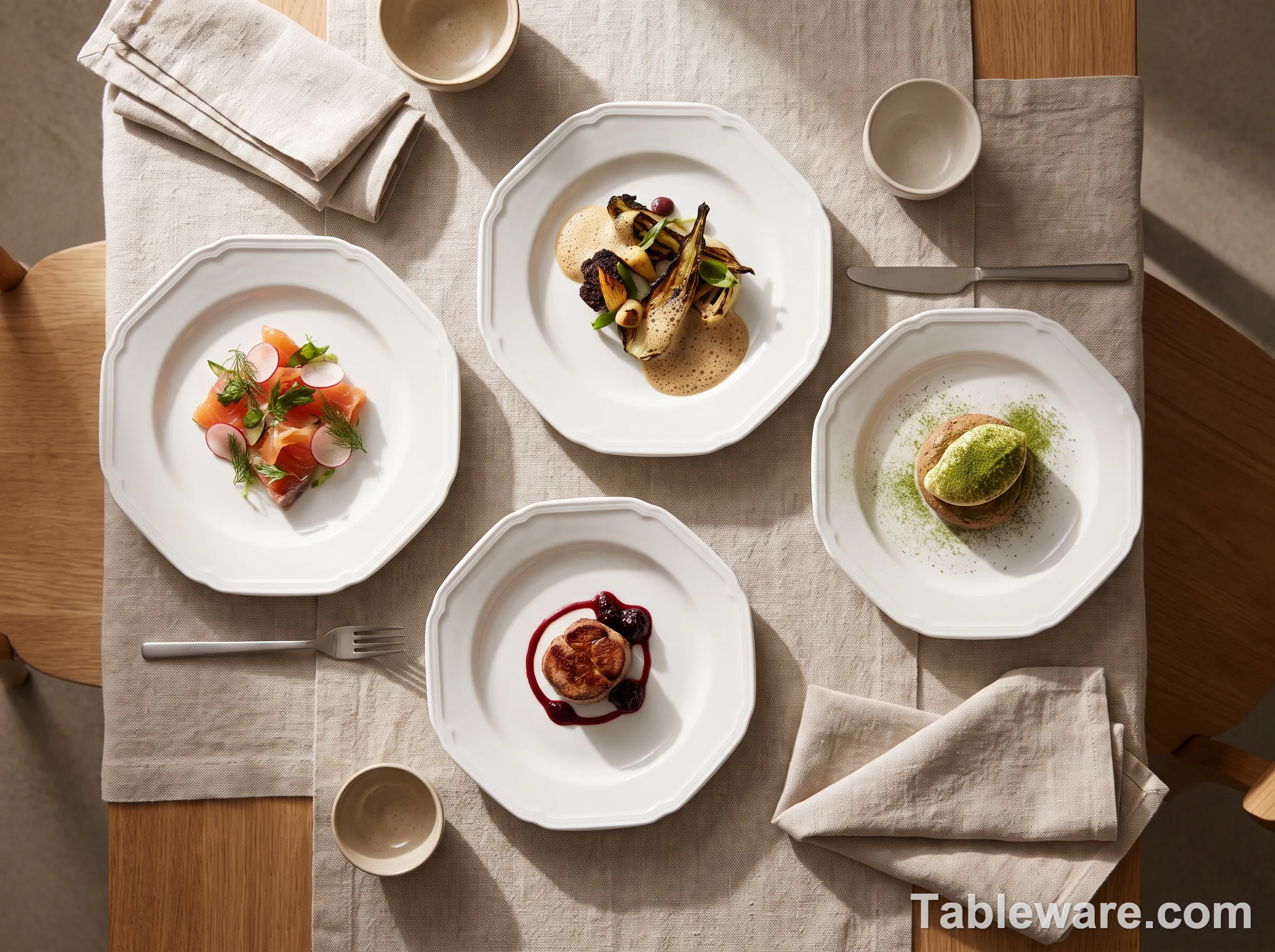
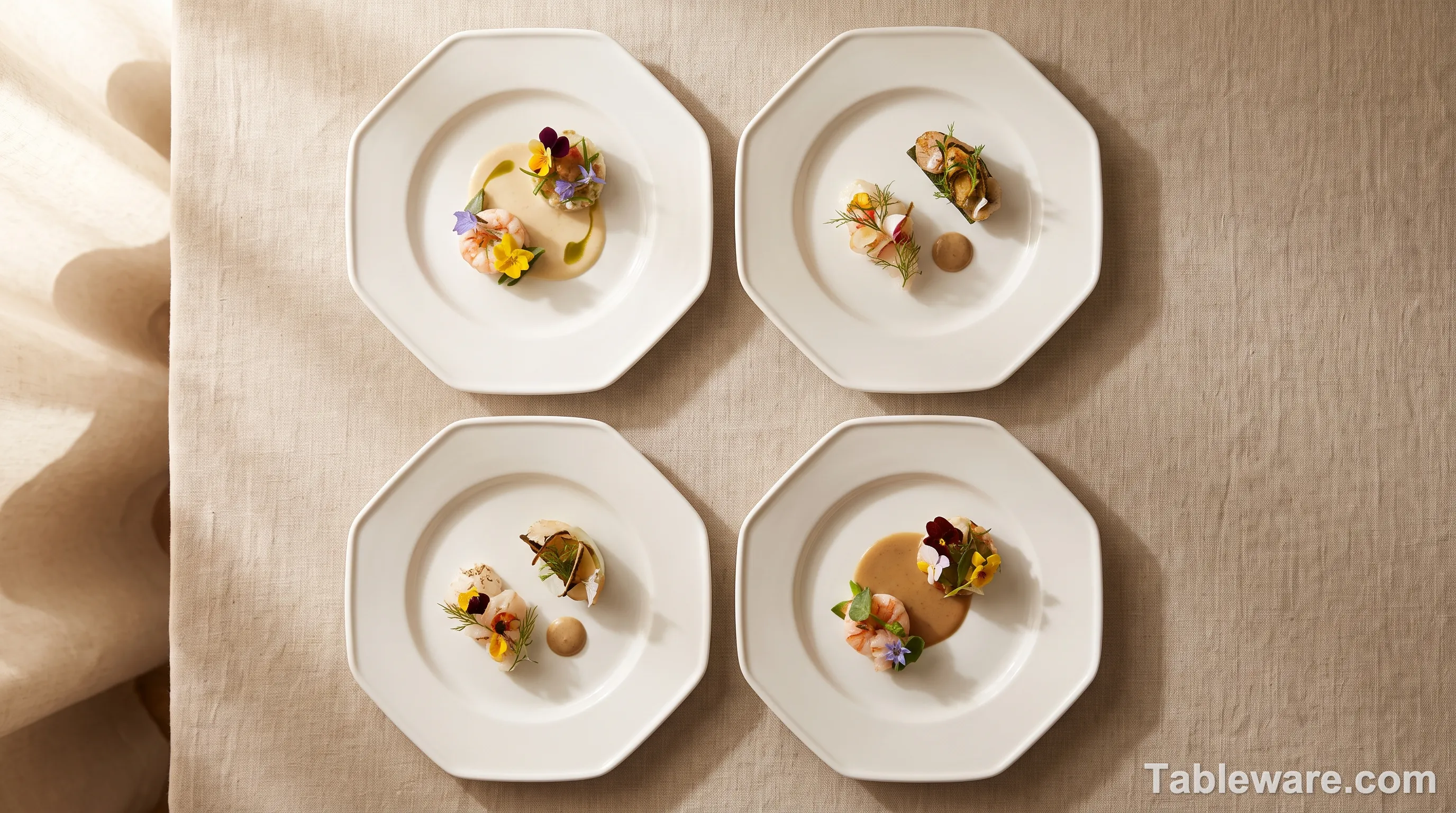
Fig 1. A top-down view of a four-course spread on white octagonal porcelain plates, the kind of composition you'll find at Atomix, Sushi Yasuda, and a growing number of tasting-menu restaurants in 2025-2026.
The Plate That Refused to Stay Square
Here's the thing nobody tells you about why octagonal dinnerware keeps coming back. It's not a trend. It's a recurrence. The eight-sided plate has cycled in and out of fashion roughly every 60-80 years for the last 300 years, and every time it comes back, the marketing copy says the same thing: "modern, geometric, fresh, a departure from the round plate." Which is true. But the departure keeps arriving. The 2026 octagonal plate dinnerware trend is the strongest in 60 years. It is the first one driven by chefs, not by home consumers.
The reason it's never quite stuck for good is that round plates are genuinely better at most things. They stack. They nest. They don't chip at the corners. They roll cleanly off a potter's wheel. They have no weak point in the rim. A round plate, made and used well, can last 200 years with no drama. An octagonal plate has eight corners. Each one is a future chip. The geometry that makes the plate photogenic is also the geometry that makes it fragile.
And yet. Every few decades, a generation of designers, chefs, and tableware companies decides that the trade-off is worth it, and octagonal dinnerware floods the market. The 2026 wave of octagonal dinnerware is the strongest in 60 years, and unlike the 1950s, it is being driven by chefs first and home consumers second. The 1750s was the first big wave — Chinese export porcelain, made in Jingdezhen for the European market, often octagonal, often with famille rose decoration, often with a Buddhist wheel or a dragon or a riverside landscape in the well. The 1880s got a second wave during the Aesthetic Movement, with octagonal majolica and Aesthetic-era serving pieces. Mid-century modern brought a third wave — the 1950s-1970s — when shapes got more architectural and companies like Block China and some European houses started producing octagonal dinnerware for the home. Rosenthal's "Modern" line, designed by Raymond Loewy in the 1950s, included octagonal pieces. Then it faded again.
We're in the fourth wave right now. It started in earnest around 2022-2023 in the high-end tasting-menu segment, and it spread to home kitchens in 2024-2026. The 2026 Catalonia Plates trend report calls octagonal and "irregular geometric" shapes one of the defining looks of the year. If you walk into a Crate & Barrel, a West Elm, or a Heath Ceramics showroom right now, the question is no longer whether they have octagonal pieces — it's how many lines they have.
A Quick History (1735-2026): Why Octagonal Keeps Coming Back
The earliest octagonal porcelain I can find in a museum catalog is a Chinese export piece from the Yongzheng period, around 1730-1735. Octagonal dishes, plates, and small tureens were a small but persistent slice of the Chinese export trade. The reason the Chinese made them was that the European market asked for them. A 1stDibs listing from a few years ago — a Qianlong-period (1736-1795) Chinese octagonal porcelain plate, hand-painted in polychrome with flowers, fruits, and a Buddhist wheel — sold for the equivalent of about $3,800 DKK (roughly $550). The dimensions: 9 inches across, 0.8 inches deep. Almost exactly the same proportions as a modern 10-inch dinner plate. The geometry didn't change. The decoration did.
The Chinese weren't inventing the octagonal plate. They were responding to a European demand that came from the dining room. In 17th and 18th century European aristocratic houses, an octagonal plate or platter signaled something a round plate could not: I have enough money that my food is not in danger of rolling off the table. The corner gave the chef and the server more places to anchor a composed dish. A round plate only has the center. An octagonal plate has the center and the four long sides, plus the four corners as visual punctuation. For a baroque or rococo host trying to make a statement with food, the eight-sided plate was the obvious canvas.
By the 1880s the Aesthetic Movement revived the shape in a different mode. William De Morgan, Christopher Dresser, and the various Liberty & Co. designers were producing octagonal tiles, plates, and serving pieces in earthenware, often with luster glazes. The aesthetic was deliberately non-functional — Art Nouveau, Islamic, Japanese all borrowing from each other — and the octagonal form fit the mood.
The mid-century modern wave (1950s-1970s) was different. This was the era of the form-follows-function plate, often in simple white or single muted color. Raymond Loewy for Rosenthal, some of the later Eva Zeisel pieces, and various Scandinavian houses all produced octagonal dinnerware. The intent was to make a plate that worked in a modernist kitchen. The result was a shape that looked clean on a teak sideboard and didn't try to compete with the food.
The current wave, starting roughly 2022, is again different. It's the first wave driven primarily by chefs, not by home consumers. The tasting-menu segment figured out that an octagonal plate with a long flat rim gives the chef more space to compose — and a more interesting frame for the diner to look at. Then the home market caught up.
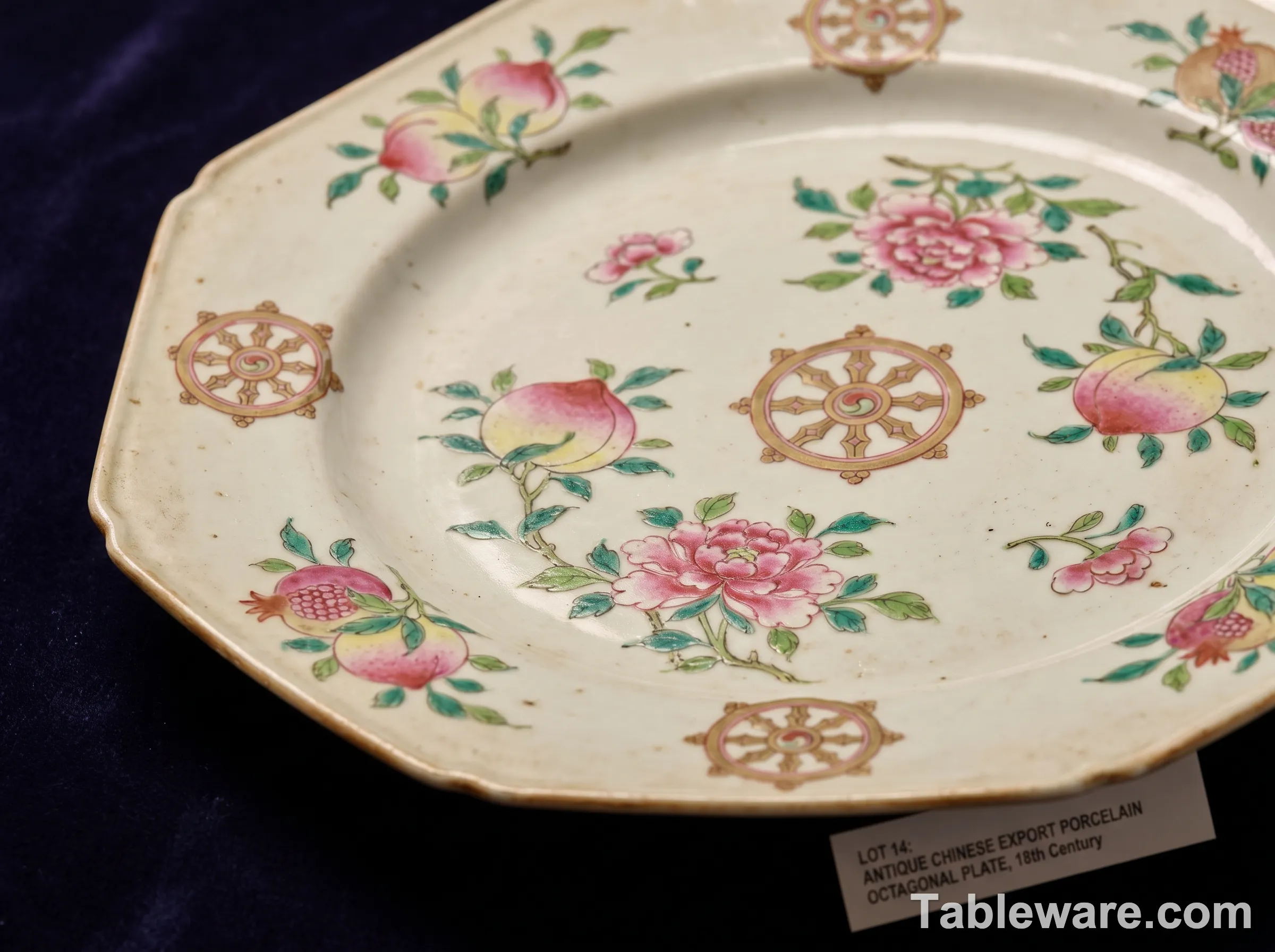
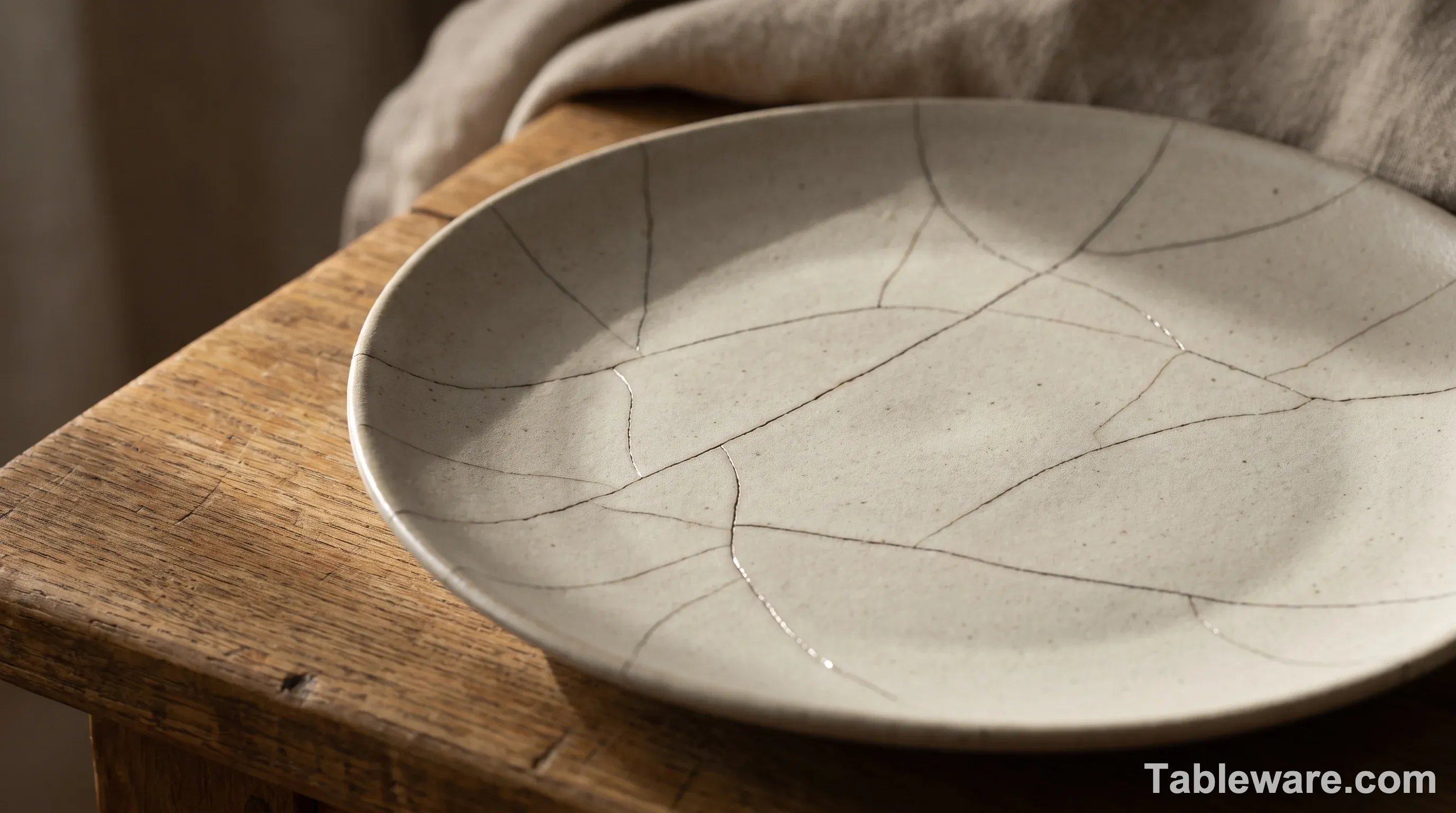
Fig 2. A Qianlong-period Chinese export octagonal porcelain plate (1736-1795), hand-painted in polychrome with flowers, fruits, and Buddhist wheel motifs. 9 inches across, 0.8 inches deep — almost exactly the proportions of a modern 10-inch dinner plate.
Why Tasting-Menu Chefs Are Picking Octagons in 2025-2026
Five reasons. Some are aesthetic. Some are practical. Some are a bit of both.
1. The frame. A round plate is a circle, and a circle has no edges. It asks the chef to put the food in the middle. An octagonal plate has eight edges, and the eye naturally reads those edges as a frame. A composed dish on an octagonal plate reads as a composition, not just a serving. The chef can place a piece of protein at 4 o'clock, a sauce at 10 o'clock, and a garnish at 7 o'clock, and the geometry of the plate supports each placement. This is why Atomix, which is a tasting menu built around precise composition, runs almost entirely on octagonal and irregular geometric plates.
2. The long rim. A round 10-inch plate has a rim about 1.5 inches wide. An octagonal 10-inch plate has long flat sides that are functionally 2-2.5 inches across. That extra half inch is enough to put a small sauce cup, a piece of bread, or a single bite of garnish on the plate instead of in a separate dish. For a tasting menu trying to minimize server trips, that's a real operational win.
3. The negative space. On a round plate, an empty area is just empty. On an octagonal plate, the negative space between the food and the corners reads as intentional composition. The French bistronomy movement figured this out in the 2010s. Atomix and the various Korean tasting-menu restaurants took it further. The 8-sided plate lets the chef leave more empty space and have it look like a choice, not a mistake.
4. The corners. A piece of nigiri sits on a round plate the same way it sits on a square plate. A piece of nigiri on an octagonal plate sits in a corner. The corner holds the rice from sliding, frames the fish, and creates a tiny architectural moment. Same for a slice of fish carpaccio, a single dumpling, a small mound of rice with a piece of uni on top. The 8-sided plate is built for the kind of small, single-bite, one-anchor-point plating that high-end Japanese, Korean, and modern French restaurants have been doing for a decade.
5. The table reads better. Three octagonal plates in a row on a long table look like architecture. Three round plates in a row look like dots. For a chef trying to build a visual experience across a 12-course menu, the geometry of the plate is part of the rhythm.
This is also why the trend is concentrated in the tasting-menu segment. A 200-cover neighborhood bistro is not switching to octagonal plates anytime soon. The dishwasher footprint, the chip rate, and the storage problem are all worse with eight sides. But for a 14-seat chef's counter where every plate is a composition? It's a no-brainer.
Octagonal vs Round: The Honest Pros and Cons
I want to be straight with you. Octagonal dinnerware is not objectively better than round. It is a different tool, and it has trade-offs. Here's how I think about it.
The case for octagonal dinnerware:
- Visual interest. This is real. The shape gives the eye more to read. It is the same reason an octagonal bathroom tile looks more "designed" than a square one.
- Composed plating. If you serve composed dishes — sashimi, dumplings, tartare, small composed salads, nigiri, dessert compositions — the octagonal plate frames them better.
- Table rhythm. A row of octagonal plates reads as architecture, not as a row of circles.
- Restaurant differentiation. For a chef, an octagonal plate is one of the cheapest ways to make the food look like the restaurant is intentional about every visual choice.
- Tactile distinction. Your hand feels the corners. It is a different grip than a round plate. Whether that is a feature or a bug depends on the diner.
The case for round (and against octagonal dinnerware, when it isn't right):
- Stacking. Round plates nest. Octagonal plates nest poorly. They wobble, the corners don't sit flat on each other, and you lose 20-30% of your cabinet space.
- Chip resistance. Every corner of an octagonal plate is a future chip. Over a 5-year life in a restaurant, the chip rate is noticeably higher than a round plate of the same thickness.
- Wheel-thrown availability. A potter can throw a round plate on a wheel in 90 seconds. An octagonal plate has to be either slip-cast in a press mold, jiggered, or hand-trimmed after throwing. The labor cost is real.
- Universal pairing. A round plate goes with everything. An octagonal plate makes a statement every time. Sometimes you don't want a statement.
- Storage in a small kitchen. If you have a 24-inch cabinet, you can fit 16 round 10-inch plates. You can fit 10-12 octagonal plates in the same space.
- Glaze pooling. At the corner of an octagonal plate, the glaze can pool slightly differently than along a flat side. Most production glazes handle this fine. Some reactive glazes, especially the rutile-heavy ones, do not. This is one of the reasons a hand-glazed reactive octagonal plate from a studio will look subtly different on every face. It is also why cheap mass-produced octagonal plates sometimes have visible glaze drips at the corners.
If you eat mostly plated composed food, you cook for guests, and you have the cabinet space, octagonal plates are genuinely a joy. If you have a small kitchen, you have kids, you stack your plates every day, or you mostly eat one-pot meals, the round plate is the right tool and the octagonal plate is going to drive you nuts.
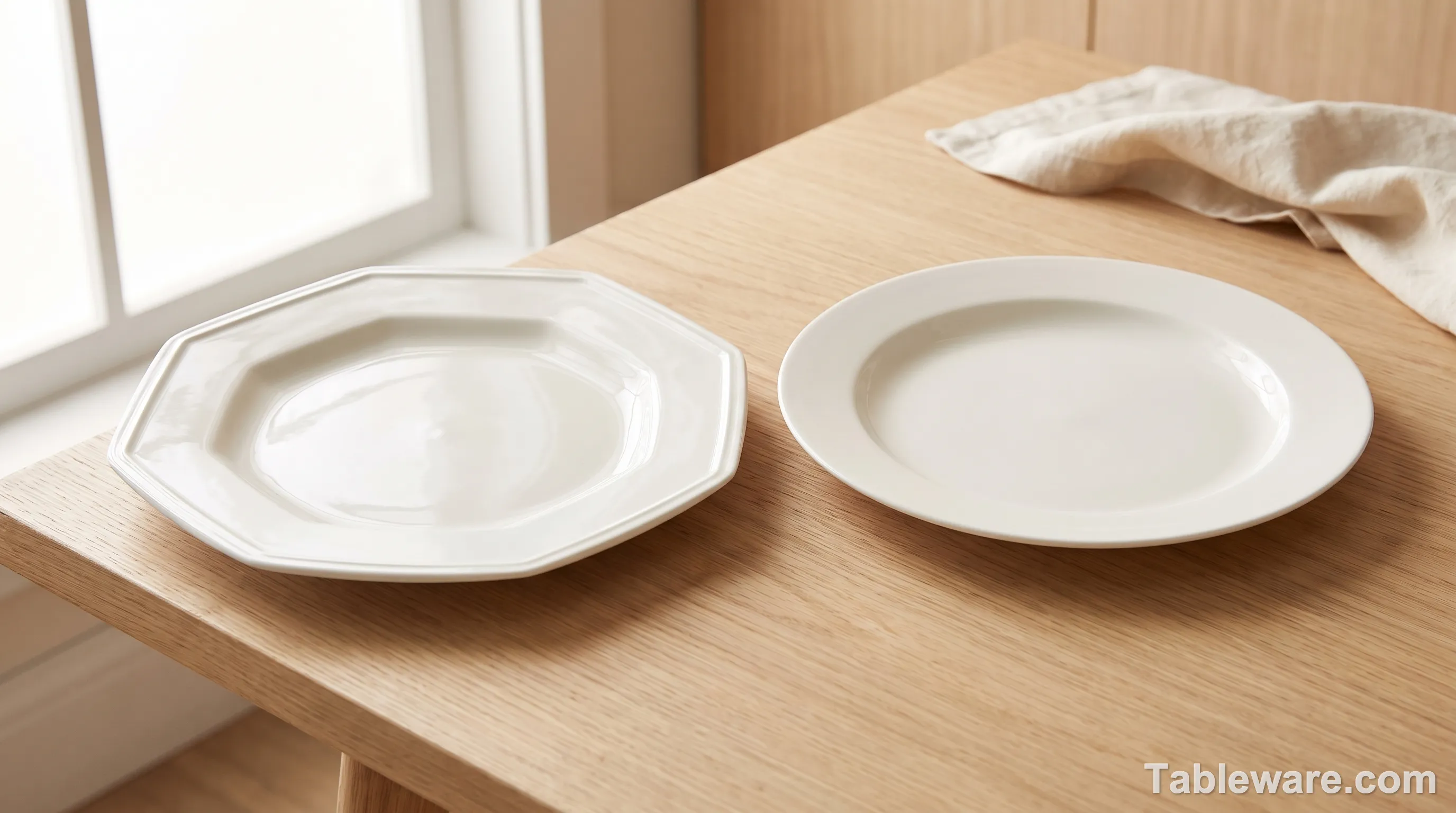
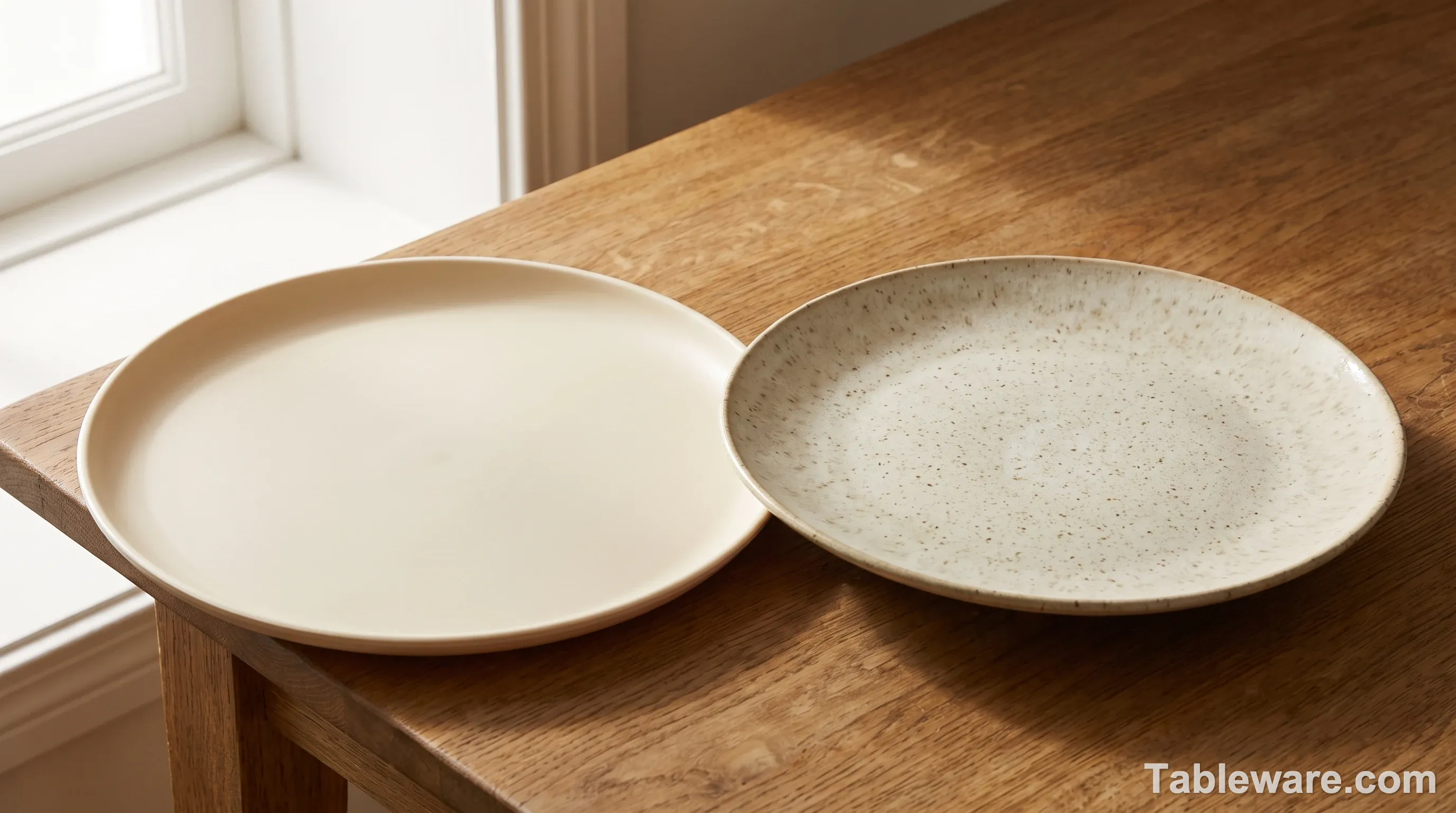
Fig 3. An octagonal plate (left) and a round plate (right), both 10 inches, both in white porcelain. The octagonal plate has roughly 25% more usable rim area; the round plate nests in a stack. Different tools, different jobs.
3 Rules for Mixing Octagonal and Round Plates at Home
This is the question I get asked most. "I have a beautiful set of white round plates. I love the look of those octagonal plates at Heath. Can I mix them?" The answer is yes, with three rules. None of them are about color. They are about geometry, weight, and rhythm.
Rule 1: Match the material, not the color. If your round plates are matte stoneware, your octagonal pieces should be matte stoneware. If your round plates are glossy porcelain, your octagonal pieces should be glossy porcelain. The reason: the eye reads finish before it reads shape. A glossy porcelain octagonal plate on a matte stoneware round base looks like an accident. A matte stoneware octagonal plate on a matte stoneware round base looks like a collection. The shape difference becomes the design feature, not the mismatch.
Rule 2: Keep the round plate as the base layer. When you stack an octagonal plate and a round plate, the round plate should be on the bottom. The octagonal plate sits in the well of the round plate, the corners extending just past the rim. This works because the octagonal plate's corners are visible and read as architectural detail. If you flip it — round on top of octagonal — the round plate floats in the middle of the octagonal plate's negative space and looks confused. The exception: if your round plate is much smaller than the octagonal plate (a 6-inch round on a 10-inch octagonal), the round plate on top works as a deliberate bowl-stand.
Rule 3: One octagonal per place setting. Not three. One. The octagonal plate is the statement. The round plates are the supporting cast. If you put an octagonal dinner plate, an octagonal salad plate, and an octagonal bowl in front of each guest, the table reads as a showroom, not a meal. If you put an octagonal dinner plate with a round salad plate and a round bowl, the table reads as a chef's table. Same materials, same color family, but the shape variation is a single note, not a chord.
The reason these three rules work is that they respect the geometry. A round plate says "I am a circle, I am a frame, I am for the food." An octagonal plate says "I am a shape, I am a composition, I am for the eye." The mistake most people make is treating them as interchangeable. They are not. They are partners, and like any partnership, they need clear roles.
I tested this last month with a 4-person dinner. White round plates (Heath dinner plates), white octagonal plates (a set of 4 I bought from a Brooklyn potter, $18 each), and the same white linen napkins. Octagonal on the bottom, round on top. Each guest had one octagonal and one round. The total cost was $72 for the four new octagonal pieces. The visual effect was: every single guest asked about the plates before the food came out. They didn't ask "why octagonal." They asked "where did you get these." That is exactly the response you want.
Who Actually Makes Good Octagonal Dinnerware Right Now
Let me name names. These are the brands and studios doing real octagonal dinnerware work in 2025-2026, with a short note on each. The handmade octagonal ceramic plate studio pottery market is small but real — about 4,000-5,000 Etsy listings in 2026, plus the seven brands below.
Heath Ceramics (Sausalito, California, founded 1948). Has a small but consistent octagonal line, mostly in their satin-matte glazes. The pieces are heavier than most — they use a thick stoneware body. Expect to pay $48-65 per plate. The octagonal pieces are typically a 10-inch dinner, a 7-inch salad, and a small 5-inch bread plate. They go on and off the catalog. Ask in the showroom. For a deeper comparison of Heath Ceramics vs East Fork (and other studio brands), I wrote a long piece on that.
East Fork (Asheville, North Carolina, founded 2010). Mostly round, but they have a small octagonal "tasting plate" line in their seasonal glaze drops. $42 per plate, 9 inches across. The Morel and Eggshell glazes are particularly good on the octagonal form. Subscribe to the email list — they sell out in 4-6 hours.
Jono Pandolfi (Hoboken, New Jersey, founded 2006). Supplies many of the New York tasting-menu restaurants. The octagonal work is mostly custom, but the studio will do small open-stock runs. Expect to pay $55-75 per plate, and expect a 6-10 week lead time. If you are buying a tasting plate for home, this is the studio.
Amphitria (Lyon, France). The brand keeps coming up when I search octagonal dinnerware. They do a French-made octagonal line in white, mustard yellow, terracotta, sky blue, and almond green. The pieces are dishwasher safe and designed to mix and match across the color set. Expect to pay about $32-48 per plate shipped to the US.
Crow Canyon Home (Marina, California). The more affordable American option. They do an enamelware octagonal plate that is genuinely good for everyday use. Not porcelain, not stoneware, but heavy-gauge enameled steel. The plate weighs almost nothing, stacks well, and the octagonal corners do not chip the way a ceramic corner does. Expect to pay $14-22 per plate. The look is more "country farmhouse" than "tasting menu." Use it for outdoor dinners, kids, and the Wednesday-night pasta.
Solecasa (China, OEM). For the restaurant buyer. They do custom octagonal porcelain with deep recessed centers, MOQ around 100-200 pieces, in any color or decoration. Not a home brand, but if you are opening a restaurant and you want octagonal plates, this is one of the OEM lines that produces for the major US distributors. Plates run $6-12 each at the OEM level, $18-35 retail.
The studio option. Etsy, in 2026, has roughly 4,000-5,000 listings for handmade octagonal dinnerware. Most are from small studios, mostly stoneware, mostly in the $25-60 per plate range. The quality ranges from genuinely beautiful to genuinely bad. Buy from a studio that posts glaze recipes, posts firing schedules, and posts their seconds rate. The best of these studios — and I have bought from at least 12 of them over the last two years — can match or beat the look of the big names for half the price. The bad ones will give you an underfired body that chips if you look at it sideways. If you're going to buy handmade pottery online, my 7 things to know before you buy handmade pottery online guide is the one I wish I had before I started.
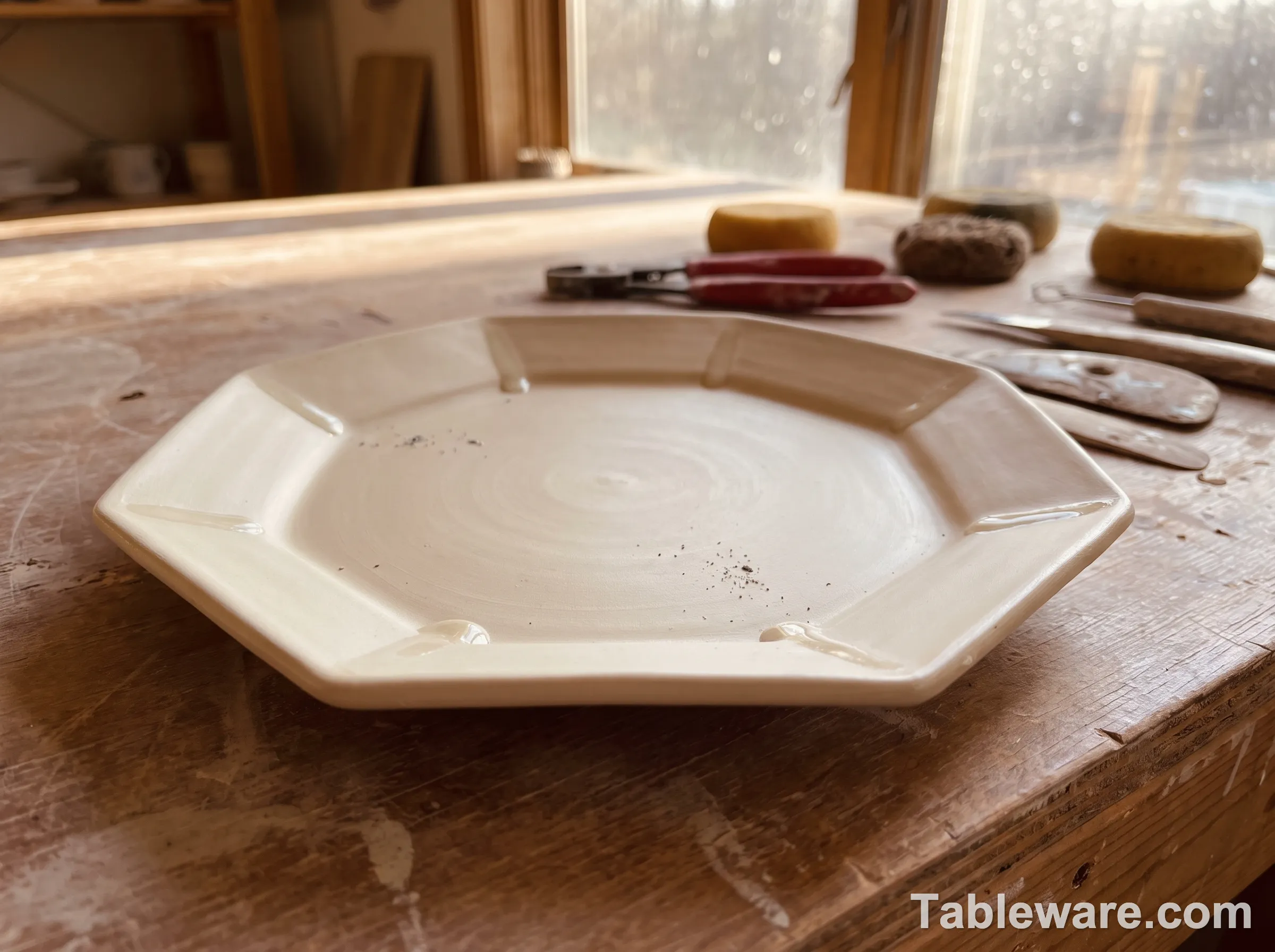
Fig 4. A handmade octagonal plate fresh from a Brooklyn studio's kiln, in a soft cream satin glaze. Studio pieces are the most expensive way to buy octagonal dinnerware, but the only way to get a glaze that no one else has.
The Buying Checklist (So You Don't Buy a Fake)
A few things to check before you spend the money.
Weight. Pick the plate up. A good octagonal dinner plate, 10 inches across, should weigh between 380 grams (thin porcelain) and 720 grams (thick stoneware). Anything under 300 grams is underfired and will not last. Anything over 800 grams is a restaurant piece and will fatigue your wrist.
The corners. Run your thumb along each of the eight corners. They should be smooth. A sharp corner on a glazed plate is a future chip waiting to happen. A properly finished octagonal plate has the corner edge either rounded (the studio potter's way) or chamfered (the factory's way). If the corner feels like a 90-degree angle, the piece is either underfired or rushed.
The glaze. Look at the corners under a strong light. The glaze should be even thickness all the way around. A heavy drip at the corner is a sign of a poorly formulated or poorly applied glaze. It is not a charm mark. It is a quality failure.
The foot ring. Turn the plate over. The unglazed foot ring (the part that sits on the table) should be smooth, ground, and free of any rough spots. A rough foot ring will scratch every surface you set the plate on. A properly ground foot ring is one of the tells of a serious maker.
The stack. If you are buying more than one, stack them in person. The corners of the top plate should sit just inside the corners of the bottom plate. If the top plate's corners sit on the bottom plate's corners, you have a stacking problem. This is the single most common issue with mass-produced octagonal plates and it is the reason restaurant supply houses reject roughly 30% of OEM octagonal shipments.
The price floor. In 2026, a real, food-safe, dishwasher-safe, microwave-safe octagonal dinner plate from any of the brands I named above is going to cost you between $14 (Crow Canyon enamelware) and $75 (Jono Pandolfi studio). If you see an octagonal dinner plate on Amazon for under $8, it is either plastic, it is underfired, or both. The Chinese export trade of the 18th century figured out the price floor for this geometry. We have not improved on it.
That's the whole story. The eight-sided plate is 500 years old, it has been in and out of fashion four times, and right now it is in. The chefs figured out why. The geometry is a better frame for composed food. The home market is catching up. If you have the cabinet space and you can handle the chip risk, buy four — one for each place setting — and use the rule above. If you have a small kitchen, three kids, and a Wednesday-night pasta habit, keep your round plates. The round plate is the better tool for most meals. The octagonal plate is the better tool for the meal you want to remember. And octagonal dinnerware, in 2026, is the easiest way to make a Tuesday-night chicken look like a chef's tasting menu. If you want a search anchor for this whole piece: the octagonal plate dinnerware trend 2026 is the one chefs started and the home market is finishing.