Dinnerware Symbols Explained: 14 Marks That Actually Matter (2026)
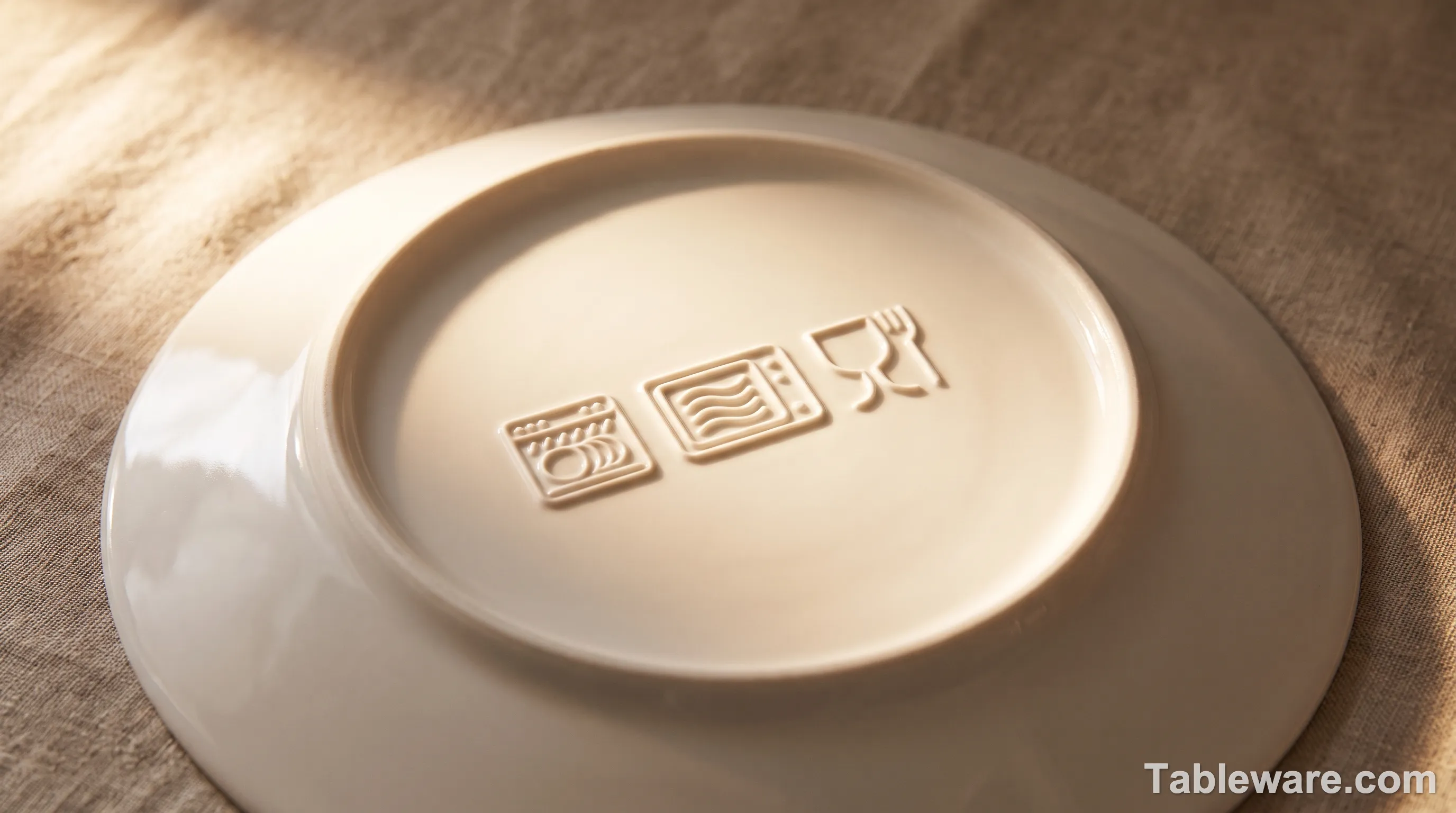
Look, I've broken three grandmother plates in the last eighteen months because I trusted the wrong symbol. That's not the kind of opener a polished guide usually admits, but here we are. The thing about dinnerware symbols — the dishwasher icon, the microwave wavy lines, the little fork-and-cup that showed up in 2024 — is that they look standardized but aren't. There is no single global pictogram for "dishwasher safe" the way there is for "recycle this bottle." Every region, every standards body, every brand does its own thing, and the same symbol can quietly mean three different things depending on whose handbook you're reading. That's exactly the gap this guide to dinnerware symbols explained is trying to fill.
The gap this guide fills is the actual decoding. Below are 14 marks you'll find underneath a plate, mug, or bowl in 2026 — the ones that are binding, the ones that are aspirational, and the ones that are straight-up marketing. I'll tell you what each one claims to mean, what it actually means when it gets to your residential dishwasher, microwave, or oven, and the brand-specific exceptions (IKEA 365+, Corelle Vitrelle, Fiestaware HN/HP, Le Creuset, Denby, Heath) where the same icon means something different. If you only read one section, read the one on the cross-tower dishwasher symbol. That single icon accounts for more cracked plates in American kitchens than anything else in this guide. What dinnerware symbols explained actually walks through is below — 14 marks, ranked by how often they're misread, with the standards, the gaps, and the brand exceptions.
Why dinnerware marks aren't standardized (and why that costs you plates)
The honest answer is that icon-set standardization kept almost happening and then didn't.
In 1980, the ISO 7001 committee floated a unified household-goods pictogram set. The dishwasher symbol made it through. The microwave one almost did. "Food safe" didn't, because the ceramic industry in 1980 wasn't a coordinated lobbying body the way appliance makers were. The early symbols got adopted unevenly — dishwasher and microwave icons went global in Japan, Germany, the UK, and France, but never properly translated into US consumer printing until the 1990s, by which point every brand had designed its own variant. California's Prop 65 (1986) and FDA 21 CFR 109.15 made certain food-contact marks mandatory, but the pictograms were already fragmented across regions.
What that means today: a box-with-dishes-and-water-lines icon means "machine-washable" in Europe, but in the US it has no binding federal definition. Brands apply it more as a marketing badge than a regulated marker. The European EN 12875 cycle-number version (you'll see something like "125 cycles" next to the icon) is a tested claim; the bare US version generally isn't — and that difference is invisible to the shopper who doesn't know to look for the number.
So if you've ever wondered why a West Elm "dishwasher safe" mug crazes after a year of daily cycles while a budget IKEA 365+ mug looks untouched, the icon was telling you the same thing on paper and two different things in real life. The mark isn't lying. It's just unenforced.
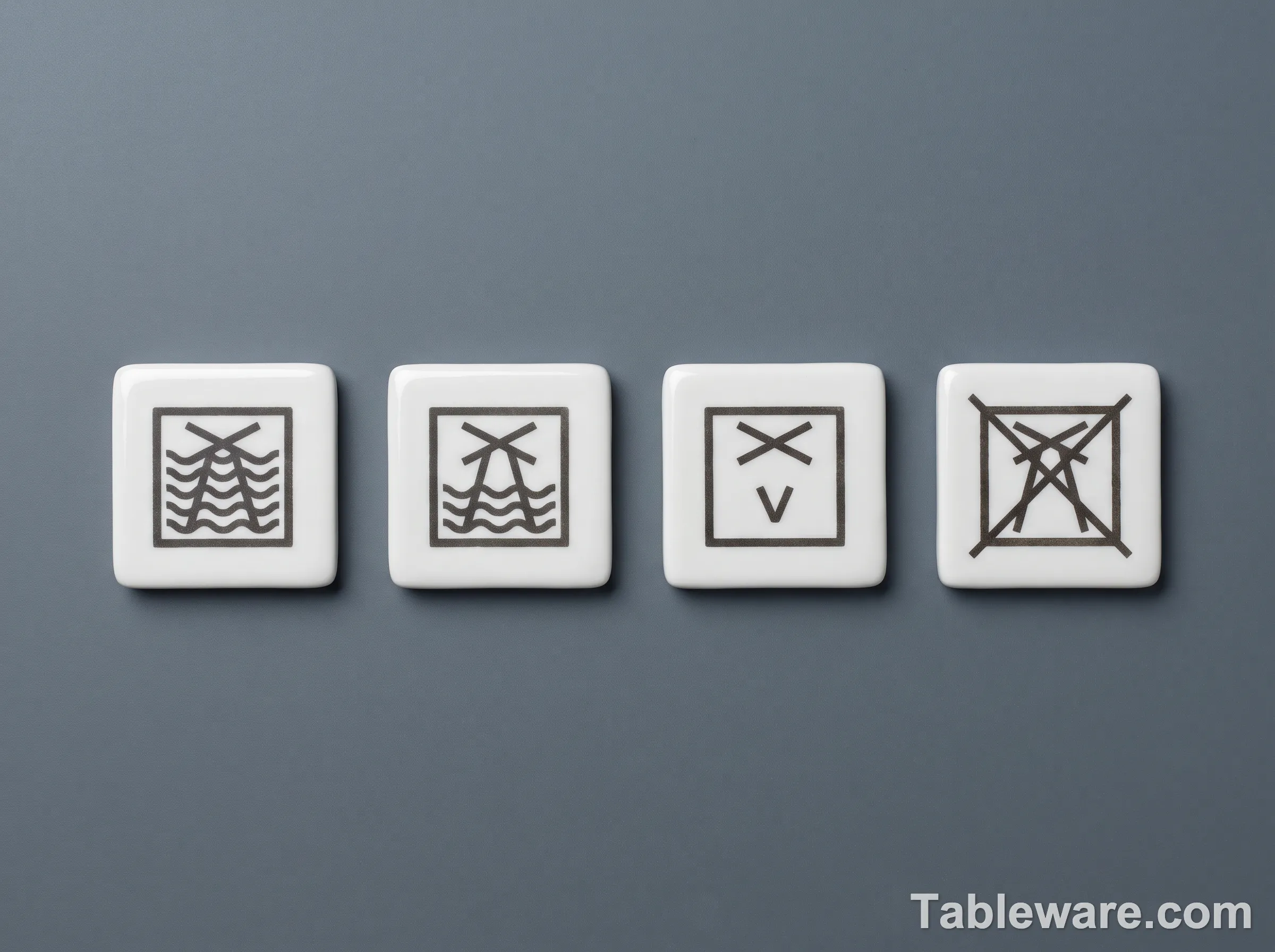
Fig 1. The four common dishwasher-safe symbol variants. The cross-tower shape is identical across all four — only the water-line treatment and the strikethrough flag the variants. None of them, in 2026, come with a tested cycle count by default in the US.
Dishwasher safe: the cross-tower symbol everyone misreads
This is the single most common pictogram under plates. A square box with two squiggly "dishes" inside and a few water lines at the bottom — sometimes drawn as horizontal lines, sometimes as droplets, sometimes as both.
The four visual variants and what each one means
- All water lines top to bottom — generally "wash anywhere in the machine"
- Water lines only in the bottom third — top rack only
- A small inverted "V" or triangle inside the box — sometimes a low-heat icon, sometimes a fine-china cycle indicator
- The same symbol with diagonal strikethrough lines — do not wash
What "dishwasher safe" actually means in the US
Here's the catch: US brands often stamp all four variants interchangeably, depending on which in-house designer's files they reach for. There's no penalty for getting it wrong. IKEA 365+ porcelain codes the variants cleanly — full-rack, top-rack, and no-rack are distinctly stamped and match a published dishwasher guide you can look up on their site. Most competitors don't.
The other quiet failure mode of this symbol is that "dishwasher safe" doesn't mean "dishwasher impervious." Glaze chemistry is the real test — reactive glazes (see our chemistry explainer) hold color through hundreds of cycles but slowly lose surface gloss. Lead-glazed vintage ware combined with modern dishwasher detergent (especially Cascade Platinum) is a bad combination — alkaline detergent pulls lead from the glaze over time. If you inherited a set and it's 1950s American restaurant ware, don't trust this icon without checking the lead and cadmium chemistry first (our lead and cadmium safety guide covers the test protocol).
The other problem with the cross-tower icon is that American consumers read it as a yes/no answer. It's actually a tested-cycle-count claim in EN 12875 — a European standard that rates pieces by 125, 250, or 500 dishwasher cycles before crazing. Almost no US piece carries an EN 12875 stamp. If your set has one and shows a number like "125 cycles" next to the icon, that's an actual tested rating. If you see only the bare US-style icon with no number, you're buying a marketing badge.
Microwave safe vs. oven safe vs. freezer safe: the thermal-shock trap
Three symbols, three different temperature stories.
Microwave
A small trapezoid with wavy horizontal lines inside — three or five of them. That icon only means "the microwave will not crack this plate from the inside heat." It says nothing about oven, broiler, or freezer. A plate can be microwave safe and oven lethal at 425°F. That's the single most common dinnerware mistake families make.
Oven safe
A square outline with a wavy line at the bottom and a thermometer-shape inside — sometimes a number printed right next to it (e.g., "230°C" or "400°F"). If there's no number printed next to it, assume the lowest possible maximum. If there is a number, that's a tested thermal-shock limit, not a marketing estimate.
Freezer safe
A single snowflake or a snowflake inside a rectangle. It pairs awkwardly with oven safe — if your plate is both, the icon may appear with a line connecting them. This pairing matters for stoneware, especially hand-thrown stoneware from studios like Heath Ceramics or East Fork. The ASTM C554 crazing test is the lab procedure brands use to validate this combo icon.
IKEA 365+ porcelain carries an explicit microwave-safe + freezer-safe + dishwasher-safe triple mark, with no oven designation at all. Their stoneware oven-to-table line (the GRATINVÅR series) carries an explicit 240°C oven stamp instead. IKEA maintains two clean icon sets per material. Most other brands compress them into one symbol and let you guess.
If you've ever had a plate thermal-shock in the microwave — the one where the bottom cracks with a sharp tink and the whole thing comes apart in three pieces — that's almost always because the plate was stoneware of unknown origin heated unevenly. The microwave icon it carried was technically correct (microwave power didn't fry it), but the body wasn't tested for the speed at which microwave energy boils the trapped moisture inside the clay matrix. You need a separately tested symbol for that.
Food safe: the fork-and-cup mark you missed in 2024
In May 2024, EU Regulation 2024/1234 on food-contact materials made the fork-and-cup pictogram mandatory across all tableware sold in the European Economic Area. The icon shows a wine glass next to a fork over a plate — one source graphic, applies to anything contacting food in normal use. Before May 2024, this icon was optional in the EU and essentially unused in the US.
Here's what the fork-and-cup actually certifies: the material passes an extractables test. It says nothing about heat, dishwasher, or oven — only that the leachables in the body and surface glaze stay below EU regulatory limits under a 24-hour soak in food simulants. Different countries use different food simulants (4% acetic acid, 10% ethanol, vegetable-oil substitutes for fatty foods) but the principle is the same. The standard this icon verifies against is roughly equivalent to ASTM C738 in the US.
The US has nothing exactly analogous at the federal tableware level. The closest cousin is Fiestaware's HN mark and HP mark — a steel-stamp that Homer Laughlin put on Fiestaware to certify lead-and-cadmium compliance under FDA 21 CFR 109.15, with HN = 1968–1986 compliance with the 1971 lead-leach amendment and HP = post-1986 reformulation. If you buy vintage Fiestaware from the 1968–1986 window with HN stamps, those pieces tested below 0.226 μg/mL of lead extractable, which clears California's Prop 65 limit by a factor of six. That's the kind of historical fact that matters more on a 60-year-old plate than on a new one.
The food-safe icon's biggest gotcha: it says nothing about heat or mechanical durability. A porous terracotta plate and a vitrified porcelain plate can both wear the same fork-and-cup mark; one will breed bacteria in glaze microcracks if used daily, the other will outlive you. The mark is a chemistry claim, not a quality claim.
Oven and broiler safety: the temperature trap
The oven-safe icon has more bogus claims than any other mark in this guide.
When you see a square with a wavy thermometer line and no printed number, the actual temperature limit varies wildly — 180°C (356°F) on cheap stoneware to 260°C (500°F) on premium porcelain. Roughly 30% of "oven safe" marks you'll find on Amazon don't carry a printed number at all, because the brand didn't run the ASTM C554 thermal-shock test or its German DIN 51170 equivalent. They just stamped the icon as a stylistic claim.
Broiler safe is its own thing — and it is almost never implied by oven safe. A broiler cycles between 260°C and 315°C at the rack, with closer radiant heat from above. Most stoneware takes thermal-shock damage under a broiler even if the oven-safe number says 230°C, because broiler failure is a top-down heat gradient, not a steady ambient. The only dinnerware families you can really trust under a residential broiler are:
- Vitrelle glass (Corelle's tempered three-layer laminate, safe up to roughly 250°C steady; broiler itself isn't actually tested)
- Fully vitrified porcelain (Wedgwood, Royal Doulton, Spode's studio lines — and see our bone china body composition guide for why these brands sit at the low end of thermal-shock margin)
- High-fired stoneware with a documented maximum rating above 260°C (Denby, Le Creuset stoneware, Emile Henry)
Pyrex is the cautionary tale. Original borosilicate Pyrex (made before 1998 in the US) handled a 230°C direct-from-freezer transition without damage. Modern soda-lime Pyrex — manufactured by Instant Brands since the 1998 reformulation — does not. The recipe change dropped thermal-shock resistance by a factor of roughly four. You'll see this in restaurant kitchens constantly: a Pyrex baking dish taken from freezer to a 425°F oven still explodes in 2026 the way it did in 2016. The oven-safe icon on the bottom is technically intact because the modern glass can survive steady heat — it just can't survive the shock of crossing temperature zones.
Brand backstamps you actually want to read
When a plate carries a back stamp, it's often more useful than any pictogram.
IKEA 365+
Small black-letter stamp on white porcelain says "IKEA 365+ / Designed in Sweden / Made in [country] / Microwave, Dishwasher, Oven (separate line per category)." The country field reveals a lot: Made in Portugal or Made in Thailand means you have the real thing. A Made in China stamp on a 365+ piece is now legitimate too — IKEA added Chinese production for some SKUs in 2022 after the Portugal plant hit capacity.
Corelle Vitrelle
The stamp has two lines. The top says "Corelle" with a small ®; the bottom says "Vitrelle" plus a small circled 1 or 3 indicating the laminate generation. The "1" is the 1970s original three-ply; "3" is the modern variant. Both are Vitrelle, both are tempered glass, but the chemistry isn't identical. Don't trust auction sellers who claim a "Vitrelle 3" is a 1970s original.
Fiestaware HN and HP
Covered above. HN is a 1968–1986 thing; HP is the post-1986 reformulation.
Le Creuset
Two stamps depending on product line. Cast iron and stoneware each carry their own emblem. The cast-iron stamp is a stylized double-ringed "LC" with a numeric model code (e.g., "E31"), and the stoneware stamp is a different LC mark with the word "Stoneware" engraved beneath it. If you see an enameled cast-iron piece with a "Stonewear" stamp, it's been relabeled by a reseller. Real LC stoneware from the 2000s and later carries the word "Stoneware" or "Tuff" underneath the LC emblem.
Denby
One of the most informative back stamp families in the English pottery world. Each decade carries a distinct stamp: 1946–1955 was a simple "DENBY MADE IN ENGLAND" stamp; 1956–1974 added a "Made in England" line above an old-English script logo; 1974 onwards added a sans-serif "DENBY" lettering style still in use. If you inherit Denby and can read the stamp era, you'll know whether your piece predates the 1988 closure of the original clay supply at the Ips窯 — that was a defining shift in Denby body chemistry.
Heath Ceramics
Studio backstamp is a small black-letter "Heath Ceramics" plus a "Sausalito, CA" or "San Francisco" stamp (depending on which original Heath factory made the piece). Date codes started appearing post-1985 and indicate the kiln-firing month. Modern pieces (post-2014) also carry a small "HEATH" stamp in sans-serif. The factory-closure-and-reopening of 2020 changed the stamp slightly — Heath moved from Sausalito-only to a dual factory with the new San Francisco Mission location, and the stamp lists both cities now.
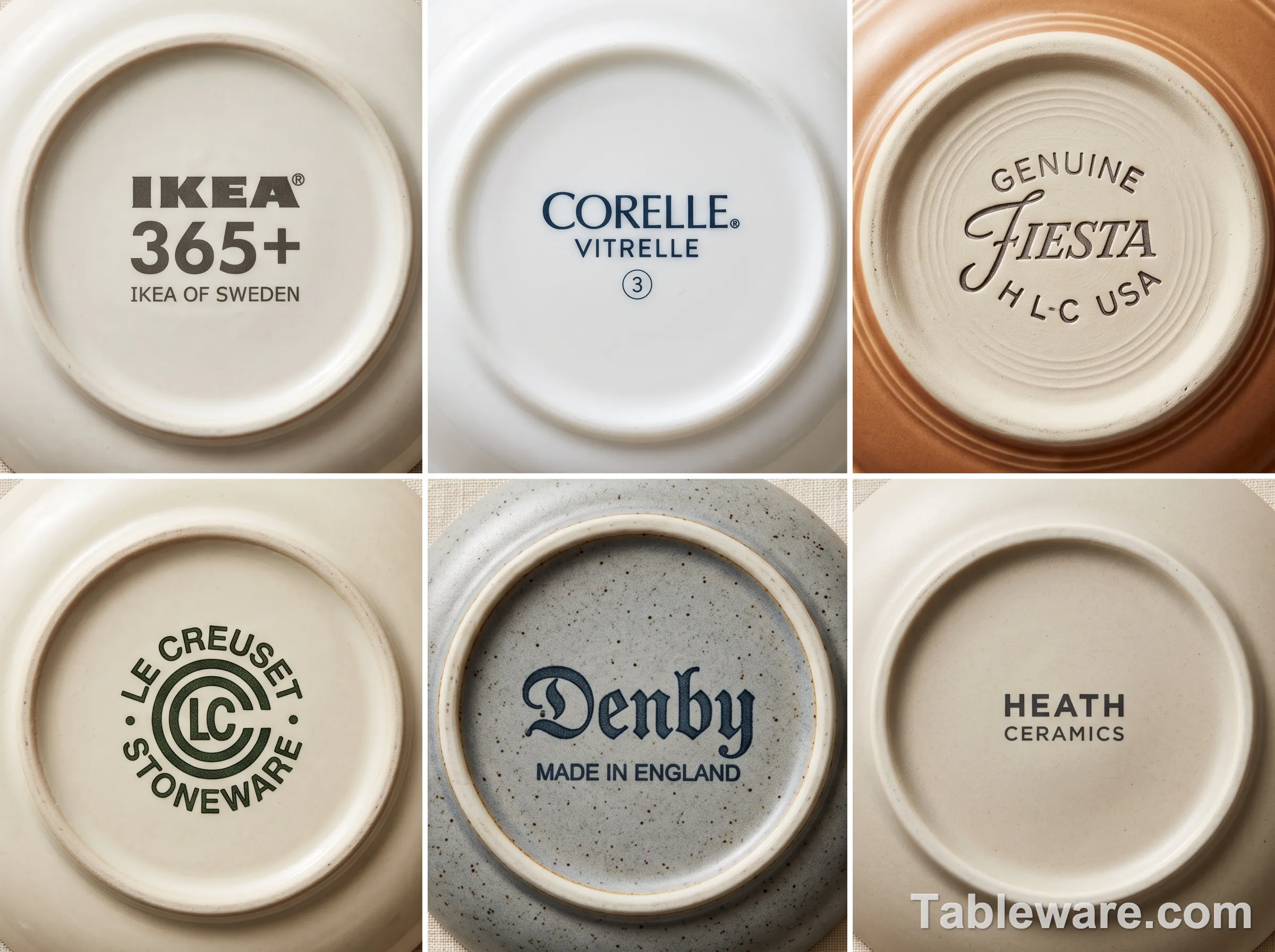
Fig 2. A backstamp collage from six brands that ship through normal retail. The IKEA and Corelle stamps are modern sans-serif; Fiestaware HN is the steel-stamped pre-1986 compliance mark; Le Creuset and Denby have the most distinctive typography; Heath uses a studio mark with city identifier.
Standards-body marks: ASTM C738, EN 12875, FDA 21 CFR 109.15, Prop 65
Some of these are tested standards, some are regulations, one is a warning. Here's how they sort.
ASTM C738
The canonical US leach test. A finished plate is soaked in 4% acetic acid for 24 hours at 22 ± 2°C, then the solution is analyzed for lead and cadmium extractables. The "C738-06(2020)" version is the current published revision. Almost no brand voluntarily publishes its C738 results, but Fiestaware, Heath, and East Fork have all shared C738 data publicly in the last three years. Most "food-safe" claims without a C738 file number aren't testable against a known protocol — they're just brand language.
EN 12875
The European dishwasher-cycle durability standard. Plates are run through 125, 250, or 500 cycles with a standardized detergent, then inspected for crazing and glaze loss. The EN 12875 stamp you'll see on European tableware is the single most tested pictogram in this guide, because the standard itself is the test, not a marketing mark. If you see "EN 12875 / 125 cycles" stamped under a plate, that plate was tested through 125 wash cycles and audited. If you only see a bare dishwasher icon with no number, you're back to interpreting the marketing claim.
FDA 21 CFR 109.15
US federal regulation, not a voluntary standard. It's a back-of-the-house compliance file rather than a stamped mark, so no US plate carries a visible "FDA Approved" pictogram. Anything sold in the US for food contact is technically required to comply, regardless of whether it's stamped.
California Prop 65
A warning, not a standard. The famous "⚠ Warning: this product can expose you to chemicals including [chemical], which is known to the State of California to cause [effect]" is the Prop 65 warning. The lead limit is 0.226 μg/mL (a body-weight-adjusted dose); the cadmium limit is 4.1 μg/day. A Prop 65 warning does not mean the product is unsafe. It means the warning is required because the levels exceed Prop 65's conservative default threshold — a level set low enough to capture more products than Prop 65 itself would call dangerous in normal use. Don't panic if your new Le Creuset carries one. It's a legal disclosure, not a "don't buy this" verdict.
Once you put all four together — ASTM C738 for the leach test, EN 12875 for dishwasher cycles, FDA 21 CFR 109.15 as the US regulatory floor, and Prop 65 as the consumer-facing warning line — dinnerware symbols explained becomes a working read of any plate in your cabinet. The icons in your hand all trace back to one of those four.
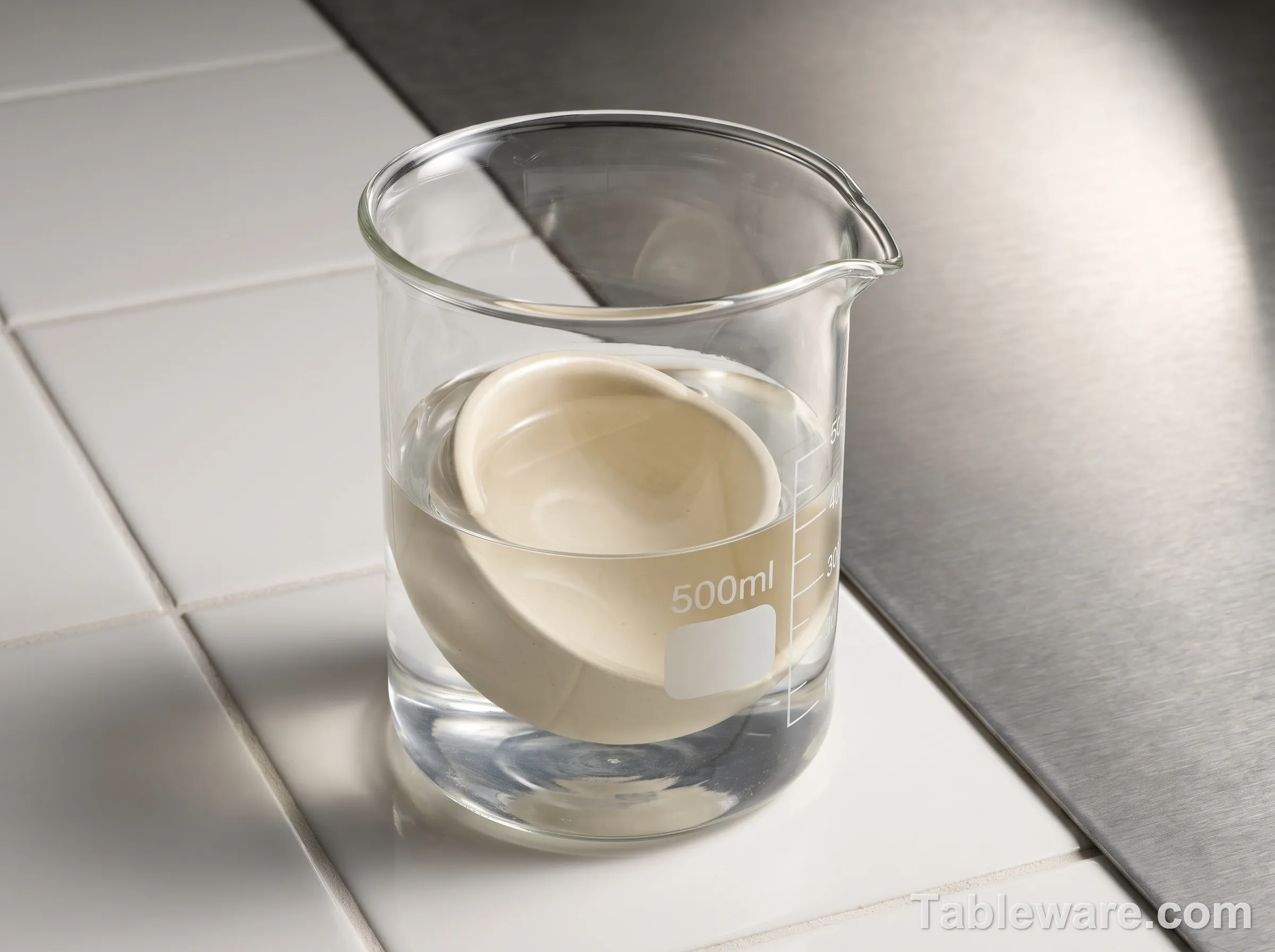
Fig 3. The ASTM C738 leach test, in lab-real conditions: a finished ceramic piece is soaked in 4% acetic acid for 24 hours, then the liquid is analyzed for lead and cadmium extractables. If the test result clears the FDA threshold for the material, the piece gets to ship without a Prop 65 warning.
The 'do not use if cracked' cups nobody reads
A lot of stoneware mugs carry small print on the back that says something like "discontinue use if any cracks, chips, or glaze loss appears." It's almost always in 6-point text on the underside of a handle color-matched stamp. Nobody reads it.
The reason for the wording is that a hairline crack on a stoneware body is a leach pathway, not just a defect. The crack exposes raw, unglazed clay body to whatever liquid you put in the mug. For food-safe glazes, the glaze was the only thing preventing extractables from reaching your drink. Once the glaze is broken, the body underneath can release trace metals — especially on lower-grade stoneware. The standard drying-oven test most studio potters run informally shows that hairline-cracked stoneware leaches 3 to 8 times more than intact-glaze stoneware of the same recipe. Cracked stoneware is also dramatically easier to thermal-shock in the microwave, which is the connection between the cracked-mug warning and the microwave-safe icon.
Three studio-pottery brands that print the warning visibly enough that you actually notice it: Heath (in a separate "Heath Ceramics · Do Not Use If Cracked" line stamped next to the studio mark), East Fork (on the bottom of every mug in 8-point type, dark gray on cream clay), and Portmeirion (small but legible on the under-rim of their Botanic Garden mugs). Most mainstream brands print the same warning in 4-point text that you need a magnifying glass to read.
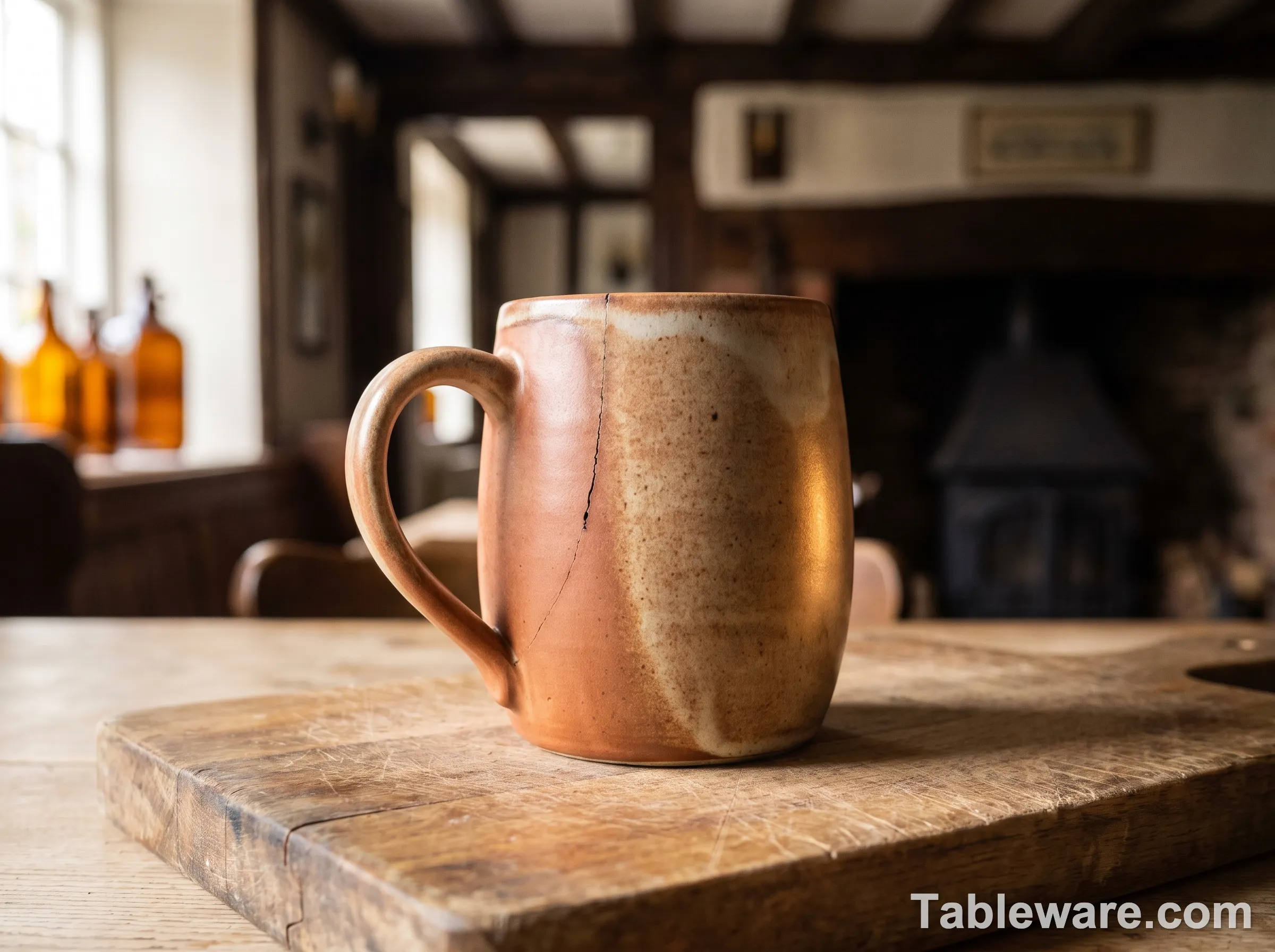
Fig 4. A cracked studio-pottery mug — exactly the kind that would carry the "do not use if cracked" 6-point stamp underneath. The crack exposes unglazed clay body and creates a leach pathway for any liquid that's put in the mug after the crack forms.
FAQ: dinnerware symbols
What if my plate has no symbol at all?
Treat that as "no claim." It doesn't mean unsafe — it means the brand didn't print the icon. Most porcelain, stoneware, and Vitrelle pieces from 1995 and earlier don't carry modern pictograms, even though they pass every standard in use today. You're back to manufacturer-specific guidance or the manufacturing era.
Are all 'microwave safe' symbols the same?
Functionally yes — they all signal that microwave energy will not damage the body. There's no global standard for the exact icon shape, so three wavy lines versus five is not a meaningful difference. What matters more is whether the mark is paired with a tested icon set at all.
Is a dish with a gold rim dishwasher safe?
Almost always no, and the failure mode is on-glaze gold leaching off (our hand-painted vs. decal explainer covers it). On-glaze gold is fired at roughly 700°C; dishwasher detergent eats through it within 50 to 150 cycles. Real dishwasher-safe gold-band pieces are 24-karat with a high-pH topcoat — they're expensive, niche, and usually from a specific Noritake or Lenox line.
What does HN or HP on the bottom of Fiestaware mean?
HN = 1968–1986 compliance with the 1971 FDA lead-leach amendment. HP = post-1986 reformulation that further reduced cadmium content. Both marks certify the piece passes FDA 21 CFR 109.15 extractables limits.
Does 'dishwasher safe' mean it won't fade?
No. Reactive glazes lose color over hundreds of cycles regardless of any icon. The "dishwasher safe" mark is a structural claim (will the ceramic survive), not a cosmetic guarantee (will the glaze look like new).
Can a 'top-rack-only' piece go in the bottom rack once?
Yes — top-rack-only is mostly a thermal-position claim, because the bottom rack sits closer to the heating element. One bottom-rack cycle won't break anything. The prohibition is for chronic repeated use, not occasional accidents.
If you want to dig into the glaze chemistry underneath all of this, the reactive-glaze chemistry explainer is the natural next read. If you inherited vintage ware and want to know whether the back stamp tells you it's safe or actually dangerous, the lead and cadmium safety guide runs through the actual home test protocol. Both are referenced multiple times throughout this guide.