My grandmother had a china cabinet. White bone china, gold trim, cabbage roses climbing around the rim, a fluted edge. There were twelve plates, twelve bread plates, twelve cups, twelve saucers, plus a gravy boat, a sugar bowl, and a serving platter that almost never came out. I assumed it was hand-painted. She called it hand-painted. The stamp on the bottom said hand-painted. I have spent thirty years assuming it was hand-painted.
It was not hand-painted. Not one stroke. It was a decal, made almost certainly in Staffordshire or Bavaria between 1920 and 1950, applied to a glazed blank by a teenage girl standing at a line, and fired onto the surface in a low-temperature decorating kiln. The "hand-painted" stamp on the bottom referred to the manufacturing process of the porcelain body itself, not the decoration. By the time that cabinet was being filled, hand-painting on commercial dinnerware was already an exception, not a rule. It had been a century since the technology to replace it was perfected.
If you want the full history of the porcelain body itself — the bone ash, the firing temperature, why it rings — we covered that in our bone china guide. The short version for this article: the body was almost certainly bone china, and the body is the part that was hand-made. The decoration is the part that was not.
This article is the one I wish I had read before I took the cabinet for granted. I will walk you through what a ceramic decal actually is, how the 200-year history of ceramic printing quietly put every brush-painter in the world out of a job, the four field tests you can run on a plate in your hand in under a minute, why the words "hand-painted" on a back stamp mean almost nothing, and the strange recent turn where a generation of studio potters has decided that the decal — the thing that killed the brush — is one of the most interesting tools in ceramics again.
By the end you will look at your own cabinet differently. I know I do.
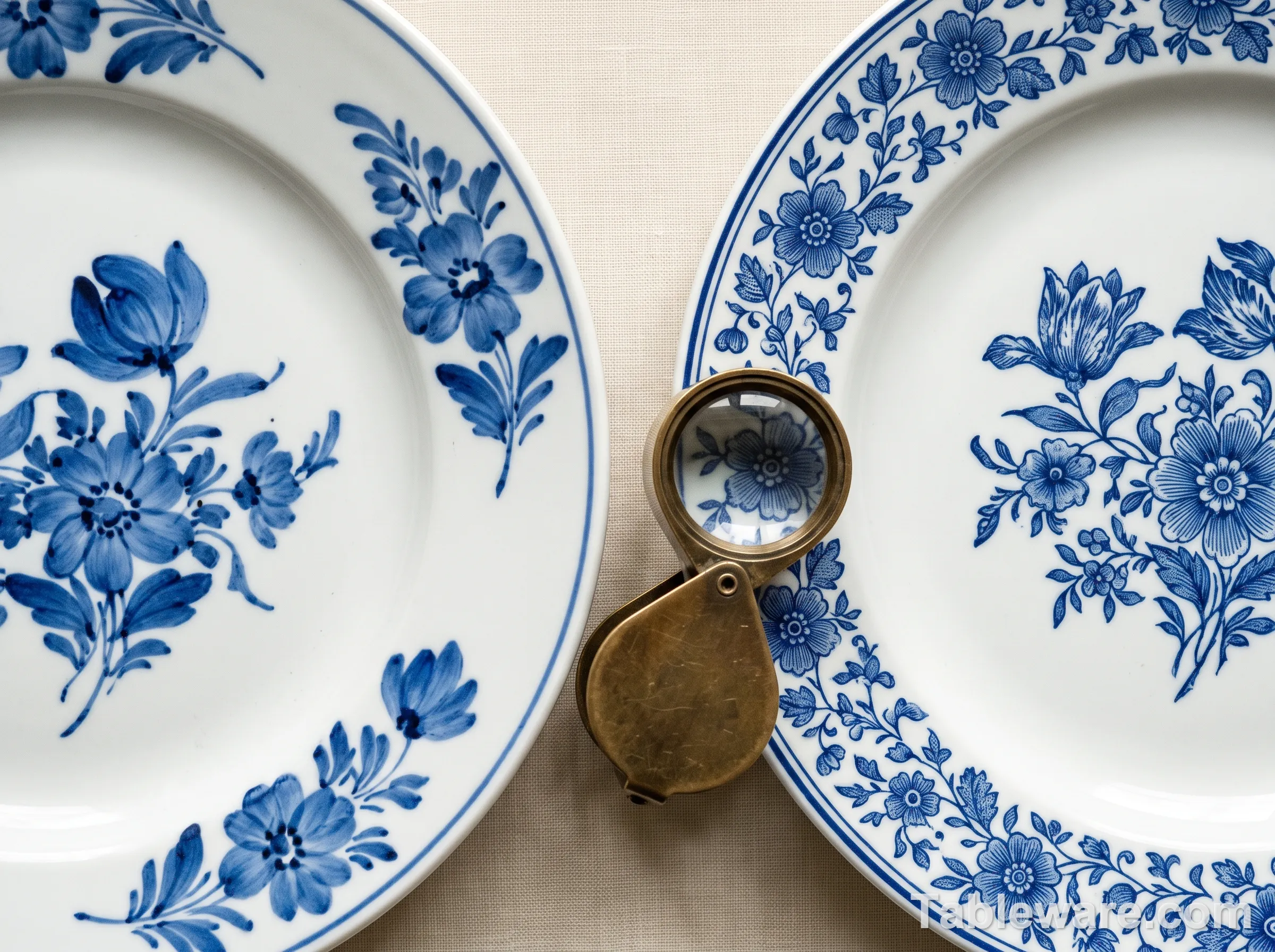
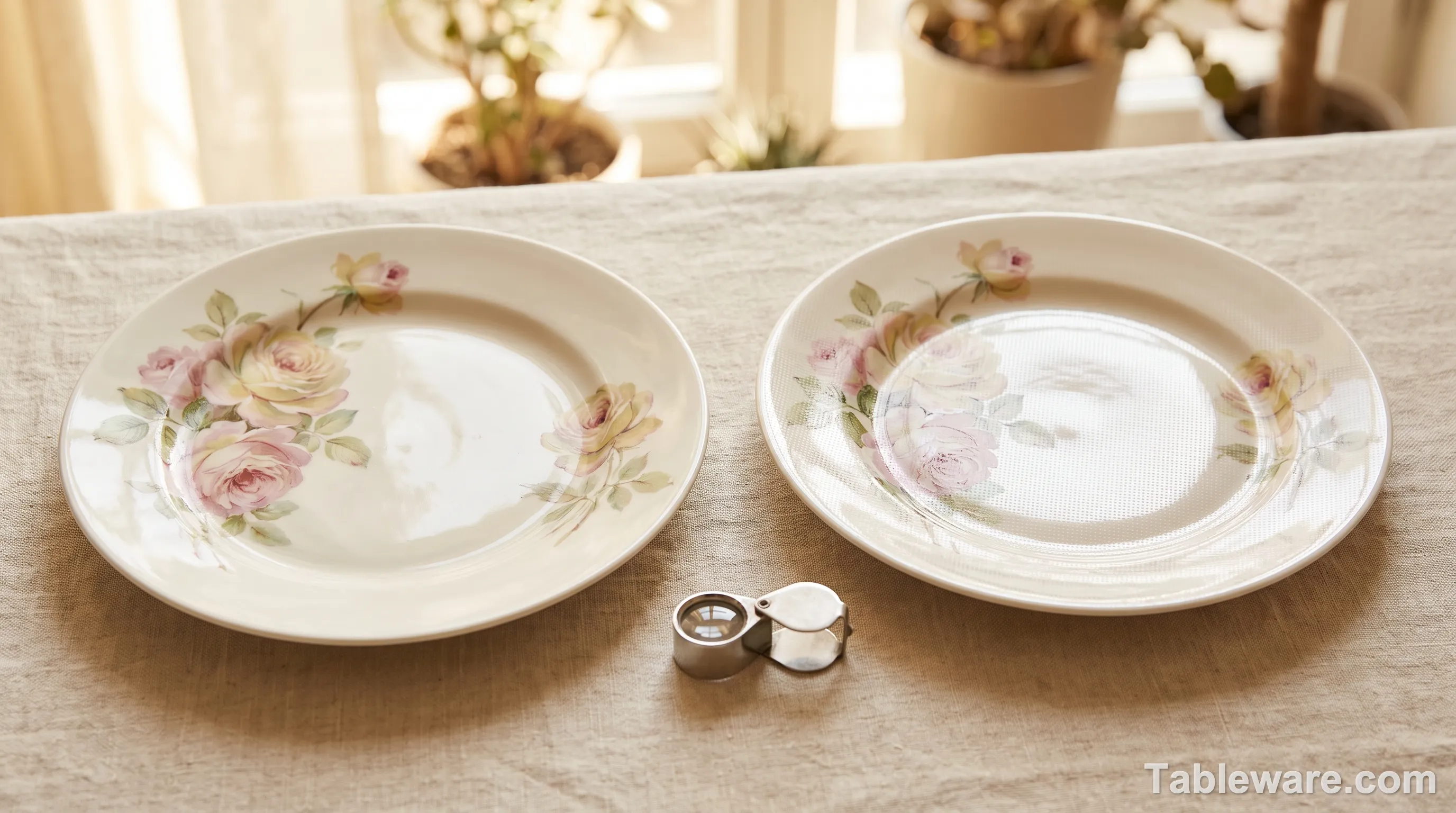
Fig 1. Two plates that look almost identical from across a dinner table. One is hand-painted, the other is a decal. The difference is invisible from three feet away and obvious under a $10 loupe.
What a Decal Actually Is (And What It Isn't)
A ceramic decal is a printed image that has been transferred to a glazed surface and then fired into it. The printing is usually lithographic or screen-printed. The transfer medium is a special paper, sometimes called thermoflat or covercoat paper, that releases the printed image in a warm water bath. The image is laid on the glazed plate, pressed down with a soft rubber kidney, dried, and then fired at a temperature below the glaze's softening point. The result is a printed pattern fused to the surface of the ceramic.
That last sentence is doing a lot of work, so let me slow it down. A decal is not a sticker. A sticker sits on top of the surface. A decal is chemically and physically bonded to the glaze — the ceramic particles in the ink fuse with the surface during the firing. You cannot peel a decal off a fired plate the way you peel a sticker off a coffee mug. It is part of the surface.
There are three flavors of decal, and the differences matter for how durable the finished piece is:
- Overglaze (on-glaze) decal. The design is applied on top of the already-fired glaze and fired again at 700 to 900 degrees Celsius, the modern workhorse for decorated tableware. Cheap to do, allows bright colors and metallic effects, but the design sits on top of the glaze like a printed skin. Dishwashers, knives, and years of stacking wear it away. This is what your grandmother's china almost certainly has.
- In-glaze decal. The design is printed on the unfired glaze layer and then fired at 1,100 to 1,300 degrees Celsius, a higher temperature that softens the glaze. As the glaze melts, the printed pigments sink into it. The design becomes physically inside the glaze layer, not on top of it. This is the modern restaurant-grade method. Dishwasher-safe, microwave-safe, scratch-resistant, and getting close to the durability of underglaze hand-painting.
- Underglaze decal. The design is printed directly on the clay body before glazing, then covered with a clear glaze and fired at the body's full maturing temperature (1,200 to 1,400 degrees Celsius). The pigments are sealed under the glaze. This is the most durable of the three, but it has a limited color palette because the pigments have to survive very high heat. Cobalt blue and iron red are about all you can get. This is the classic Chinese blue-and-white method, sometimes automated, sometimes still hand-painted.
The three terms get used loosely online — vendors selling "in-glaze" sets that are really overglaze, vendors calling everything "underglaze" because it sounds more authentic. The most reliable thing you can do is ask what the firing temperature was. If the answer is "we don't know," assume overglaze.
The 200-Year History: From Engraved Copper Plates to a 30-Second Waterslide
The decal is not a modern invention. The reason the story is worth knowing is that the technology was already two hundred years old by the time your grandmother's china was being decorated, and almost nobody outside the industry knows any of it.
The earliest work on transferring printed images to ceramics started in 1818, and the first English patents on the process were filed in 1835 and 1836. The first French patent followed in 1837. These early decals were monochrome and finicky. The pattern was printed on a thin tissue paper from an engraved copper plate, the paper was pressed onto the glazed surface, the paper was moistened and rubbed away, and the printed image was left behind. It worked about half the time. The pattern cracked, the paper tore, the registration slipped, the colors came off in the kiln. It was still cheaper than hand-painting, and as labor got more expensive the industry kept investing in it.
The man who really pushed the technology forward was a French engraver named Simon François Ravenet, who emigrated to England around 1750 and developed a water-release transfer system using a paper coated with water-soluble adhesive under a water-resistant printed layer. Immerse the sheet in water, the adhesive releases, and the printed image floats off like a temporary tattoo. Ravenet's process was technically a decalcomania — the word means, roughly, "the love of or craze for decals" — and it remained the dominant industrial method for ceramic decoration for the next 150 years. Ravenet's innovation was imported to the United States around 1865 and popularized during the ceramic-decorating craze of the 1870s, when the English word decalcomania got shortened to the version we use today: decal.
The next big breakthrough was chromolithography, the technique of using a separate lithographic stone for each color in a pattern and overprinting them in sequence. By the 1870s, French manufacturers in Sèvres and Limoges had made the process commercially viable. By the 1890s, English manufacturers in Stoke-on-Trent had made it boring. By 1902, Sears, Roebuck was selling decal-decorated American ceramics in their catalog. By the 1950s, the decal was the default decoration method for tableware worldwide. Hand-painting had not disappeared. It had just become the luxury option.
Two technical refinements are worth knowing. The first is Duplex paper, introduced in 1895. Duplex paper is two layers: a thick backing paper for stability during multi-color registration, and a thin tissue layer that holds the image. The backing is stripped off before transfer. The thin tissue conforms to curved ceramic surfaces, which made the process practical for teacups, vases, and tureens. The second is the modern water-bath release system, perfected around 1936. The image is printed on a special gummed paper, coated with a thermoplastic layer called covercoat, and then floated off in a warm water bath. A modern decoration line looks like this: rolls of printed decal paper coming off one end, warm water baths in the middle, a battery of women in hairnets sliding the floated images onto plates and pressing them down with rubber kidneys, drying racks, and a low-temperature decorating kiln. A single line can produce thousands of decorated pieces a day. A single hand-painter can produce maybe ten.
That is the whole story of why your grandmother's china is a decal. The economic logic was over a century old by the time she bought the cabinet. The technology was just no longer the bottleneck.
The interesting twist is what has happened since about 2010. A new generation of studio potters — Joe Garcia in London, Sara Dario in Venice, Byron Ashley in Texas, Howard Kottler in Seattle before he died — has started using the same decal technology that wiped out the brush painters, but to do things the brush painters could never have done. Photographic images of consumer goods reproduced at scale on slip-cast vessels. Newspaper-style typography layered on stoneware. Queer iconography on factory blanks. The decal, which spent a century as the technology of the boring, has become the technology of the interesting. We will come back to that.
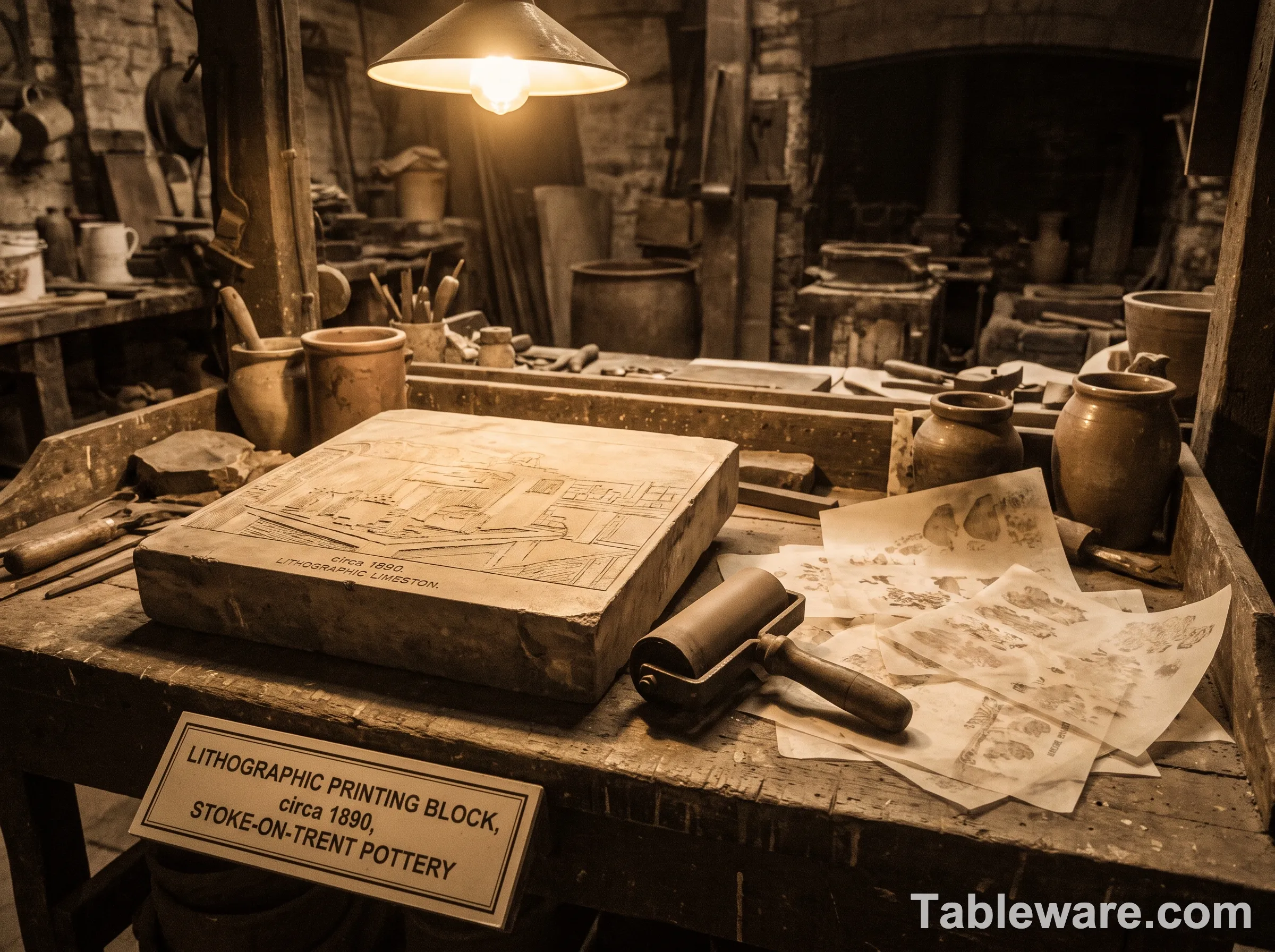
Fig 2. The 1870s-1890s breakthrough: chromolithography on lithographic stone, one stone per color. This is the technology that made the 12-piece matched set economically possible.
The 4 Tests That Separate Hand-Painted From Decal in 30 Seconds
Here is the field kit. You can do all four of these in your kitchen in under a minute, with a 10x loupe that costs ten dollars on Amazon. The point is not to certify a $4,000 piece of antique Nippon. The point is to never get fooled by the word "hand-painted" again.
Test 1: The fingerprint test. Run your fingertip across the decorated area. On a true hand-painted piece, especially overglaze enamels like famille rose, the decoration sits slightly raised above the glaze. You can feel the bump of pigment. On a decal, the surface is dead flat. The ink is part of the glaze layer, or bonded to it, but it is not built up. If you cannot feel any texture, it is a transfer. This is the single fastest test. I have never known a hand-painted piece that failed it.
Test 2: The repeat test. Pull two of the same item out of a set. Two cups. Two saucers. Two dinner plates. Hold them next to each other and look at the same feature on each — the same flower, the same leaf, the same letter of a maker's mark. On a hand-painted set, the feature is in slightly different positions, with slightly different brush pressure, with slightly different pigment density. On a decal set, the two features are literally identical. Same lines, same shading, even the same tiny imperfection if the decal had a speck of dust under it. Real hand-painters cannot reproduce their own brushstrokes. Decal machines cannot avoid it.
Test 3: The loupe test. This is the one that settles arguments. A 10x jeweler's loupe on the decorated surface. A decal under magnification shows a fine grid of tiny dots, like a newspaper photo. The image is a half-tone print, and you are seeing the screen pattern. A hand-painted piece shows nothing like that. You see continuous brush strokes, varying line thickness, pigment that pools where the brush paused, the wobble of a hair that got caught in the brush. If you see dots, you are looking at a decal. If you see brush, you are looking at a hand.
Test 4: The seam test. This one only works on round or curved pieces — vases, teapots, mugs, tureens. Decal paper is flat. To wrap a flat image around a curved surface, the decal has to be cut into wedges. Look at the edges of the pattern, especially on the underside of a handle, the inside of a foot ring, or around the curve of a tureen lid. Hand-painted designs flow continuously around the shape with no visible join. Decal pieces almost always show overlap, misalignment, or a tiny gap where two paper wedges meet. It is a small detail. Once you have seen it, you will see it everywhere.
A note on asymmetry. Real hand-painted sets are slightly different from each other. A real set of four teacups has four slightly different saucers. A real twelve-piece set has twelve slightly different plates. If every plate in your set is identical to every other plate, with the same exact flower in the same exact spot, your set is a decal. The exception is very modern studio pottery, where the entire point of the brand is matched uniformity — but those potters will tell you explicitly, because matched uniformity is the value proposition. If nobody is telling you, you are looking at a decal.
Overglaze, In-Glaze, Underglaze: Why "Decal" Covers Three Different Things
I keep coming back to the three flavors because the durability difference is so large that it changes what you can do with the piece.
Overglaze decals are by far the most common. Most of the decorated bone china and porcelain sets sold on Amazon, Wayfair, Macy's, and Williams-Sonoma are overglaze. The decoration looks beautiful on day one. It will wear visibly after 200 to 300 commercial dishwasher cycles, sooner at the gold-rimmed edges and any metallic accents. A gold-rimmed plate that looked pristine in 1990 looks scuffed in 2010. The ceramic body is fine. It is the metallic layer that erodes. If you want your china to look like new in 2046, hand-wash it. If you do not care that much, run it through the dishwasher and accept the patina.
In-glaze decals are what serious restaurant supply houses sell. The firing temperature is much higher, the pigment sinks into the glaze layer, and the design is protected by the vitrified surface. These pieces survive 1,000+ commercial dishwasher cycles with no visible change. The color range is slightly more muted than overglaze because the pigments have to survive the higher temperature, but the trade is worth it for anything that gets hard use. Most of the new restaurant-grade "denim" and "stone" pattern dinnerware from brands like Bauscher, Steelite, and Churchill is in-glaze.
Underglaze decals are what you see on classic blue-and-white. The color palette is limited because the pigments have to survive the body's full maturing temperature. Cobalt, iron, copper, manganese — that is about the list. But the design is sealed under the glaze and will outlive you. A 200-year-old blue-and-white underglaze piece looks essentially the same as the day it was fired. This is the technique Chinese porcelain factories automated first, and most of the cheap blue-and-white you see online is in fact an underglaze decal, not hand-painted.
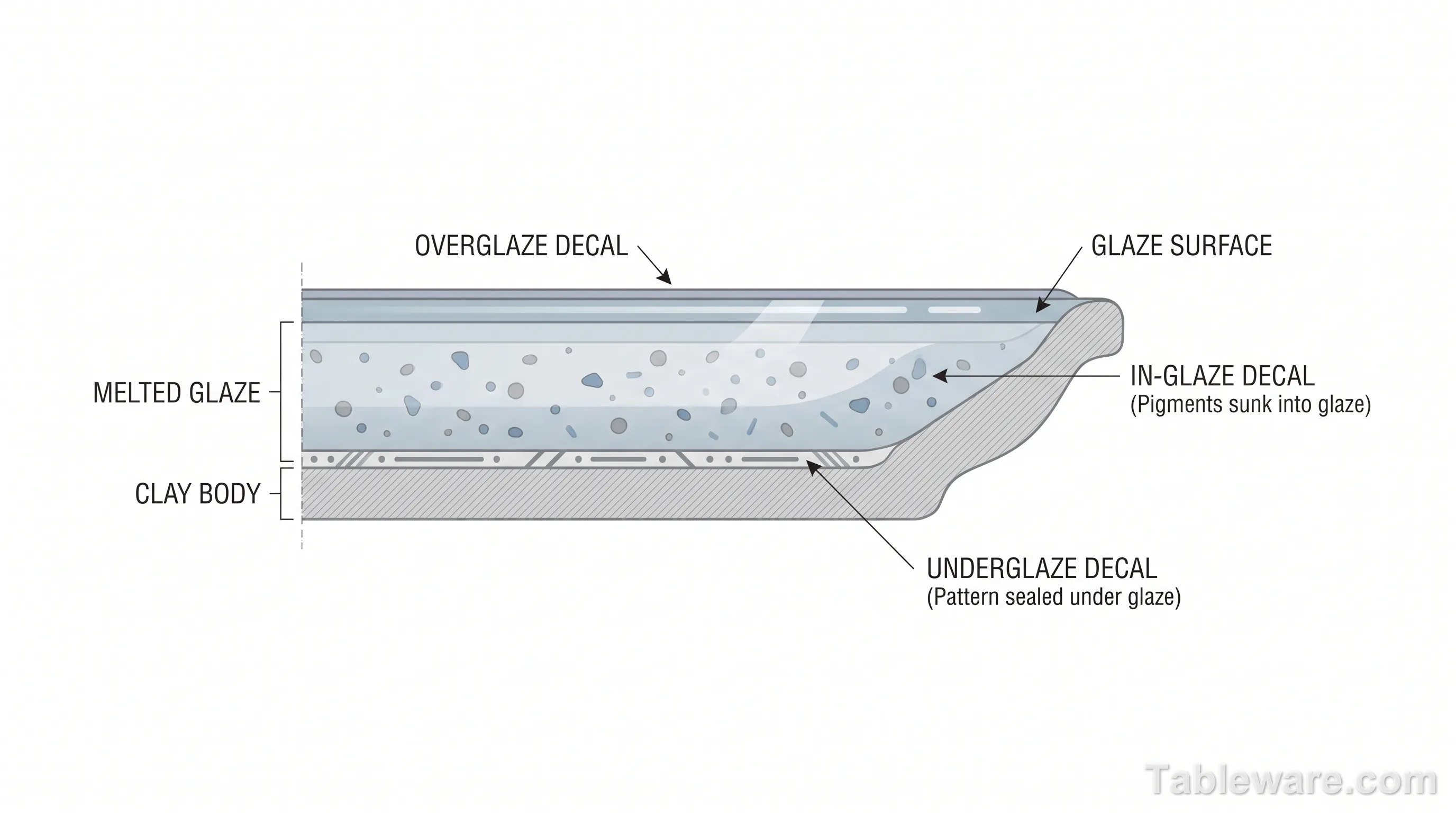
Fig 3. Cross-section of the three decal types. Overglaze sits on top of the glaze. In-glaze sinks into the glaze. Underglaze sits under the glaze, sealed against the clay body. The difference is what your dishwasher sees.
Are Decals Dishwasher Safe? The Honest Answer by Type
You will see the phrase "dishwasher safe" on every piece of decorated dinnerware you have ever owned. The phrase is technically true and operationally misleading.
The ceramic body of a vitrified porcelain or stoneware plate is essentially indestructible in a home dishwasher. The 140 to 160 degree Fahrenheit wash water and the 180 degree final rinse are well below the body's thermal shock threshold. The alkaline detergent, pH 11 to 13, will not attack a vitrified glaze. The plate will be fine.
The decoration is a different story. Overglaze decals are vulnerable to both the alkaline detergent and the cutlery abrasion of the wash cycle. The pigments are physically bonded to the glaze surface, but they are still a thin layer on top of it. After 200 to 300 commercial cycles, or 500 to 800 home cycles, the high-contact areas — the rim, the well, the spot where the knife goes — start to look worn. The pattern is not gone. It is just less crisp. If the decoration has any metallic content (gold, silver, platinum), the metal erodes first. Plain overglaze color lasts longer than metallic overglaze. Reactive-glaze color on stoneware is the most durable of the overglaze family because the visual is generated by the glaze itself, not by an added layer.
In-glaze and underglaze decals are functionally dishwasher-proof. The design is sealed inside or under the glaze, protected by a vitrified surface that is essentially glass. These are what the commercial foodservice industry uses, and they run them through industrial washers with detergents that would make a home chemist uncomfortable. You can too.
The honest answer, then, is: depends. If your dinnerware is overglaze-decorated and you want it to look the same in 2036, hand-wash it. If you do not care, run it through and accept the slow fade. If your dinnerware is in-glaze or underglaze, the dishwasher is irrelevant.
The Trap: "Hand-Painted" Stamps on Purely Decal Pieces
This is the part that irritates me the most, because it is the part that fooled my grandmother and fooled me for thirty years.
The words "Hand Painted" on a back stamp are not, in general, a lie. They are a referent to a different thing than the buyer assumes. Until at least the 1970s, Chinese and European manufacturers sold unpainted porcelain blanks already stamped "hand-painted" to ceramic hobby shops and home painters. The stamp referred to the manufacturing process of the porcelain body — the body was cast by hand, the glaze was dipped by hand, the blank was ready to receive decoration by hand. Whether the decoration was ever actually applied by hand was a separate question, often answered in the negative. I have personally seen entirely blank, never-decorated porcelain blanks that said "hand-painted" on the bottom, sold in craft stores for the home-decorator market. The manufacturer of the blank did not paint it. The hobbyist was supposed to.
The same practice continued after the hobby market shrank. The stamp is now sometimes applied to decal-decorated pieces, because the body was made by hand in the technical sense — slip-cast or jiggered, dipped in glaze, fired, and then decal-decorated on the line. The stamp refers to the body, not to the decoration. So that little red seal on the bottom of your grandmother's china is technically not lying. It is just not answering the question you think it is answering.
There are a couple of ways to get past this. One is to ignore the stamp entirely and run the four tests above. The other is to buy from makers who use unambiguous language. Wedgwood's modern "Nautilus" line says "Bone China, Made in England" and "Decorated in Stoke-on-Trent" — they make no claim about how. Heath Ceramics says "Sauleda" glaze and dates each piece, because the glaze is the point. East Fork calls their process "wheel-thrown, hand-dipped, gas-kiln fired" and they mean it. The most honest dinnerware brands in the world are honest specifically because they do not lean on the word "hand-painted" to imply value.
If you are buying vintage — and the vintage market for hand-painted Nippon and Bavarian china is real and lively — assume the stamp is irrelevant. Look at the work. The loupe test is the only one that counts.
Why Studio Potters Are Quietly Bringing Decals Back
Here is the part of the story I was not expecting when I started writing this.
The decal was the technology of mass production. It replaced the brush painter, standardized the design, and made matched sets of twelve economically possible. The studio pottery movement of the 1960s and 70s — Bernard Leach, Warren MacKenzie, the Mingei tradition — explicitly defined itself against the decal. The potter's hand on the clay, the potter's hand on the glaze, the uniqueness of the individual piece. Decoration was, by definition, a thing the hand did. A factory-printed image was a thing the hand did not do. The studio pottery world spent fifty years arguing, often very politely, that the decal was the enemy.
And then, sometime around 2010, a generation of studio potters started using decals again. Not because they had given up on the hand. Because the decal turned out to be a better tool for what they actually wanted to do.
Look at Joe Garcia, a production potter in Deptford, London, whose 2026 show Heat Seeking at SET 91 includes stoneware thumb-print tiles and porcelain wall pieces decorated with photographic decals. Look at Sara Dario, a Venetian ceramicist who uses screen-printed photographic decals to build freestanding porcelain sculptures that read like film strips. Look at Byron Ashley, a Texan MFA whose practice is built around slip-cast ceramic replicas of consumer goods — fireworks, beer bottles, t-shirts — finished with screen-printed decal labels that quote the original packaging. Look at Howard Kottler, who in the 1970s and 80s used factory decals on blank factory porcelain and then deliberately cut them up, distorted them, and reassembled them to satirize American consumer culture. The decal, in their hands, is not a substitute for the brush. It is a new medium with its own grammar.
The thing that is going on, I think, is a recognition that the studio pottery opposition to the decal was actually an opposition to mass production. The opposition was to uniformity, to disposability, to the cultural flattening of consumer goods. The decal itself — the technology of printing an image and firing it onto a surface — is not the enemy of craft. The enemy of craft is the decal used to pretend that mass production is something it is not. The new generation of potters is using the decal to do the thing it is actually good at, which is reproducing an image with precision. The image is the point. The repetition is the point. The way the image plays against the thrown form is the point.
I find this a hopeful development. It means the future of decorated ceramics is not a choice between the brush and the printer. It is a choice about which tool serves the work.
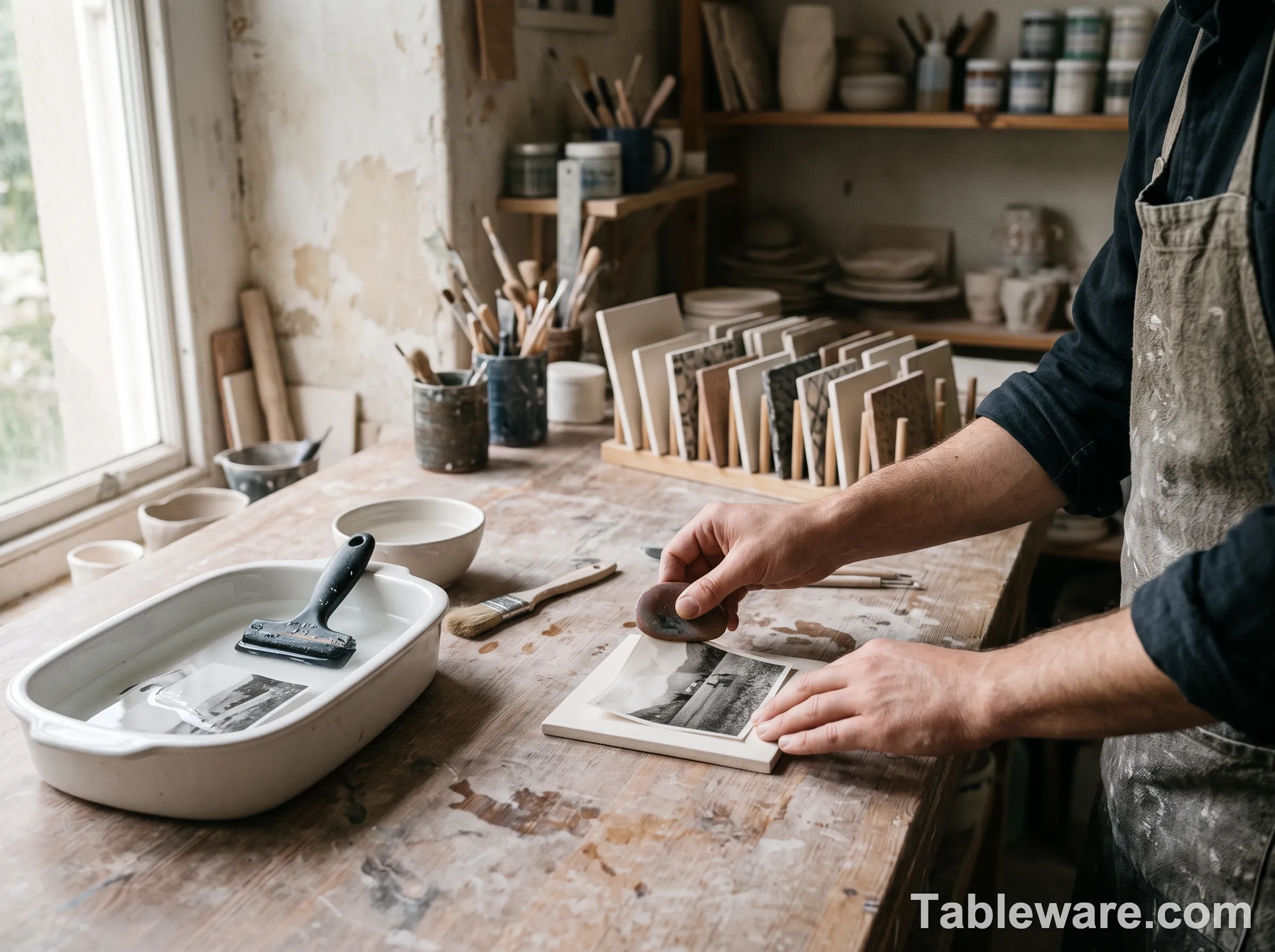
Fig 4. Joe Garcia in his studio at Cockpit, Deptford, applying a photographic decal to a porcelain slab. The decal here is not a substitute for hand-painting. It is a separate medium with its own visual logic.
The Practical Takeaways
A few things worth remembering the next time you are in a vintage shop, a museum gift store, or a Williams-Sonoma.
- The four tests work. Fingerprint, repeat, loupe, seam. Under a minute. If you are buying a $200+ piece, the $10 loupe pays for itself the first time.
- "Hand-painted" on a back stamp is essentially meaningless. Run the tests.
- The decoration method — overglaze, in-glaze, underglaze — is a more important predictor of long-term durability than the word "hand-painted."
- For everyday dinnerware, in-glaze is the right choice. It looks slightly more muted than overglaze, but it survives decades of dishwasher abuse without visible wear.
- For decorative pieces that will be looked at more than used, overglaze is fine. The colors are brighter, the metallic options are more varied, and the piece will outlast you if you do not run it through a commercial dishwasher.
- The decal is not the enemy. It is a 200-year-old technology that has its own uses. The studio pottery world is, finally, treating it that way.
The next time you are in a china shop — or your grandmother's cabinet — pull two pieces off the shelf and look at them side by side. If they are identical down to the smallest brushstroke, you are looking at a decal. That is not an insult. The decal is one of the great industrial technologies of the 19th century. It is also, increasingly, a tool for the 21st. The work is to know which is which.