If you want to understand celadon pottery — what it actually is, who really made it, and how to tell whether the piece in front of you is the real thing or a $40 green-painted knockoff — this is the piece I wish someone had handed me ten years ago.
I bought a "celadon" bowl on Etsy in 2018 for $48 plus shipping. The seller had photographed it next to a sprig of eucalyptus on a wood table, the listing said "antique celadon glaze," and I was twenty-six and a little stupid about ceramics. The bowl arrived in a nest of shredded paper. It was a pale, slightly minty green. The glaze was even. There were no crackle lines, no color variation, no halos. It looked like a swimming pool tile, kind of.
I used it for miso soup for about two years before the glaze started coming off in tiny flecks along the rim. The body underneath was bright white earthenware, not porcelain. The whole thing was, in retrospect, a printed underglaze pattern over a cheap pot, then photographed to look like a Song dynasty Longquan celadon pottery bowl by someone who also didn't know the difference.
That bowl is the reason I care about real celadon pottery more than I should.
Here's the thing most product listings won't tell you: real celadon is one of the hardest things in pottery to fake, because the color is not a color at all. It's an absence of color. It's what happens when you take iron — the same stuff that turns clay terracotta orange — and starve it of oxygen in the kiln. The molecule that makes terracotta orange and the molecule that makes celadon green are the same iron oxide, fired in different atmospheres. Anyone who can paint a green glaze has not made celadon. They've made a green bowl.
If you want to talk about real celadon pottery — what it actually is, where it actually came from, who is making it well now, and how to avoid getting fleeced on fake celadon pottery — this is the guide. It draws on three trips to the National Museum of Korea in Seoul, one very confused afternoon in the Longquan celadon museum in Zhejiang, and about seven years of accumulating the real celadon pottery at home.
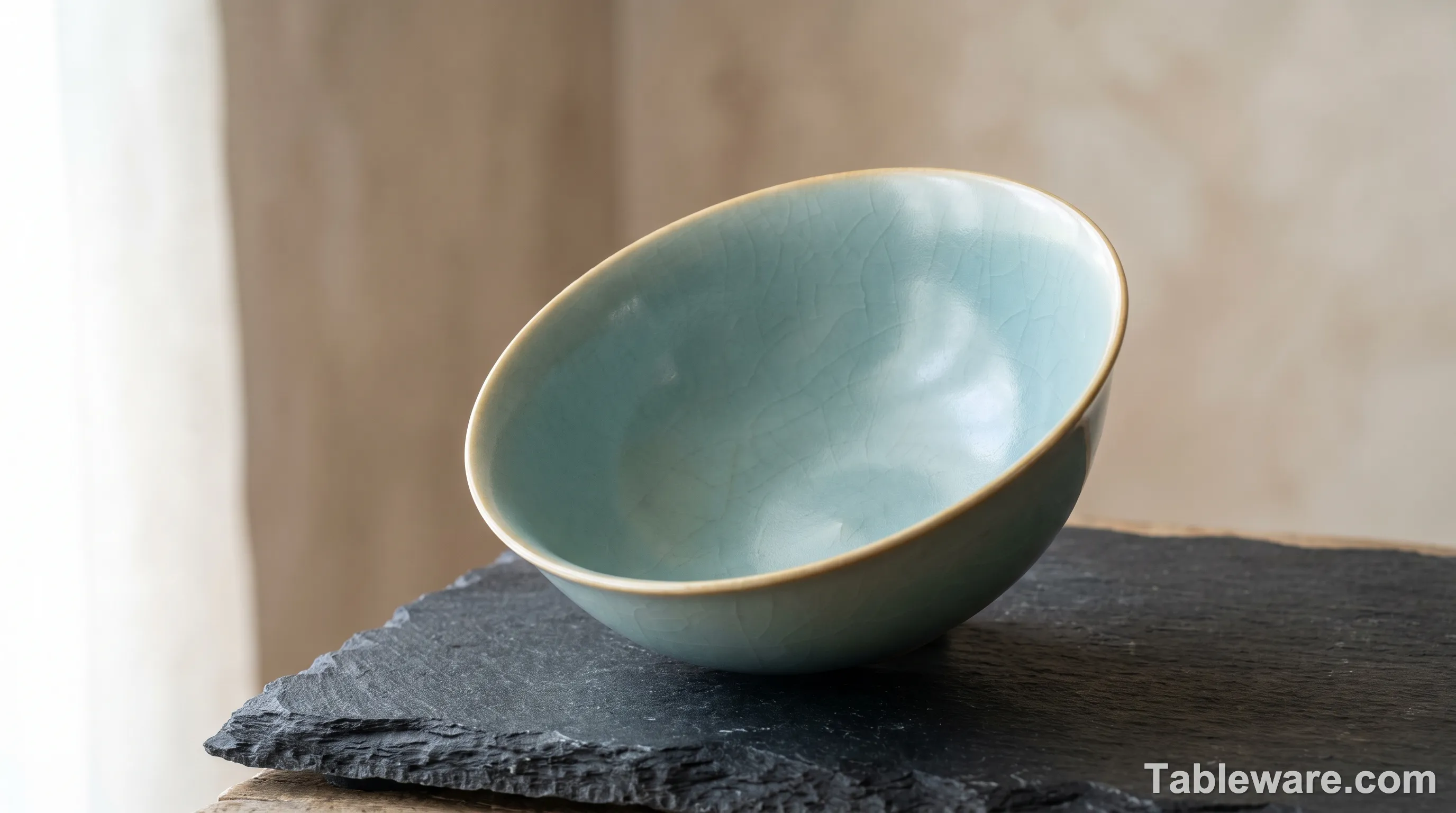
Fig 1. A modern Longquan celadon bowl (the closest living descendant of Song dynasty Guan ware). Notice the soft color shift from a cooler blue-green in the well to a faint honey halo near the rim. That color break is iron doing its job in a reduction firing.
What celadon pottery actually is (and why it isn't a color)
Most people think of celadon as "that pale green glaze." That description is wrong in two ways.
First, the color is not a pigment. There's no copper carbonate, no chromium oxide, no cobalt, no pre-mixed "celadon green" stain in the bucket. The green is iron. Specifically, it's iron oxide (Fe₂O₃) being converted under heat into a different iron oxide (FeO) that absorbs red wavelengths and reflects blue-green. The transition happens in the kiln, in the presence of the glaze, and only when the kiln atmosphere is starved of free oxygen. Fire the same iron-bearing glaze with plenty of oxygen flowing through the kiln, and you get the warm tan, caramel, and rust colors of an iron oxidation glaze. Fire it with the oxygen restricted, and the same iron goes green. This is the basic celadon vs green glaze distinction that 90% of product listings on Amazon and Etsy miss.
Reduction firing vs oxidation firing
The technical term for this is reduction firing. Most studio kilns in the West are electric and fire in pure oxidation. To get reduction, you need either a gas kiln (where you can tune the air-to-fuel ratio), a wood kiln, or a charcoal fining kiln. Reduction firing is more expensive, more time-consuming, more variable, and more dangerous than oxidation firing. Which is the first reason real celadon pottery is more expensive than it looks. The iron-reduction-firing chemistry is also what sets celadon apart from reactive glazes — both involve iron, both involve color variation, but reactive glazes typically stay in oxidation and produce warmer tones, while true celadons need the kiln atmosphere starved of oxygen.
Second, celadon is not one color. It ranges from a near-white "secret color" (mìsè, 秘色 — the most prized Song dynasty shade, also the most subtle, often barely green at all) to a deep, almost jade-like gray-green. The color you end up with depends on:
- The amount of iron in the glaze recipe (typically 1% to 3% by weight of the dry batch)
- The thickness of the glaze layer (thin = pale and almost colorless; thick = saturated green-blue)
- The peak temperature of the firing (most celadons are fired to cone 8 to cone 10, around 1260°C to 1300°C)
- How long the kiln spends in reduction (typically 20 to 60 minutes near peak temperature)
- The cooling rate (a slow cool brings out the crackle pattern; a fast cool suppresses it)
The crackle is the part that drives beginners crazy. Most celadon glazes have a higher coefficient of thermal expansion than the clay body underneath. As the kiln cools, the glaze contracts faster than the body, and the stress resolves as a network of fine cracks. The Chinese call this jīnwén (金纹) — gold pattern. The Koreans call it bisaek (비색, 비색) and consider it part of the beauty. The cracks are not a defect. They are a record of the glaze giving up its fight with the body.
A good celadon potter, over a career, will learn to "tune" the crackle. Too much crackle means the glaze will eventually fail along the crack lines and admit water into the body. Too little, and the glaze looks like a print. Most production celadons target a "fine, even" crackle that doesn't compromise the seal.
The list of real celadon characteristics, in plain English:
- Soft, grayish to blue-green color, not saturated or bright
- A subtle color shift across the surface (the well of a bowl will be a different shade from the rim)
- A network of fine crackle, present and intentional
- A "broken" or "haloed" surface where the glaze is thinner over textured clay
- Iron-break color shifts at edges and where the glaze pools
- A glaze that is slightly translucent at thin spots and shows the body underneath
A fake celadon, by contrast, is a uniformly green-painted bowl with no crackle, no color variation, no iron break, and (often) a very flat, "swimming pool" appearance under bright light. The fake is recognizable. It just takes knowing what you're looking for.
The 1,700-year history (very compressed)
The first celadon was almost certainly an accident. The Eastern Han dynasty (around 25-220 CE) had high-fired stoneware kilns in what's now Zhejiang province. The local clay contained some iron. The kilns, which were wood-fired, occasionally drew in less oxygen at the top of the firing. The result: a thin, accidental greenish glaze on an otherwise pale stoneware pot. The kilnsmen probably didn't know what they had.
The craft matured through the Tang dynasty (618-907 CE), with Yue ware from the Shanglinhu region in Zhejiang becoming the first named celadon production center. Yue ware bowls are squat, simple, pale, and have a slightly bluish-green glaze. They're the great-great-grandparent of everything that came after.
The Song dynasty (960-1279 CE) is the golden age, and the period that anyone serious about celadon eventually ends up obsessing over. Three kilns matter most:
- Ru ware (汝窑) — produced in a single, very short window (about 1085-1100 CE), possibly in just one kiln with only a few hundred pieces surviving. Ru ware is the most expensive pottery in the world per piece at auction. The glaze is the famous mìsè — a soft, near-colorless pale blue with a faint warm undertone, like looking through skim milk. The crackle is fine and regular. There are perhaps 90 known pieces. I have never seen one in person and likely never will.
- Guan ware (官窑) — the "official" kilns, moved south to Hangzhou after the Song court fled the Jurchen invasion. Guan ware has a thicker glaze than Ru, with a slightly more visible crackle, and a deeper body color. The crackle often forms in a "golden" pattern because iron-rich clay shows through the cracks. The Hong Kong University museum has a stunning pair of small Guan ware bowls; I went twice.
- Ge ware (哥窑) — possibly the most distinctive of the three, with a very dramatic crackle that is intentionally double-layered: a fine, irregular crackle on top of a coarser one underneath. The Chinese call this jīnxiàn tiěxiàn (金线铁线, gold line, iron line) — the smaller crackle looks gold, the larger one looks dark. Ge ware's origin is debated; some scholars think it's a Southern Song product, others think it's a later Ming or Qing copy of an earlier style. Either way, it changed what people thought crackle could do.
The Yuan dynasty (1271-1368 CE) saw celadon production move to large export-oriented workshops. The Longquan celadon kilns, in southern Zhejiang, became the global supplier. By the 14th century, Longquan celadon was being shipped to Japan, Southeast Asia, the Middle East, and (eventually) Europe. A 14th-century Longquan dish with a carved peony motif sold at Sotheby's in 2014 for $26 million. I bring this up not to make you feel bad, but to make the point that, for about 400 years, celadon was a global luxury commodity — the iPhone of the medieval world. Every court in Eurasia wanted some.
The Ming dynasty (1368-1644) saw celadon fall out of fashion in China itself, replaced by blue-and-white porcelain as the prestige export. But the kilns kept firing, the techniques kept being passed down, and a small line of potters kept making celadon for the local and Japanese market. Almost everything you can buy as "Longquan celadon" today is made in the same village, by potters whose families have been doing this for twenty or thirty generations.
The Korean chapter is its own story, and a different one. The Goryeo dynasty (918-1392 CE) in Korea produced celadon that is, in the considered opinion of most serious potters, the most technically refined in the world. Where Chinese celadon from the same period tends toward a slightly more gray-green color with warm undertones, Goryeo celadon (cheongja, 청자) goes for a distinctive cool, almost pure blue-green — the famous bisaek (비색) shade. The Goryeo potters had access to very pure kaolin clay, very controlled kiln atmospheres, and a court that paid for the work. They developed a celadon so refined that the Chinese, who invented the genre, sent envoys to Korea to try to figure out how they did it. The surviving Goryeo inlaid celadon — where black and white slip are inlaid into the clay body before glazing, so the design sits under the celadon — is one of the most beautiful things ever made out of dirt.
The Joseon dynasty that followed the Goryeo (1392-1897) lost most of the celadon tradition, partly because Confucianism frowned on decorative excess and partly because the kilns were disrupted by the Japanese invasions of the 1590s. Korean celadon only revived in the 20th century, partly through the efforts of a single potter, Yu Geun-hyeong (유근형), who spent the 1920s and 1930s trying to recreate Goryeo recipes from museum shards. The modern Korean celadon industry is built on his work.
The Japanese celadon tradition, which is much smaller, came mostly via Korean potters in the 16th and 17th centuries and via direct trade with the Ming dynasty. There's a small but very serious "Mashiko-yaki adjacent" celadon scene in contemporary Japan, mostly small studios using local clays and reduction firing in gas kilns. The quality is high. The volumes are small. The pieces are hard to find outside Japan.
The European celadon chapter is the saddest and funniest part of the whole story. From the 17th century on, European potters were obsessed with celadon and mostly failed to make it. The German Meissen manufactory tried repeatedly in the 1720s and 1730s. The French Saint-Cloud manufactory made a pale tin-glazed earthenware it called "celadon" that had basically nothing in common with the real thing except the color name. By the 18th century, "celadon" in European usage often meant any pale green ceramic, regardless of how it was made.
Then in the 19th century, a French company called Saint-Clément (in Lorraine, France, not the same as Saint-Cloud) finally cracked a true high-temperature reduction celadon glaze. They were making tea sets and dinner services in a soft gray-green glaze, fired to about 1280°C in reduction, in direct imitation of Chinese Longquan. Saint-Clément's "Bleu céleste" line was the first mass-market European celadon that would pass a chemistry test. Royal Copenhagen in Denmark started making their own celadon-style glaze around the same time, and their "Musselmalet" dinner service from the 1880s onward uses a soft celadon ground that has been in continuous production ever since.
The American chapter is mostly small. A handful of studio potters in the Appalachian region (East Fork, based in Asheville, North Carolina, and a few others) have built reputations for celadon-style work in reduction, often on stoneware bodies rather than true porcelain, with iron glazes tuned to give a soft gray-green effect that the marketing language usually calls "celadon" or "eucalyptus." These are not historically accurate celadons — they are iron glazes fired in reduction on dark bodies — but they are beautiful, and they are the closest thing most Americans will ever get to a real celadon pot without flying to Seoul or Hangzhou. The way East Fork and similar studios get to that look is mostly through slip-cast and jiggered forms with a sprayed reduction-iron glaze, which is a fundamentally different process than the hand-thrown celadon pottery tradition.
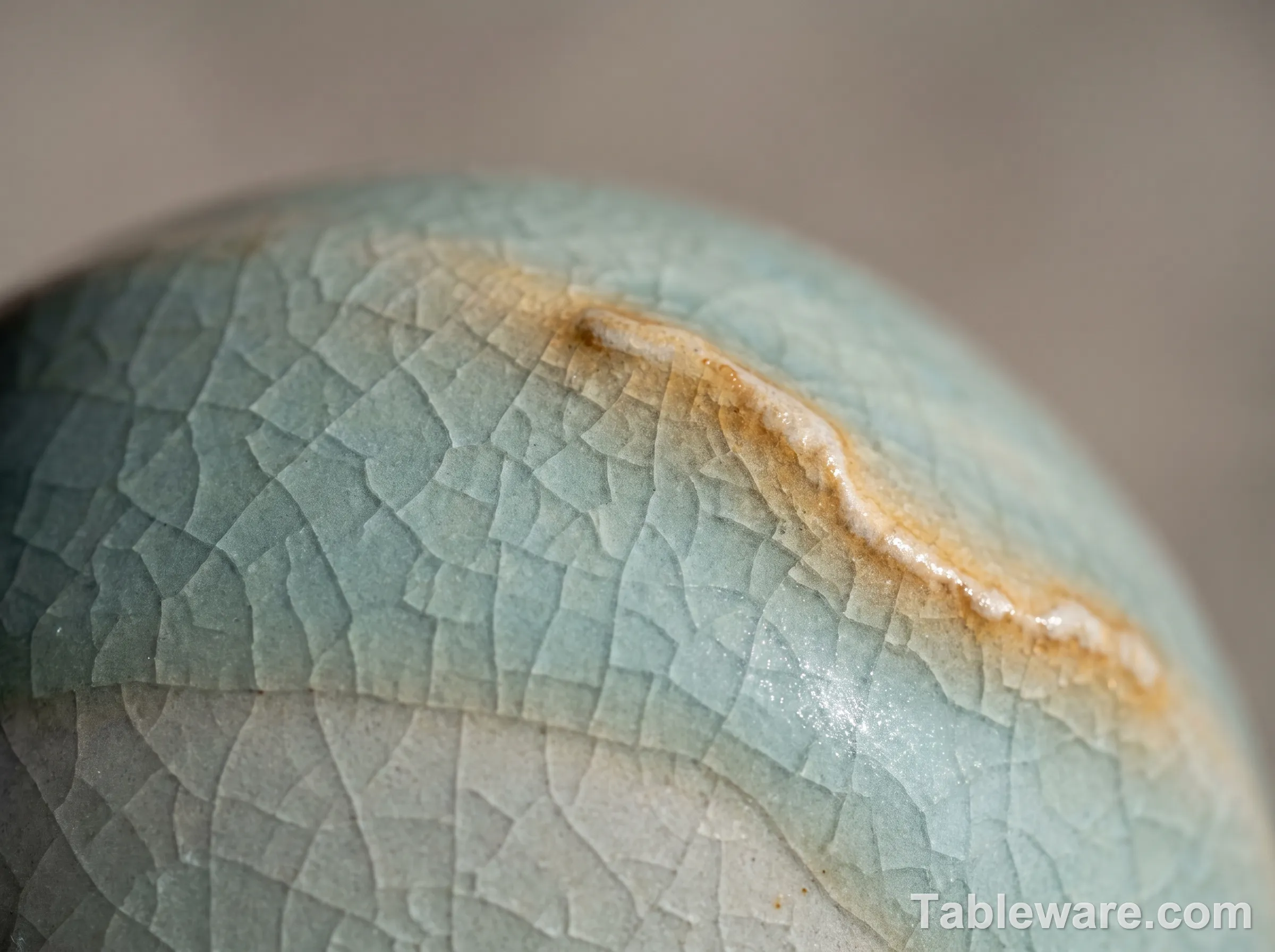
Fig 2. A close-up of a real celadon glaze surface. The orange-tan halo at the ridge is an iron break — the same iron that gives the glaze its green color, in a thinner spot, shifts toward its natural oxidation hue. The fine crackle pattern is intentional and is the visual signature of a properly fitted celadon glaze.
How to actually tell real celadon from a green-painted impostor
I have made the mistakes so you don't have to. The test isn't one thing. It's a checklist. Walk through it in this order.
Step 1: Look for crackle
Real celadon almost always has crackle. There are a few rare exceptions (very thickly applied glazes can suppress crackle) but if the surface is completely smooth and glassy under magnification, the odds drop sharply that it's real celadon. A 10x loupe or your phone's macro camera is enough.
Step 2: Look for color variation
Real celadon is not one color. Pick up the pot, rotate it under a single light source, and look for places where the green shifts. The well of a bowl will be a different green from the rim. Where the glaze is thinner (over a textured surface, near an edge), the color will be paler or warmer. A painted green glaze will look like one color under all conditions.
Step 3: Look for iron break
At textured ridges, near the foot of a bowl, around handles and spouts, the celadon will often shift toward a warm tan or honey color. This is the iron in the glaze reverting toward its natural oxidation color in the thinner spots. A painted green glaze doesn't do this. A real celadon almost always does.
Step 4: Check the back / foot / unglazed areas
Real celadon is almost always partially unglazed on the foot ring or the underside. The unglazed clay should be a high-fired stoneware or porcelain body — pale gray, dense, slightly translucent in thin spots. If the unglazed clay is bright white, chalky, or rough like earthenware, the pot is not real celadon. (The Etsy bowl I bought was white earthenware, which is what eventually flaked off.)
Step 5: Check the sound
This sounds silly but it works. Real celadon, being thinly potted and high-fired, rings when you tap it. A painted-imitation earthenware "celadon" gives a dull thud. The difference is obvious after you've done it a few times.
Step 6: Look for inlay, carving, or sculptural detail under the glaze
Many of the most prized celadons (Song dynasty, Goryeo) have decoration carved into the body before glazing. The glaze then fills the carved areas, so the decoration appears to be under the glass. This is hard to fake. A painted imitation has decoration on top of the glaze, or no decoration at all.
Step 7: Buy from sellers with reputation and provenance
A genuine Longquan celadon bowl from a contemporary Longquan workshop will cost you between $40 and $400 depending on size and the artist's reputation. Royal Copenhagen's "Musselmalet" or "Blueline" lines with a celadon ground are $60-300 per piece new. Studio potters in the US doing celadon-style work (East Fork's limited celadon drops, for example) start around $80 per piece. Anything advertised as "antique celadon" for under $200 with no provenance paperwork is almost certainly a fake.
I keep coming back to the chemistry, because that's the part that doesn't lie. If you want to read one piece that will give you the full technical background, look for the glaze chemistry chapter in Daniel Rhodes's Clays and Glazes for the Potter — the standard studio textbook, now in its third edition. He devotes about 30 pages to iron glazes, and the section on reduction firing explains the molecular mechanism in a way that's still accessible if you've had high school chemistry. The whole thing is also about $25 used.
The brands that actually make real celadon
For a buying guide, this is the part you came for. Here's a working list, in rough order of price, of who is making real celadon-style glazes right now and where to find them.
Longquan celadon workshops (Zhejiang, China). The direct continuation of the Song dynasty tradition. There are perhaps 200 active workshops in the Longquan area. The most reputable names are well known to collectors but not always to the general public — the top of the line includes makers like Mao Jiashun (毛家顺) and the Li Jiawan (李家完) family workshop, whose pieces appear at major auction houses. Prices range from $30 for a small tea cup to $5,000+ for a museum-quality vase. For a working person's entry point, look for the "Longquan celadon" generic production at prices of $30-100 per piece, sold by makers with verifiable workshop names and addresses. Avoid anything on Alibaba claiming to be "ancient" or "antique" Longquan — it's almost always a modern reproduction being misrepresented.
Royal Copenhagen (Denmark). Founded 1775. Their classic Musselmalet (Blue Fluted) pattern is on a soft celadon ground — one of the longest continuously produced patterns in European porcelain. A 20-piece place setting retails for about $1,400. A single dinner plate is around $60-80. They also produce the Blueline and Elements collections in solid celadon shades. This is the most accessible "real celadon" you'll find in a normal retail channel, and it's actually good.
Saint-Clément / Keller (France). The original French celadon maker, founded 1758. The brand has changed hands several times; the modern continuation is sold under various labels. Production is limited. Pieces appear in antique shops and at the occasional French flea market. Not easy to find in North America.
East Fork Pottery (Asheville, NC). Studio production, mostly stoneware bodies with iron glazes fired in reduction. They do release "celadon" colorways a few times a year — these are technically not true porcelain celadons but they have the soft gray-green color and they are well-made, dishwasher safe, and lead-free. A 4-piece place setting is $148-220. This is the easiest way for an American to get a real celadon-style piece without spending $400 on a Korean or Chinese import.
Korean Goryeo-style celadon (Korea). There is a small but serious revival of Goryeo-style celadon in Korea, led by artists like Yoo Sung-jong (유성종) and the Hwang-chang (황창) pottery group in Gangjin. Pieces range from $200 for a small bowl to $8,000+ for a museum-quality vase. The Korean Cultural Center in New York sometimes carries small pieces from these makers; otherwise, the only way to buy is to go to Korea or work through a specialist gallery.
Studio potters (mostly US and UK). A number of independent studio potters make real reduction-fired celadon. Names that come up in the studio ceramics world include Linda Arbuckle (US), Peter Beals (US), and Steve Booton (UK). Their work is one-off or small batch. Prices start around $80 for a small piece and go up fast. If you want the most "real" celadon you can buy, this is where to look — but you need to follow these makers on Instagram, show up at craft fairs, and be ready to buy when a piece drops.
A word of caution on a brand that often gets listed alongside these: Wedgwood "Celadon" is not a true high-fired celadon. It is a low-fired colored earthenware glaze. Beautiful, but not in the same category as the items above. If someone is selling you "Wedgwood celadon" and quoting reduction firing chemistry, they don't know what they are talking about.
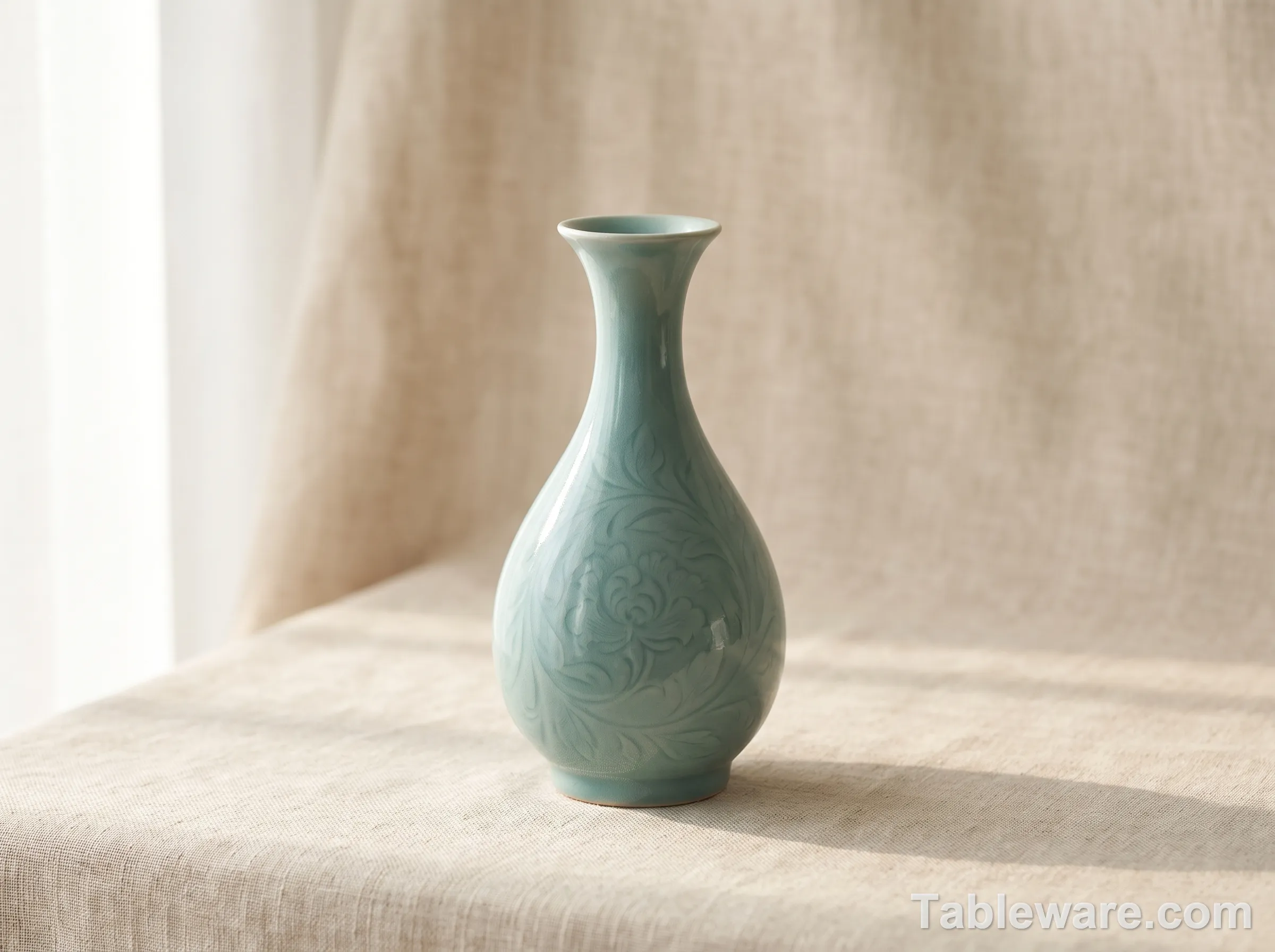
Fig 3. A modern Goryeo-style celadon vase, made by one of the contemporary Korean potters working to revive the 12th-century cheongja tradition. The cool, almost pure blue-green color is the signature bisaek shade, and the carved peony decoration sits under the glaze rather than on top of it.
The 800-year celadon war, in one sentence
Chinese celadon came first and stayed the largest. Korean celadon took the same materials, the same chemistry, and the same firing principles and made the most technically refined version. Japanese celadon took the Korean version and made the smallest, most carefully-tuned version. European celadon came last, took 200 years to figure out the chemistry, and made the most commercially successful version. The modern studio celadon pottery revival in the US and UK is now in its third generation, mostly by potters who have been to Korea or Longquan, brought back recipes, and adapted them to local clays and gas kilns.
If you want to buy one piece of real celadon this year and you're not made of money, my actual recommendation is to start with Royal Copenhagen's Musselmalet pattern. A single plate, around $60-80, on a real celadon ground, made by a 250-year-old company. Eat off it. Wash it. Look at it in different light. After six months, if you're still curious, buy a small contemporary Longquan bowl from a workshop with a verifiable reputation, around $50-80. After a year, if you're still curious, go to Korea, find a Gangjin studio, and bring back a cheongja piece.
That is the path. The chemistry stays the same. The potters change.
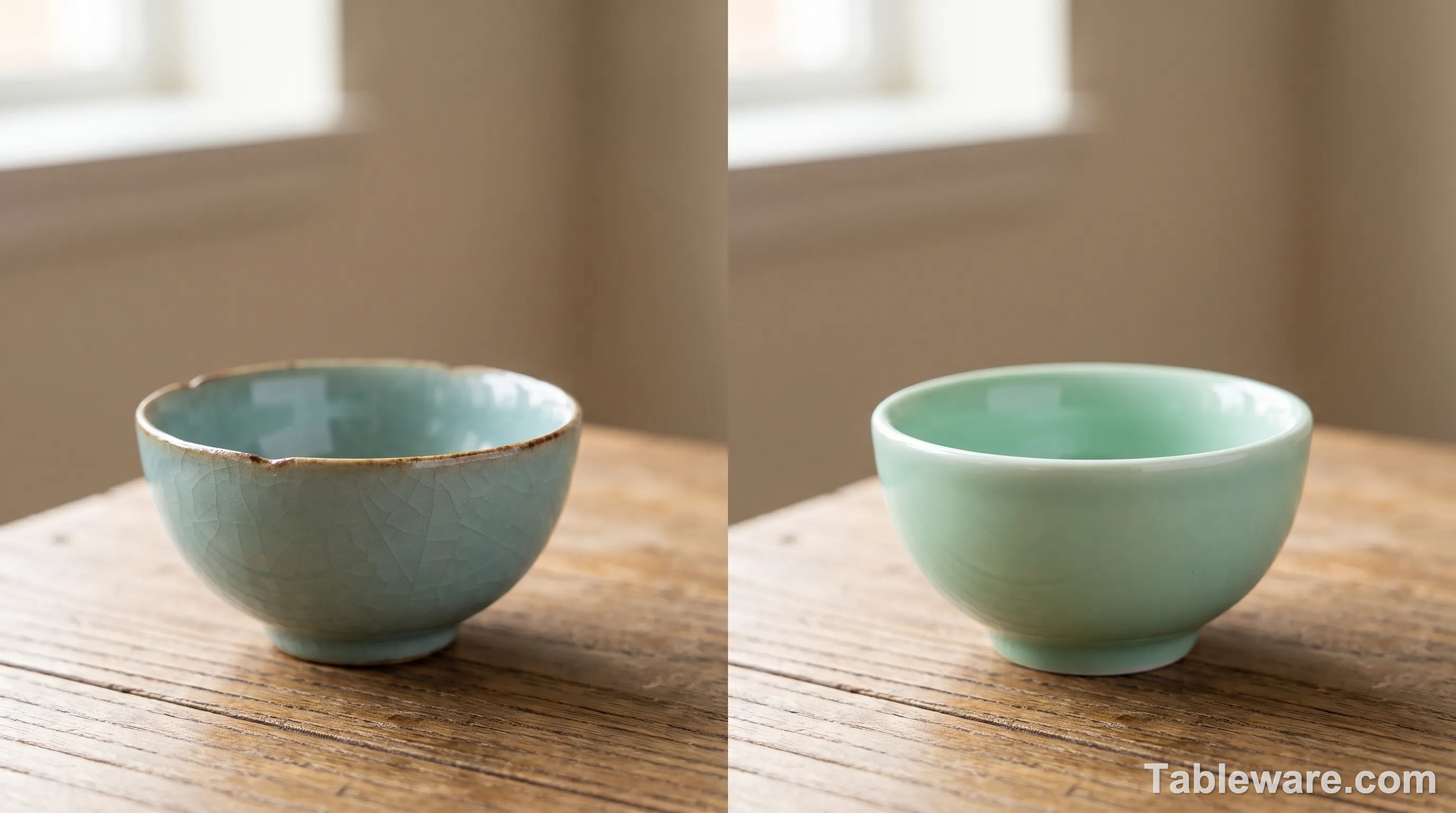
Fig 4. The real (left) and the fake (right), side by side. The real piece has visible crackle, an iron-break color shift at the rim, and a soft warm-to-cool color transition across the surface. The fake is uniformly green, has no crackle, and the rim and well are exactly the same color. Both pieces are labeled "celadon." Only one of them is.
The bottom line
Celadon pottery is a 1,700-year-old tradition of getting a single element — iron — to do something surprising with the air in a kiln. It is one of the most technically demanding glazes in pottery, one of the most beautiful, and one of the most consistently faked. If you're buying celadon pottery, check for crackle, color variation, and iron break. If you're selling it, expect the people who know to be skeptical. If you're making it, expect to spend years dialing in your kiln atmosphere and your glaze thickness.
And if you see a "celadon" bowl on Etsy for under $100 with a hand-photographed eucalyptus sprig in the listing photo, walk away. The bowl in that photo is almost certainly the same green-painted earthenware I bought in 2018. The miso soup is fine in a real one. It's not fine in a fake.