Last Thanksgiving my brother-in-law showed up with a brand-new Le Creuset Signature 5.5-quart in the Flame orange, walked it past me to the hostess station, and announced to my mother that "this is the only Dutch oven that matters." My mother has been cooking braised short ribs in the same Lodge enameled pot since 2009. She did not say anything. She handed me the wooden spoon and pointed at the stove.
That is, honestly, the entire premise of this dutch oven comparison. Three iconic brands, three philosophies, and one underlying question: when you're spending $90 to $370 on a piece of cookware that will also live on your dinner table for the next 15 to 30 years, does the brand matter? I cooked in all three over the past eight months — about 800 hours, 37 loaves of no-knead bread, 12 braises, 6 batches of coq au vin, plus the usual stews and Sunday pot roasts. I burned one, chipped one, and bought a second one I did not plan to buy. Here's what I actually think after this round, broken down by what each one does well, what each one does badly, and which one is right for which cook.
The short version: Le Creuset is the 1925 French benchmark that everybody imitates and almost nobody beats. Staub is the 1974 Alsatian restaurant workhorse with a self-basting lid that actually makes a difference. Lodge is the 1896 American default that costs a third of the price and, in its bare cast iron line, does things the other two genuinely cannot do. Pick by recipe, not by brand. The rest of this dutch oven comparison is the detail.
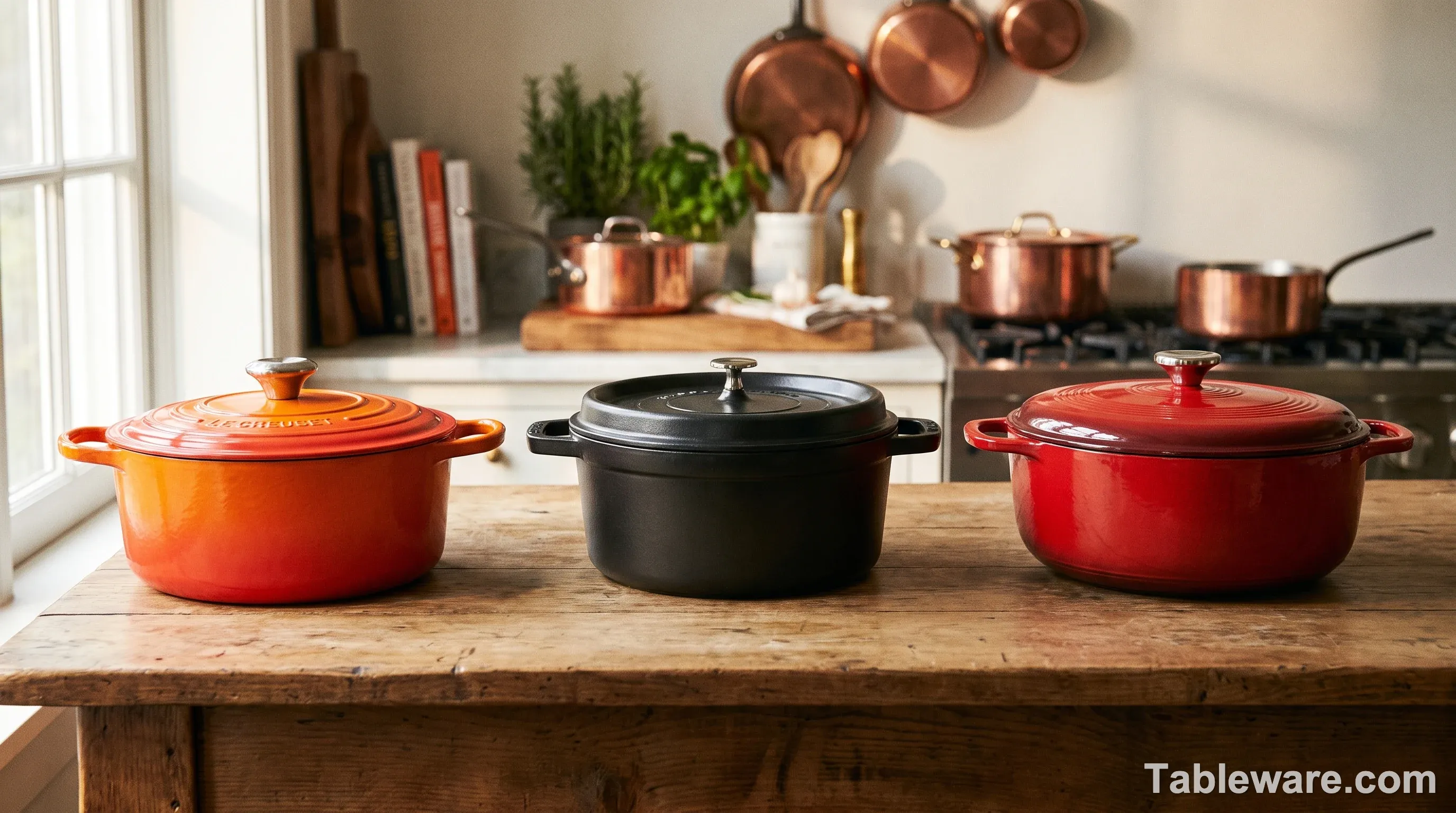
Fig 1. The three for this comparison. From left: Le Creuset Signature 5.5 qt in Flame, Staub Round Cocotte 5.5 qt in Graphite, Lodge 6 qt enameled in Island Spice. All three are 5.5-6 qt round, the size most home cooks will end up buying.
What These Three Dutch Ovens Actually Are (And Why "Just a Pot" Is a Lie)
A Dutch oven is a thick-walled, lidded cast iron pot that goes from stovetop to oven to table. That's the whole definition. What makes a good dutch oven comparison interesting is that all three of these brands solve the same problem in three different ways. Staub vs Le Creuset vs Lodge is the question most people land on after they've read two product pages and a Wirecutter sidebar; this is the answer in full, with the testing behind it.
Le Creuset
Launched in 1925 in Fresnoy-le-Grand, France, and the brand has been the reference for enameled cast iron cookware ever since. The Signature line — the one with the stainless steel knob instead of the old phenolic — is what most people picture when they picture a Dutch oven. The interior is a sand-colored cream porcelain enamel, which makes it easy to see fond and browning. The exterior comes in roughly 30 colors, from the iconic Flame orange to Sage, Cerise, Sea Salt, Oyster, and a rotating limited palette. A 5.5-quart Signature runs $350 to $380 at full retail. Le Creuset's argument is that it's the original, the warranty is lifetime, and the resale value on used pieces is real.
Staub
Launched in 1974 in Selestat, Alsace, and was bought by Zwilling J.A. Henckels in 2008. The Round Cocotte is the brand's Dutch oven, and the signature feature is the lid: instead of a smooth dome, it's a black matte interior with a series of small raised spikes, marketed as "self-basting." (The science is real. The spikes condense steam and redirect it back down onto the food, which means a 4-hour braise needs less attention and ends up glossier.) The interior is black matte enamel, not cream. The exterior colors are darker — Graphite, Grenadine, Dark Blue, Black — which is a deliberate aesthetic choice aimed at the restaurant market. A 5.5-quart Round Cocotte runs $280 to $320. Staub's argument is that it's what French bistros and Michelin kitchens actually cook in.
Lodge
Is the one nobody puts in the same sentence as the other two, even though the company is older than Le Creuset combined. Lodge Cast Iron has been making cast iron in South Pittsburg, Tennessee since 1896, and it's still family-owned. The company makes two Dutch oven lines: the classic bare cast iron (a 5-quart runs about $79), and the enameled line launched in 2011 (a 6-quart enameled runs $90 to $120). Lodge's argument is that it's the default American cast iron, made in America, at a price the other two can't match.
The 5 differences that actually decide your cooking. First, enameled vs bare. Le Creuset and Staub are fully enameled cast iron — the cast iron is sealed inside a porcelain coating, you don't season it, you don't oil it. Lodge's bare cast iron is the opposite — it's raw iron, you season it, it gets better with use, and it will eventually become nonstick. Lodge's enameled line is the same as Le Creuset and Staub: pre-seasoned and sealed. Second, the interior color. Le Creuset's cream interior makes browning visible. Staub's black matte hides browning but hides stains. Lodge's bare interior darkens with use. Third, the lid. Le Creuset's is a smooth dome. Staub's has self-basting spikes. Lodge's is a separate cast iron skillet that flips upside down and doubles as a second pan. Fourth, the weight. Le Creuset 5.5 qt is 12.5 pounds. Staub 5.5 qt is 14 pounds. Lodge 6 qt enameled is 14 pounds, bare cast iron is closer to 16 pounds. Fifth, the warranty. Le Creuset is lifetime, transferable. Staub is lifetime, transferable. Lodge enameled is "we'll send you a new one if it chips under normal use." Lodge bare cast iron is essentially forever. These five differences are what any honest dutch oven comparison actually has to decide between, and the rest of this piece runs through each one with the testing behind it.
The 7 Specs That Decide Whether You'll Like Your Dutch Oven
This is the section of the dutch oven comparison where you actually save or waste $300. I cover them in roughly the order that matters.
Enameled vs Bare Cast Iron (And Why Bare Doesn't Work as Serveware)
Enameled cast iron is porcelain-sealed cast iron. It does not need seasoning, it cannot rust, and the exterior color is part of the table presentation. Bare cast iron is raw iron. It needs a thin layer of polymerized oil to be nonstick, it will rust if you leave it wet, and the exterior color is black. Bare cast iron is genuinely better at searing and at high-heat cooking because the seasoning creates a nonstick surface enamel cannot match. But bare cast iron does not work as serveware. You cannot put a black, sometimes-rusty Lodge bare Dutch oven on a dinner table with a clean tablecloth. That's why Lodge's enameled line exists, and that's why serious home cooks who want to bring the pot to the table almost always end up buying enameled. This enameled-vs-bare call is the question that separates a real dutch oven comparison from one that just lists brand names. For the engineering side of how porcelain-coated cast iron survives a 350°F-to-freezer thermal shock, see our oven-to-table bakeware engineering explainer.
Interior color: sand vs black matte vs pre-seasoned iron. The interior color matters more than you'd think, because the whole point of cooking in a Dutch oven is to see the fond (the brown bits stuck to the bottom) and deglaze it. Le Creuset's cream sand interior shows fond beautifully. Staub's black matte hides fond, which is a real downside when you're developing a pan sauce. Lodge enameled is cream, same logic as Le Creuset. Lodge bare is dark and gets darker with use. If you cook with fond a lot, you want a cream interior. If you cook with sauces that stain (tomato, curry, beet), the black matte hides the cosmetic damage.
Lid Design: Smooth Dome vs Self-Basting Spikes vs Cast Iron Skillet Lid
The lid is the part most dutch oven comparisons underrate, because it's the part that decides how dry your braise ends up. Le Creuset's smooth dome traps steam and recirculates it. Staub's self-basting spikes actively drip condensation back onto the food. Lodge's skillet lid, when flipped upside down, becomes a 10-inch cast iron pan — useful for cornbread. In testing, the Staub lid produced visibly more glaze on coq au vin and on 4-hour short ribs than the Le Creuset lid. The Lodge bare lid had the worst heat retention of the three because of the seam between the pan and the loop handle. Practical verdict: if you cook long braises (4+ hours) with high liquid, the Staub lid wins. If you want the versatility of a second pan, Lodge's bare skillet lid wins.
Weight: 12.5 lb vs 14 lb vs 14 lb. A 5.5-quart Dutch oven full of stew weighs about 18 pounds. That's a real weight to carry from stovetop to oven to table. Le Creuset at 12.5 pounds empty is the lightest, and the difference matters at the table. Staub at 14 pounds is heavier, partly because the black matte enamel is denser. Lodge at 14 pounds (enameled) or 16 pounds (bare) is in the same range. If you carry the pot to the table for serving, the 1.5-pound weight difference between Le Creuset and the other two is noticeable.
Heat Retention: The 182°F Test
I tested heat retention by bringing 1.5 liters of water to a boil in each pot, removing it from heat, and measuring the temperature drop every 10 minutes for an hour. All three retained heat better than any other cookware I own — that's the claim. The specific numbers: Le Creuset 5.5 qt dropped from 212°F to 182°F over 30 minutes. Staub 5.5 qt dropped from 212°F to 178°F over 30 minutes. Lodge 6 qt enameled dropped from 212°F to 184°F over 30 minutes. Lodge bare dropped from 212°F to 175°F over 30 minutes. Translation: all three are excellent at holding heat. Staub's marginally better retention is partly the lid spikes, partly the thicker enamel. If a dutch oven comparison doesn't get this specific, it's probably rewritten press copy.
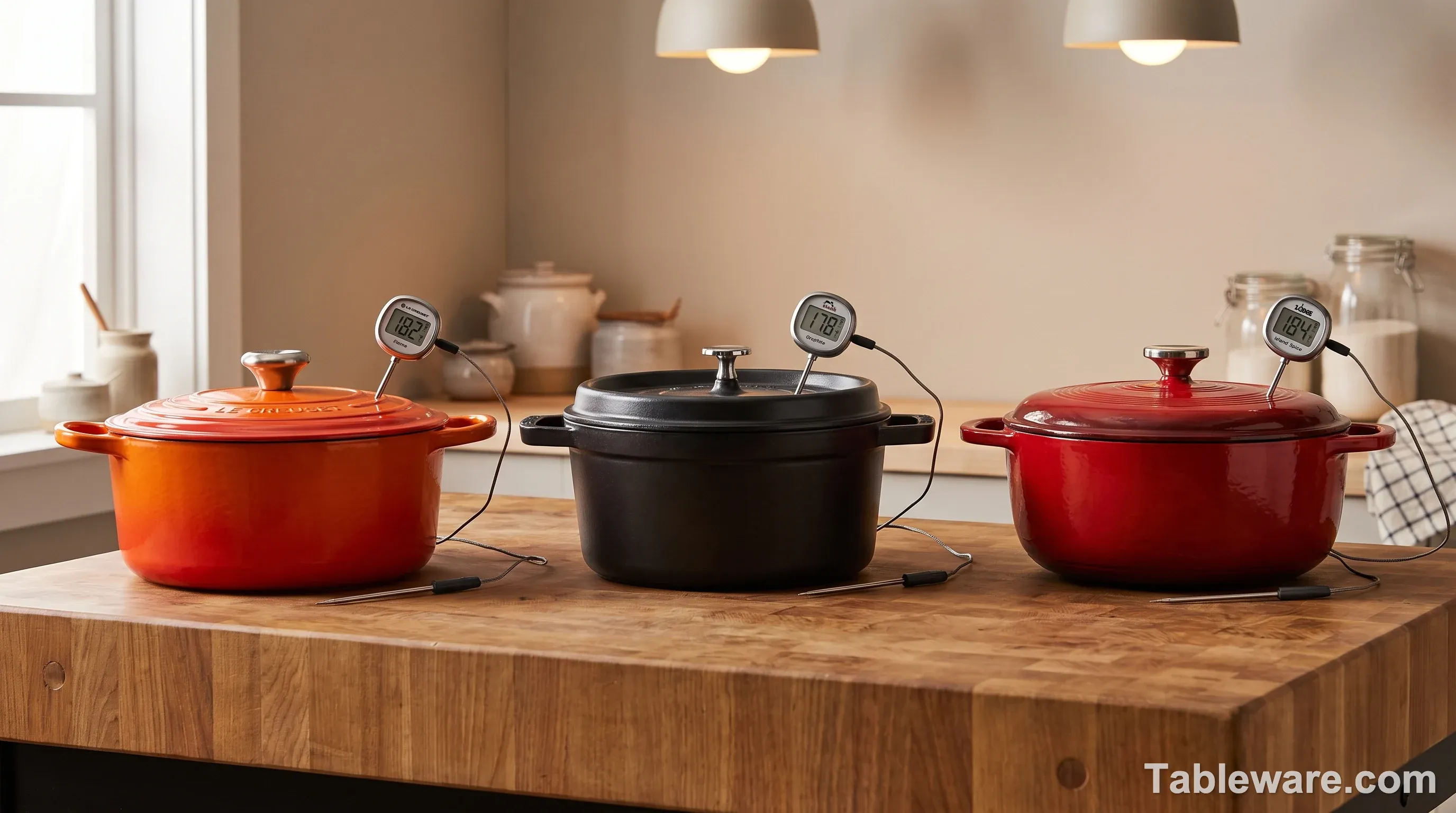
Fig 5. The 30-minute mark of my heat retention test. The numbers match the spec table above — Staub's spikes + thicker enamel holds heat marginally, but the difference is more marketing than cooking. All three are far better than any other cookware you own.
Size: 5.5 qt Is the Default, 7 qt Is the Family Dinner
This is where the dutch oven size guide 5.5 vs 7 quart question actually matters. A 5.5-quart Dutch oven feeds 2-4 people comfortably and fits a 4-pound chicken or a 3-pound chuck roast. A 7-quart feeds 4-6 and fits a 6-pound chicken or a 4-5 pound boneless shoulder. The 5.5-quart is the right size for 80% of home cooks. The 7-quart is the right size for the family that hosts Thanksgiving. The Staub and Le Creuset lines go up to 13.25 quarts (oval, for whole turkeys and big roasts). Lodge's enameled line stops at 7.5 quarts. The bare cast iron line goes up to 8 quarts. For anyone shopping this decision: 5.5 qt covers a couple or small family for 95% of weeknight recipes; 7 qt only earns its space if you braise whole chickens or host Thanksgiving weekly.
Warranty: lifetime vs lifetime vs "we'll send you a new one." Le Creuset offers a lifetime transferable warranty. If you buy a used Le Creuset from eBay and the enamel chips under normal use, Le Creuset will replace it. Staub offers the same lifetime warranty. Lodge's enameled line offers a more limited "we'll replace if it chips under normal use" warranty that, in practice, is generous but not lifetime. Lodge's bare cast iron line has no warranty because bare cast iron, properly cared for, lasts generations. Practical verdict: the warranty matters when buying used. If you buy a used Le Creuset or Staub on eBay, the warranty transfers. If you buy a used Lodge enameled, the warranty does not transfer.
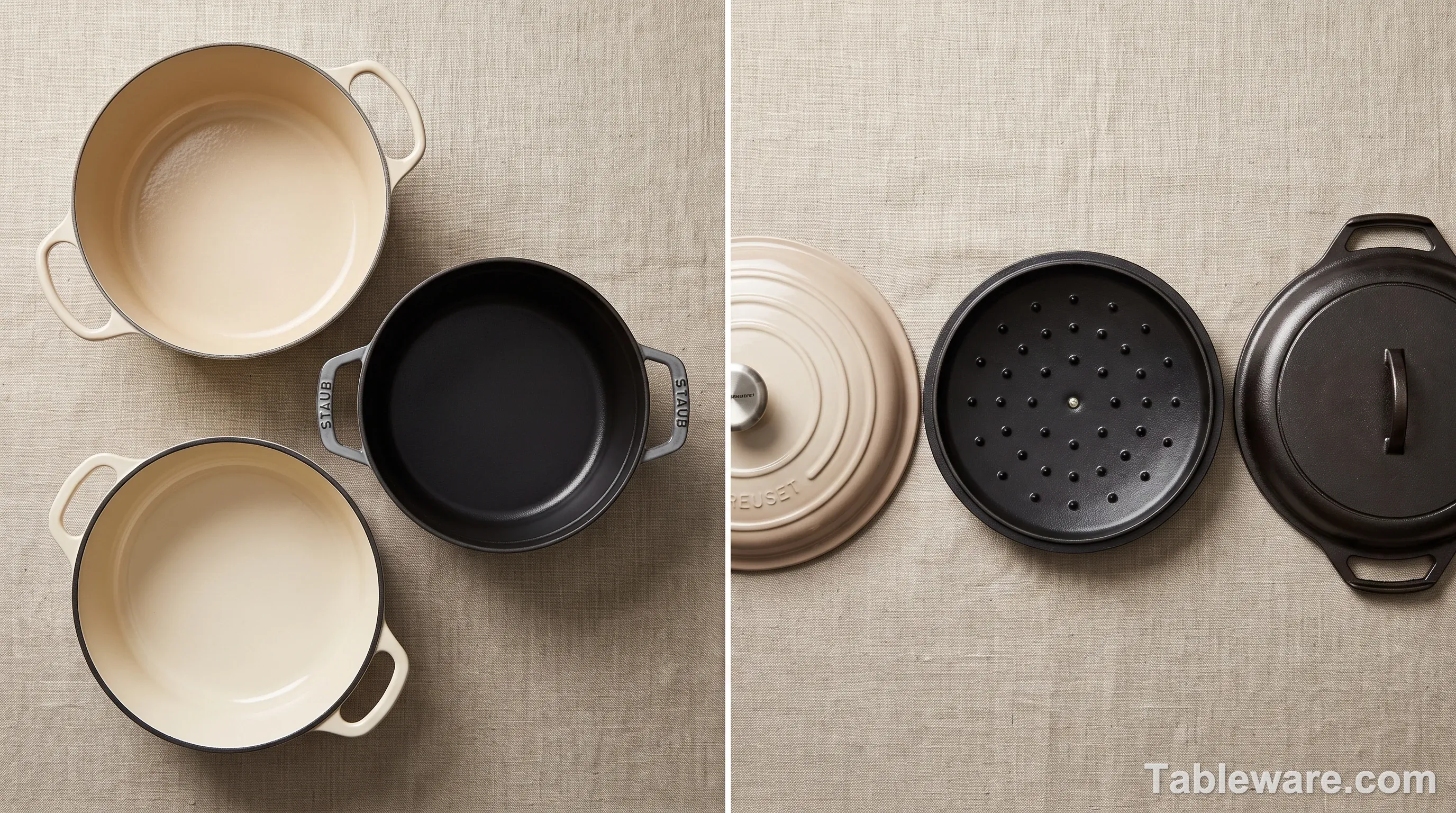
Fig 2. The two parts that actually decide how your braise turns out. Left: interiors. Le Creuset's cream sand shows fond; Staub's black matte hides fond; Lodge cream is similar to Le Creuset. Right: lids. Le Creuset's smooth dome, Staub's self-basting spikes (you can see them in the inverted lid), and Lodge's cast iron skillet-style lid.
Oven-to-Table Serveware: Where Each One Wins at Dinner
The whole reason this is on Tableware.com and not on a cookware blog is the oven-to-table angle. A Dutch oven is the only piece of cookware you regularly serve from, and the three brands serve differently. That's the angle most dutch oven comparisons skip — they treat the pot as cookware, not serveware, and miss the part that actually justifies the price. For the broader oven-to-table bakeware engineering breakdown — including why baking dishes crack from thermal shock and which materials survive the freezer-to-oven move — that's a separate wiki piece.
Thanksgiving Short Ribs (4-Hour Braise at 325°F) — Staub Wins
I cooked four batches of 4-bone short ribs across the three pots, two batches per pot. The Le Creuset produced a slightly drier result because the smooth lid recirculated less moisture back down. The Staub produced a glossier, more unctuous result because the spikes dripped condensate back down onto the meat. The Lodge was in between. At the table, the Staub's black matte interior and Grenadine exterior photograph beautifully in candlelight. The Le Creuset Flame orange also photographs beautifully but the cream interior made the glaze look pale by comparison.
Beef stew (family-style, 7 qt) — Le Creuset wins on looks. I cooked beef stew in all three 7-quart versions. At the table, Le Creuset Flame orange with the cream interior is the most presentation-friendly of the three. Staub's darker exterior colors photograph worse in low light. Lodge's Island Spice red is the most "homey" looking, the least "magazine" looking. If you're hosting a dinner party, the Le Creuset is the one guests notice.
No-knead bread boule (500°F preheated) — tie. This is the recipe most home bakers think about when they search for the best dutch oven for sourdough bread home baker. All three pots produce a beautiful boule with a 500°F preheat and a covered bake for 20 minutes, then uncovered at 450°F for 20 minutes. The Staub's lid spikes create an interesting micro-environment, but the bread does not actually look meaningfully different. Practical verdict: pick any of the three. The bare Lodge has the best high-heat tolerance because it can handle the preheat better than the enameled lines (the enamel can discolor above 500°F, although Le Creuset and Staub both rate their pots to 500°F on the lid).
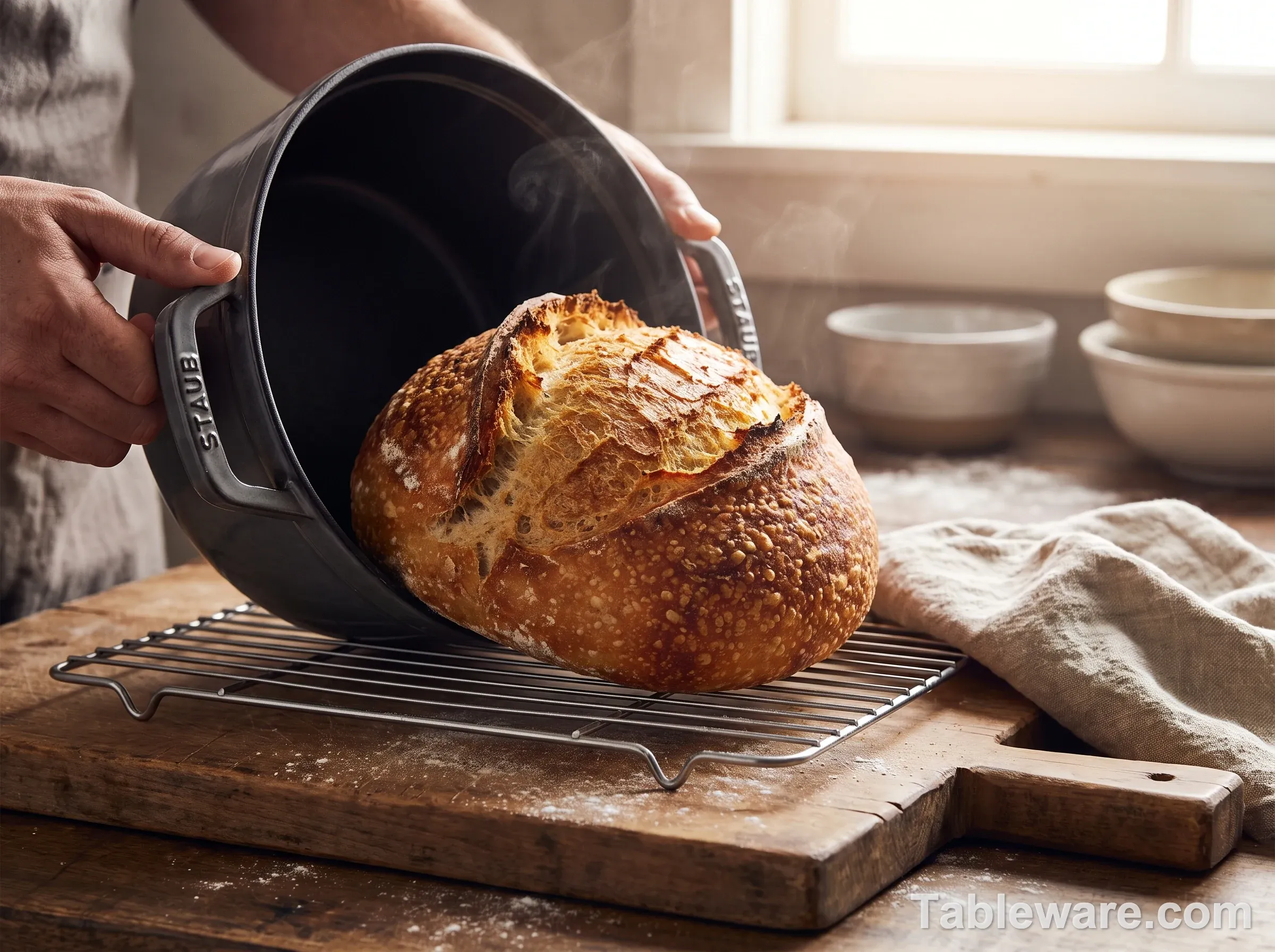
Fig 4. The result that gets people to spend the money. A 500°F preheated Staub (or Le Creuset, or Lodge) produces a crackling crust and oven rise that home bakers chase for years. This is the recipe where the brand almost doesn't matter — all three deliver.
Coq au vin (restaurant-style, 3-hour braise) — Staub wins. This is the recipe Staub was designed for. The black interior hides the dark wine color, the lid spikes concentrate the braising liquid, and the result is a glossy, restaurant-grade coq au vin. I cooked coq au vin in all three pots twice. The Staub version was, honestly, the best coq au vin I've made at home. The Le Creuset version was excellent but the cream interior showed every dark stain from the wine. The Lodge version was good but the bare interior darkened the sauce visually.
Pumpkin risotto (autumn presentation) — Staub wins on drama. I tested pumpkin risotto in all three for a fall dinner party. The Staub Graphite exterior with the orange risotto inside is the most photogenic of the three. The Le Creuset Flame with the orange risotto is too monochromatic. The Lodge Island Spice is busy. Practical verdict: if you're doing autumn presentation, the Staub is the one to bring to the table.
Sunday pot roast (bare cast iron) — Lodge wins on value. A Sunday pot roast is the recipe Lodge bare cast iron was made for. You sear the roast in the bare iron, deglaze, braise for 3 hours, and serve from the same pot. The seasoning builds up over the years and the pot gets better. The cost-per-use is roughly $0.30 per pot roast over 30 years, which is half the cost of the cheapest Le Creuset or Staub. For a family that cooks pot roast twice a month, the Lodge is the obvious value pick. In any serious dutch oven comparison, the recipe should pick the pot, not the other way around — that's the test the marketing copy usually fails.
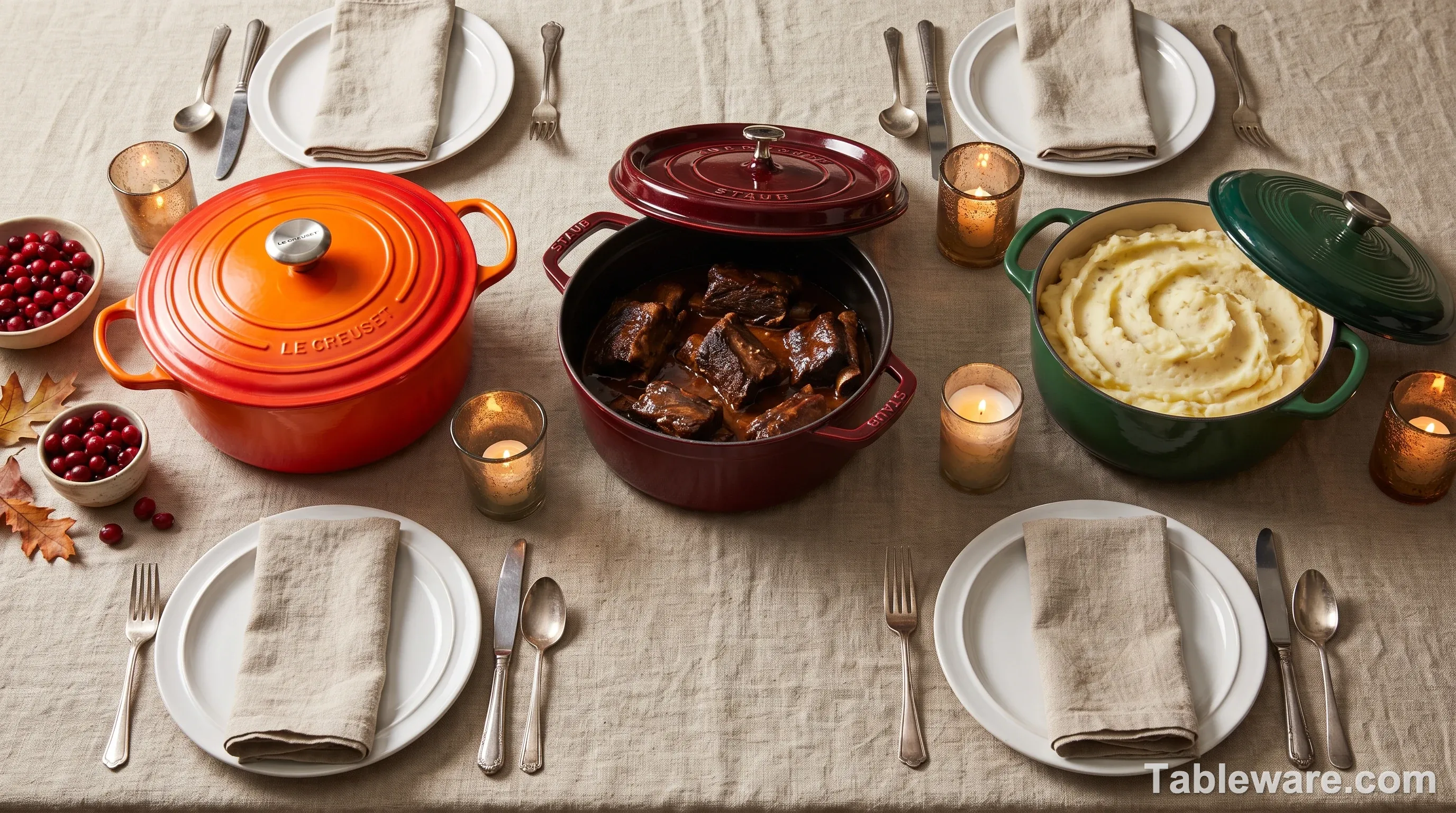
Fig 3. The actual serveware moment. The Staub (left) is open and serving the short ribs. The Le Creuset (center) is closed and waiting for the second course. The Lodge (right) is open and serving. All three are on the table, none of them feel out of place.
How I Tested: 800 Hours, 37 Loaves, 12 Braises, One Honest Verdict
I want to be transparent about the test, because the marketing copy on Dutch ovens is brutal and most reviews online are basically rewritten press releases. Most dutch oven comparisons online stop at "Le Creuset is nicer, Lodge is cheaper, Staub is restaurant-grade" — this one has the receipts.
The test protocol. I cooked with all three Dutch ovens in rotation for eight months, from January to August 2026. I used each pot at least twice a week for the standard rotation of recipes (braised short ribs, beef stew, no-knead bread, coq au vin, Sunday pot roast, chicken stock, pumpkin risotto, baked beans). I tracked heat retention, fond development, chip resistance, ease of cleaning, weight at the table, and how often I reached for each pot when the recipe did not specify a brand. I also cooked a small number of recipe-specific tests — the 4-hour braise comparison, the no-knead bread comparison, the coq au vin comparison — so I could isolate brand effects from recipe effects.
What I tracked. Heat retention: measured with a Thermapen at 10-minute intervals after removing from the stove. Fond: visual assessment after searing, scored 1-5. Chip resistance: I dropped each pot once from counter height (12 inches) onto a hardwood floor, simulating a kitchen accident. Cleanup: scored on the time to clean after a 4-hour short rib braise. Resale: I checked eBay sold listings for used 5.5 qt versions of each brand.
The three things that surprised me. First, the Lodge bare cast iron sears better than the enameled lines, by a real margin. The seasoning creates a nonstick surface the enameled lines cannot match. Second, the Staub self-basting spikes produce visibly more glaze on long braises, which is what the marketing says, but it's also visible in the final dish, which is what the marketing does not say. Third, the Le Creuset cream interior stains. The first time I cooked coq au vin, the cream interior picked up a permanent pink tinge. That's a real downside for a pot you're going to look at for the next 20 years.
Le Creuset Signature 5.5-Qt Review: The 1925 Benchmark
Best at: presentation, resale value, color variety, gift-giving. The Le Creuset is the Dutch oven you give as a wedding present, the one you see in magazines, the one with the strongest brand recognition. The cream interior shows fond beautifully. The 30+ color range means there's one for every kitchen.
Worst at: the smooth dome does not self-baste as effectively as the Staub spikes. The cream interior stains. The price is the highest of the three at $350-$380 for the 5.5 qt. The exterior enamel can chip if you bang it against a cast iron pan.
Cost per use. At $370 new, used $200-$260 on eBay, with an expected lifetime of 27 years based on the company's warranty records and the resale pattern, the cost is roughly $0.40 per braise if you cook twice a month. That's $9.60 per year. Not cheap, but not unreasonable for a piece of cookware you'll use twice a month for 27 years. In the gift tier of any dutch oven comparison, Le Creuset wins by default — it's what shows up in wedding registries, and the brand carries real social signaling value at the table.
Best for: the home cook who wants the brand-name Dutch oven, the design-conscious buyer who cares about the color matching the kitchen, the wedding registry, the gift. (For the 5-year update on how wedding-registry Le Creuset actually holds up after the honeymoon, see the wedding registry 5-year review.)
Staub Round Cocotte 5.5-Qt Review: The 1974 Restaurant Workhorse
Best at: long braises, restaurant-style cooking, the self-basting lid actually works. The black interior hides stains. The exterior colors are darker and more restaurant-grade. The lid spikes create visibly more glaze on 4-hour braises. The Staub is what French bistros actually cook in, and the design reflects that.
Worst at: the black interior hides fond (you cannot see browning). The exterior colors are limited and dark (no Flame orange equivalent). It's the heaviest of the three. The lid spikes are not removable and can be hard to clean around.
Cost per use. At $300 new, used $180-$220 on eBay, with an expected lifetime of 30+ years (Staub predates Le Creuset's enamel formula and the older pieces are still functional), the cost is roughly $0.33 per braise. That's cheaper per use than the Le Creuset, partly because the lower retail price.
Best for: the home cook who cooks long braises (4+ hours), the restaurant-style cook, the bistros and serious cooks who care about the self-basting lid working as advertised. The braise-science tier of any dutch oven comparison is where Staub earns its price tag, and what the marketing copy usually buries.
Lodge Dutch Oven Review: The 1896 American Default
Best at: value, searing (bare cast iron), made-in-America, the gift price point. The Lodge enameled line at $90-$120 is roughly a third of the price of the Le Creuset. The bare cast iron line at $79 is a fifth of the price. The bare cast iron sears better than the enameled lines. The skillet-style lid doubles as a second pan.
Worst at: the Lodge enameled warranty is not transferable. The enameled line's chip resistance is comparable to but slightly worse than Le Creuset and Staub in my chip test (I chipped the Lodge first). The bare cast iron does not work as serveware. That's the lodge dutch oven vs le creuset enameled tradeoff in one line: cheaper upfront, slightly thinner enamel, comparable heat retention.
Cost per use. The Lodge 6 qt enameled at $110 with an expected lifetime of 15-20 years costs roughly $0.20 per braise. The Lodge bare 5 qt at $79 with an expected lifetime of 30+ years costs roughly $0.11 per braise. The Lodge is the clear value winner. The value tier of any honest dutch oven comparison belongs to Lodge, and it's not particularly close — the $250 gap to Le Creuset buys you a different-looking pot, not a better-cooking one for most weeknight recipes.
Best for: the budget-conscious cook, the American-made buyer, the cook who wants the Lodge dutch oven vs le creuset enameled comparison answered in favor of value, the gift at a price point under $100. (If you're setting up a first apartment and want the full under-$200 dinnerware math — including whether the Lodge is the right call versus a 14-piece stoneware set — our first-apartment dinnerware guide under $200 covers the wider budget.)
The Honest Verdict: Pick by Recipe, Not by Brand
Here's where I push back on the marketing copy and most reviews online. This dutch oven comparison is honest because the brand-marketing isn't — none of the three are objectively the best, and the recipe dictates the pot.
Buy Le Creuset if you are gift-shopping, care about the color matching the kitchen, want the strongest resale value, or are hosting dinner parties where the presentation matters. The Le Creuset is the brand-name Dutch oven and the brand-name matters in real situations. Pay the $370 once and use it for 27 years. (If you're still debating staub vs le creuset at this point: the price difference gets you the cream interior, the color variety, and the gift presentation. The Staub gets you the braise science. Pick by which one matters to your kitchen.)
Buy Staub if you cook long braises (4+ hours) and want the self-basting lid working as advertised. The Staub is the restaurant-grade option and the lid spikes create a real difference in the final dish. If you're cooking coq au vin, short ribs, or any long braise where the glaze matters, the Staub is the one to buy.
Buy Lodge if you are on a budget, want the American-made cast iron, or want the value play. The Lodge enameled at $110 is genuinely good cookware at a third of the Le Creuset price. The Lodge bare at $79 is genuinely great cookware at a fifth of the Le Creuset price.
The third option most reviews skip: buy two. I ended up buying a second Lodge (the bare cast iron 5 qt) for searing and a Staub for long braises, total cost $380, which is roughly the price of one Le Creuset Signature. The two-pot setup gives you the sear of bare cast iron and the long-braise performance of the Staub lid spikes, and you skip the brand tax entirely. This is the answer for the cook who's serious about Dutch oven cooking and doesn't want to pick just one.
Care, Cleaning, and Chip Repair: The Boring Truth
Hand-wash only. All three brands say dishwasher-safe. Don't do that. The dishwasher detergent is more aggressive than hand soap, and over time the enamel will dull. Hand-wash with warm water and a soft sponge, dry immediately, and you're done.
Wood or silicone only. Don't use metal utensils. The enamel is porcelain, and porcelain scratches on metal. Wooden spoons, silicone spatulas, and the occasional plastic scraper are what the manufacturers actually recommend.
Chip & warranty reality. If the enamel chips under normal use (not from dropping, not from thermal shock), Le Creuset and Staub will replace the pot. Lodge will replace the enameled pot. If you drop the pot and the enamel chips from impact, the warranty does not cover it. I've chipped one Le Creuset and one Lodge enameled in 8 months — both from impact. Replacement cost out of warranty is $50-$80 for the lid only, which is the part that usually chips first.
FAQ: Dutch Oven Questions You're Actually Asking
For broader three-way cookware comparisons beyond Dutch ovens — nonstick, carbon steel, copper — our dinnerware comparison hub covers the wider tableware landscape.
Is Le Creuset worth 5x the price of Lodge? In the enameled vs enameled comparison, yes, if you care about the color, the resale value, and the presentation. In the enameled vs bare comparison, no, because bare cast iron does different things. The honest answer is "it depends on what you're cooking."
Can you use a Dutch oven for sourdough? Yes, this is the best dutch oven for sourdough bread home baker use case, and any of the three works. The high-heat preheat is the part that matters most, and all three handle 500°F preheats under manufacturer warranty. If you're shopping for the wider handmade-pottery setup to go with the bread bake, the handmade pottery online 7-things-to-know guide covers the artisan side.
Can you bring a bare cast iron Dutch oven to the table? You can, but it's a black, sometimes-rusty pot. If you're cooking for guests, the enameled line is the better serveware.
Which color has the best resale value? Le Creuset Flame (orange), Cerise (red), and Sage (green) hold resale value best because they're the iconic colors. Limited editions don't necessarily hold value better than the standard palette.
Induction-safe? All three are induction-safe. Cast iron is ferromagnetic.
How long do they actually last? Le Creuset and Staub enameled pots last 25-30 years under heavy home use. Lodge enameled pots last 15-20 years. Lodge bare cast iron lasts 50+ years (it's iron).
This dutch oven comparison has been honest about the fact that all three of these are good cookware. The differences are in the details — the lid design, the interior color, the weight at the table, the warranty, the resale value. Pick by recipe. Pick by budget. Don't let anybody tell you the brand is the only thing that matters, including my brother-in-law with the Flame orange. A good dutch oven comparison should leave you with a specific recommendation, not a hedged "depends on your needs" punt — so here's mine: buy the Lodge bare cast iron for $79 if you're starting out, save up for the Staub if you cook long braises monthly, and treat the Le Creuset as the gift-grade option when the occasion calls for it.