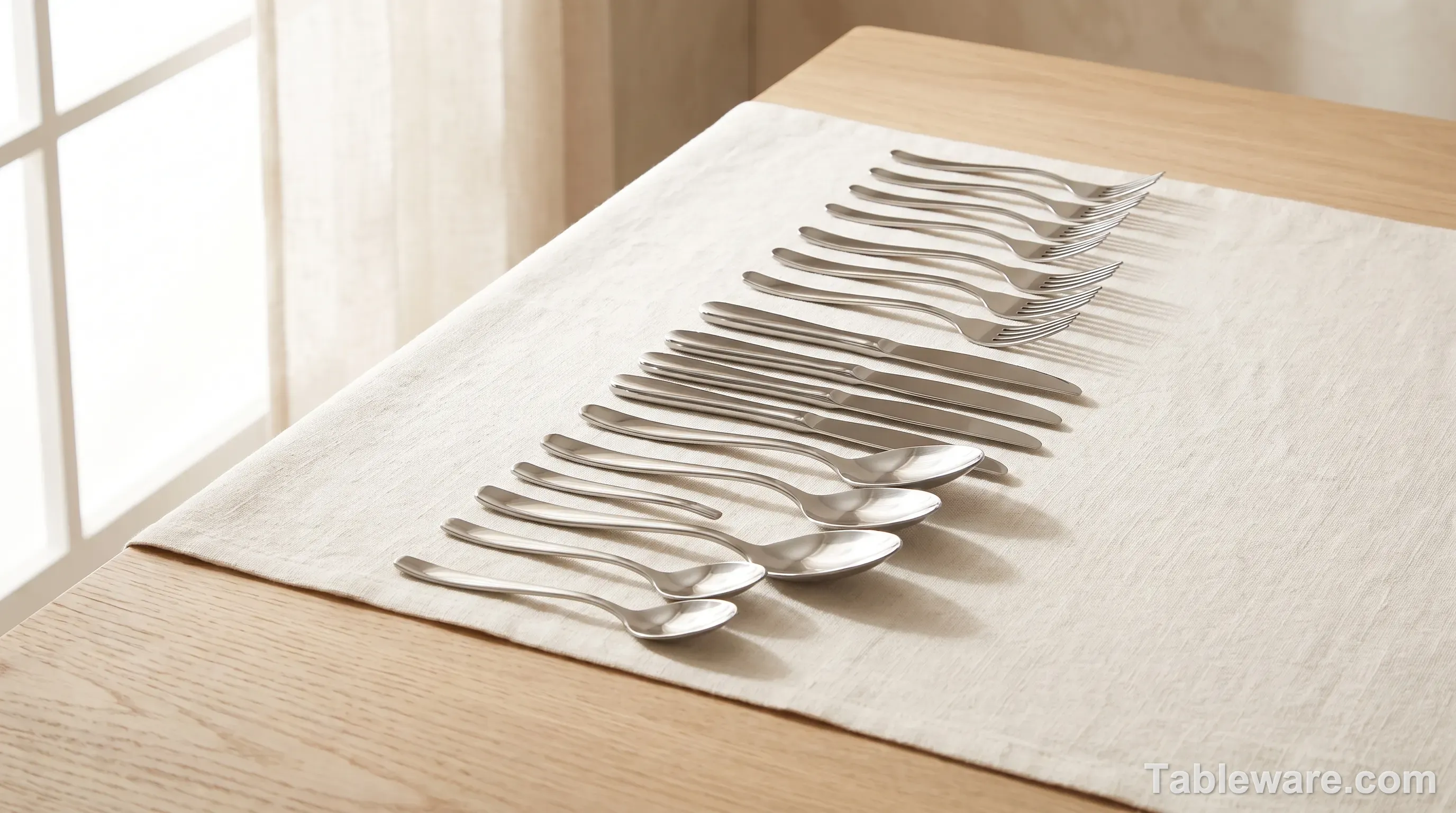
How to Buy Flatware That Lasts 20 Years: 6 Specs to Check
Here's the number that killed my last set: fourteen.
I bought a 20-piece flatware set from a job-lot marketplace in 2021. Stainless, marked 18/10, $70 including shipping. It looked great in the listing photos. Fourteen months later one of the dinner forks had a soft spot in the bowl where the metal had thinned and flexed, and my daughter flicked it across the kitchen floor while she was setting the table and it landed in two pieces at the bolster.
The rest of the set is fine. The salad forks are great. The spoons are great. It's the one cheap fork that cost me a trip to Target at 9pm.
Nothing about that set advertised cheapness, and if you knew how to buy flatware that lasts, that fork is the last thing you'd have brought home. Nobody in 2021 was selling a $70 set by saying "this will fall apart." They were selling it with the word stainless, the number 18/10, and a photograph of a table setting that looked like a magazine. A few words of truth doing all the work.
So here's how to buy flatware that lasts — not for a decade in a rental apartment, but for twenty years, through moves, kids, dishwashers, and the specific moment when someone drops a fork onto a tile floor and you're holding your breath. Six specs. That's the whole list.
If you're in a hurry, the short version is this: 18/10 stainless with a solid or hollow-handled dinner knife, forged if the budget allows, 2.5mm or thicker, weight checked per-piece in the store rather than per-set. The rest is detail.
First, a Vocabulary Thing Nobody Explains to You
Before the specs, one word that trips people up: flatware.
Flatware is the industry-standard American term for knives, forks, and spoons regardless of what they're made of. Stainless, silver, pewter, gold-wash — all flatware. "Silverware" technically means flatware containing silver, which is why restaurants that serve actual sterling often call it silverware and everything else flatware.
Regular Americans say silverware to mean "the spoons," which is why you'll see "silverware sets" used interchangeably with "flatware sets" on Amazon and at Target. Nothing is wrong with either word in conversation. For shopping, though, flatware is the accurate term — searching "silverware" pulls you toward sterling silver and plated sets you're not looking for. We use flatware throughout this guide.
Now, the specs.
1. 18/10 vs 18/0 Stainless Steel Flatware: What the Numbers Mean
This is the first place marketing does real work, so let's take it apart.
The numbers are chromium and nickel, by percentage. 18/10 is 18% chromium and 10% nickel. 18/0 is 18% chromium and zero nickel. In technical specs, 18/10 almost always points to grade 304 stainless and 18/0 almost always points to grade 430.

Side-by-side crystal structure diagram: on the left, 18/10 austenitic steel with nickel atoms locking a face-centered cubic lattice that will not respond to a magnet; on the right, 18/0 ferritic steel with a looser body-centered cubic lattice that does. Clean technical illustration, warm cream background, muted teal and amber line work, minimal labels.
The first number is always 18, and it does almost nothing for you
Here's the part most "18/10 vs 18/0" comparisons get backwards. The first number is chromium, and chromium is what forms the invisible passive oxide layer that actually resists rust. Both alloys have the same 18%.
So on the axis you'd think matters most — rust resistance of the surface itself — they're identical. The difference lives entirely in the second number.
Nickel is where the durability and the price live
Nickel does three things in this context. It stabilizes the crystal structure into what's called austenitic, which resists pitting and staining better over decades. It adds ductility, so the metal bends under pressure instead of snapping. And it's what holds a high polish — nickel-rich steel keeps a gloss where nickel-poor steel goes dull and grey.
It's also expensive. Nickel trades around $7 to $10 a pound, against well under fifty cents a pound for iron. Pulling 10% nickel out of the alloy cuts a real chunk of the raw material cost, and some of that saving reaches the retail price. This is genuinely why 18/0 exists — it's a budget alloy, and there's nothing dishonest about it. It's just not the one you want if you plan to keep the set.
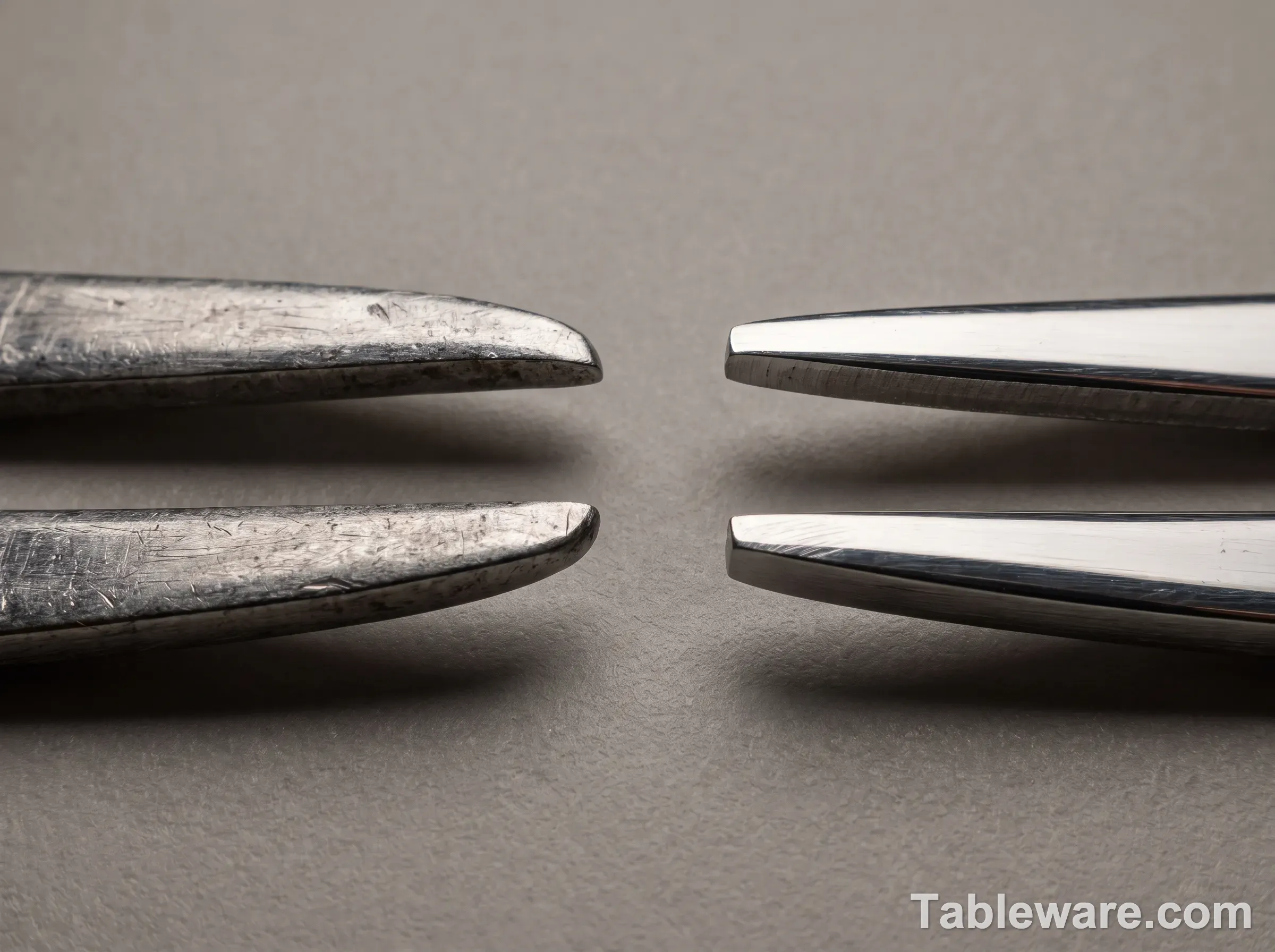
Extreme macro comparison of two dinner fork tines: on the left, a soft, dull, visibly thinned tine from a low-gauge budget fork, metal worn thin at the tip; on the right, a crisp machined tine with clean edges. Neutral gray background, raking side light, forensic product photography.
18/0 also deforms. Ferritic 430 at flatware thickness has less give than 304, which is why you'll find 18/0 in cheaper construction and why budget sets tend to bend rather than flex. A heavy, well-finished 18/0 fork will feel better in the hand than a flimsy 18/10 fork. Material is not the same thing as build quality.
The magnet test, and why it proves almost nothing
This one drives me up a wall, because it keeps resurfacing as advice. Magnet test: if it sticks, it's bad.
18/0 ferritic steel is magnetic. 18/10 austenitic steel is not magnetic when annealed, though cold working during manufacturing can give it a slight magnetic response. So the magnet roughly sorts the two alloys apart.
But magnetism is not a quality score and not a food-safety test. It's a crystal-structure artifact. Judge the alloy on the stamp and the manufacturer's spec, and judge the fork on its weight, its edges, and how it feels — none of which a magnet can tell you.
My rule: if the set doesn't state 18/10 or a grade number on the listing or the backstamp, I don't buy it. Ambiguity on the alloy is the strongest signal you'll get that nobody at the company is paying attention.
2. Knife Steel Grades for Flatware Blades: How to Buy Flatware That Keeps Its Edge
Table knives are the only cutlery where steel grade genuinely matters, and nobody explains why, so let me.
Your chef's knife is a tool. It gets sharpened on a stone, it gets a hard edge, it holds for weeks. A dinner knife does something different: it sees a bone, a fish spine, a grapefruit rind, and a stack of plates landing on it at once. It never gets properly sharpened in most households, ever. Serrated dinner knives basically never get sharpened at all.
Which means the steel a dinner knife uses should be tough and corrosion-resistant, not maximally hard. A 65 HRC blade is the wrong answer for a dinner knife. It'll chip on the first bone.
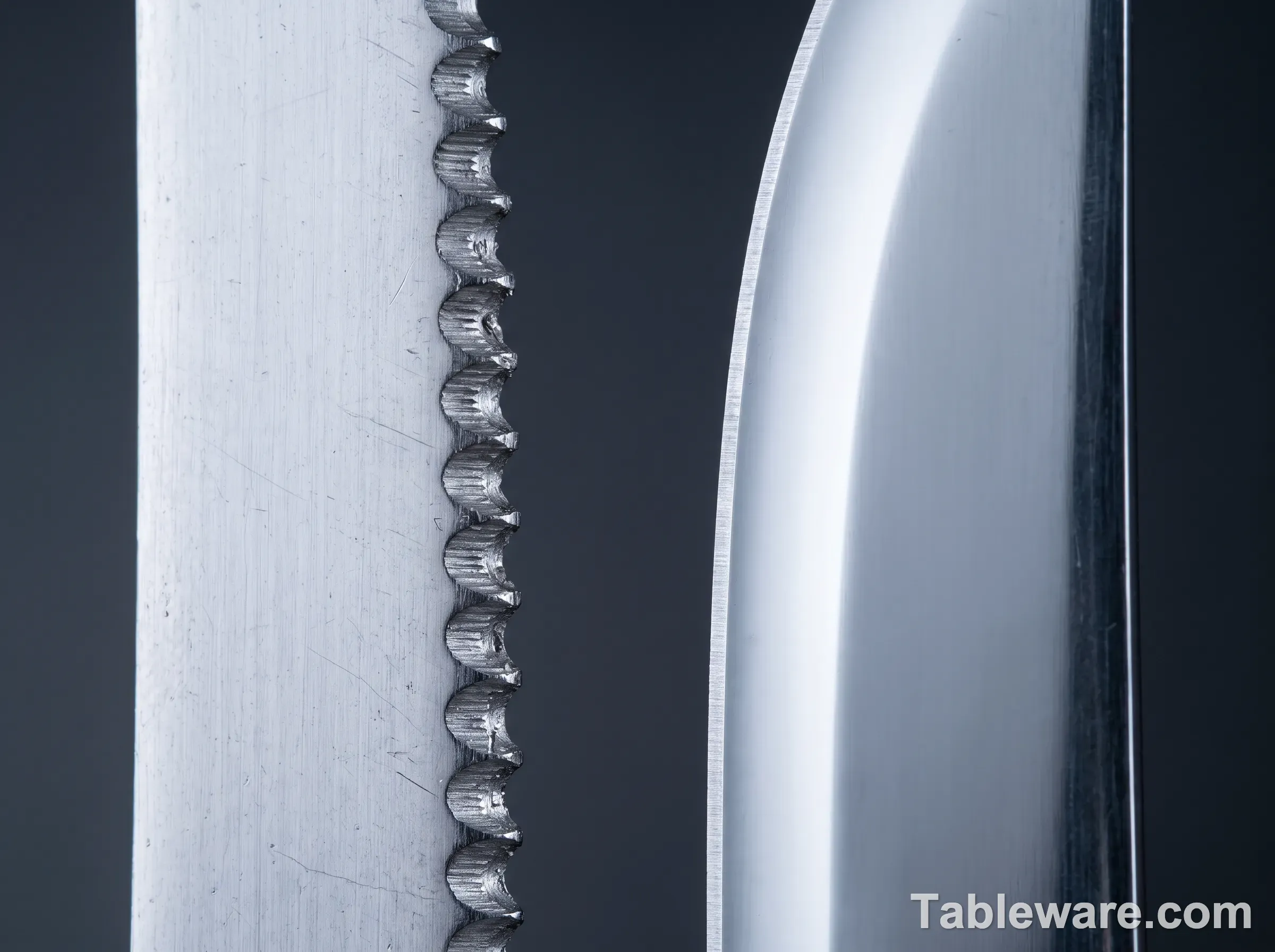
Two knife edges under a microscope-like macro lens: on the left, a serrated dinner knife edge with its fine scalloped teeth, designed to saw rather than slice; on the right, a hollow-ground dinner knife edge with a polished concave grind. Cool neutral studio light, dark charcoal background, high detail.
Serrated is the correct answer for most people
A serrated edge works by sawing. The teeth do the cutting, and there are a lot of them, so each tooth does very little. It's forgiving, it barely needs sharpening, and it handles soft bread and cake without turning it to shavings.
A hollow-ground dinner knife — the kind that's part of the actual cutlery tradition, sharpened with a special grooved sharpening steel — gets a genuine straight edge and slices. It's prettier and better at cutting soft food, and it costs you more to maintain.
For most households with one sharpening steel that lives in a drawer and never gets used: serrated. I'm not being lazy, I'm being honest about what happens in real kitchens.
What the steel numbers actually mean
Common grades in table knives, roughly:
- 420 / 420HC — 0.15–0.40% carbon, 12–14% chromium, 48–55 HRC. Very corrosion-resistant and tough, easy to sharpen, holds an edge poorly. This is the cheap-set default and it's not a bad material, it's just not a sharp one.
- 5Cr15MoV — 57–59 HRC. Molybdenum and vanadium in the mix; good wear and corrosion resistance. Very common in mid-range Chinese-manufactured table knives.
- 440C — 0.95–1.20% carbon, 16–18% chromium, 56–60 HRC. Excellent edge retention, tougher than you'd expect, more expensive.
- X50CrMoV15 — the German standard, roughly 56–58 HRC. Tough, easy to maintain, favored by Wüsthof and Cangshan. This is the "boring and reliable" answer.
- VG-10 — about 60–61 HRC, Japanese, favored by Shun. Harder than a dinner knife needs.
For flatware, the German standard and 5Cr15MoV are the sweet spot: hard enough to stay sharp, tough enough to survive contact with a serving dish. Don't pay a premium for VG-10 in a dinner knife. You're buying hardness your steak knife should have.
3. Forged vs Stamped Flatware: Which Construction Survives
Forged vs stamped flatware is the second-biggest price driver after brand name, and it's the one with the clearest payoff.
Forged means each piece is cut from solid steel bar and shaped by pressing or hammering under pressure. The metal's grain gets refined and compressed during forming. Pieces are thicker, heavier, more rigid, and more expensive.
Stamped means the piece is cut from a rolled steel sheet with a punch and die, like a cookie cutter. It's fast, it's cheap, and the thickness is fixed by how thick the manufacturer rolled the sheet.
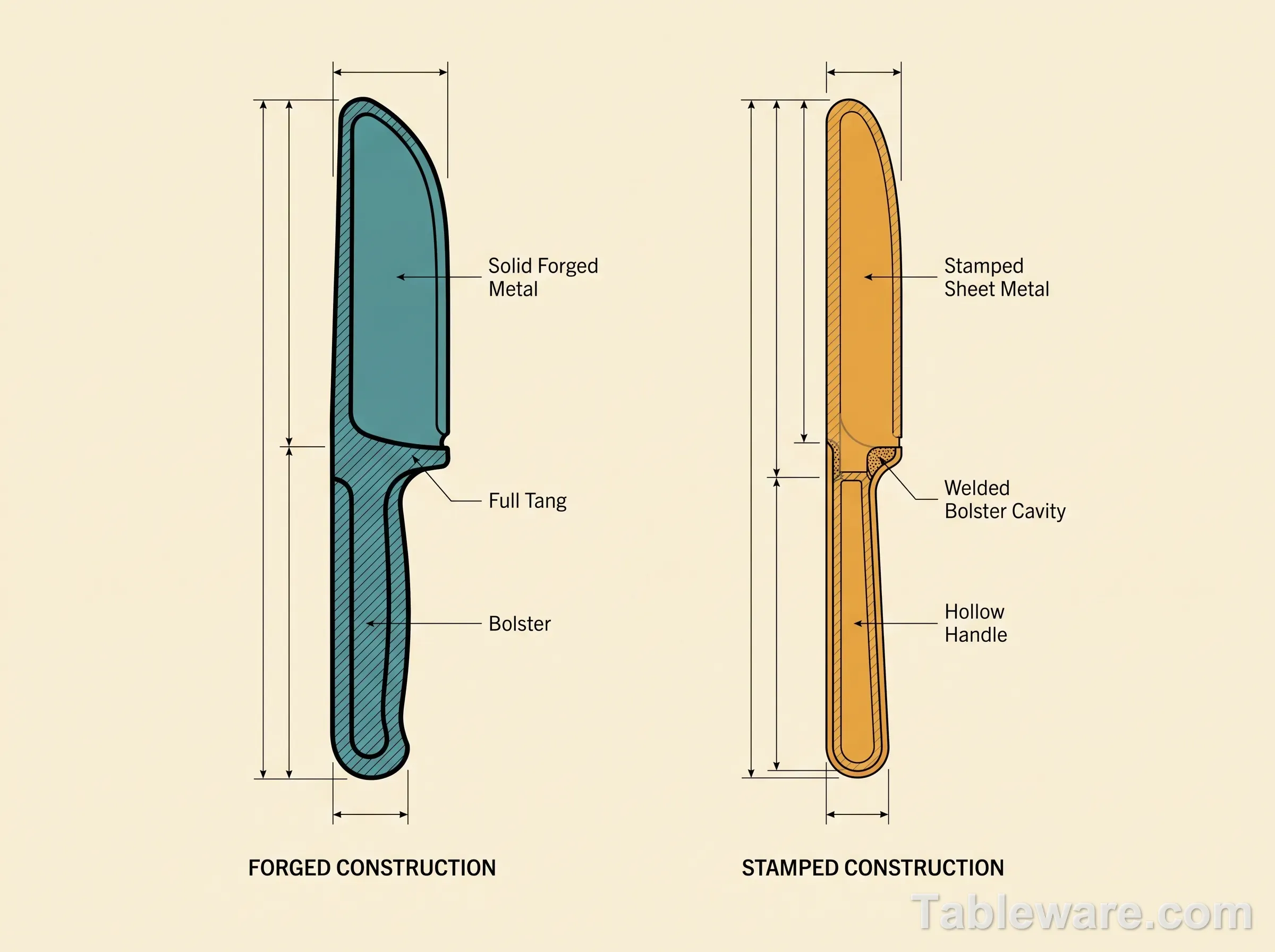
Cross-section comparison: on the left, a forged dinner knife showing solid, continuous steel through the full bolster and tang, noticeably thicker section; on the right, a stamped dinner knife showing a thin uniform wall with a hollow, welded bolster cavity. Clean technical illustration, warm cream background, muted teal and amber line work.
What survives fifteen years
A stamped dinner knife has a finite amount of steel in it. The tines deflect. You flex it cutting a sheet cake, the metal work-hardens at the joint, and one day — usually fourteen months in, or forty, depending — there's a soft spot where the fork tears instead of bends.
A forged piece has enough metal there to just take the abuse. It resists the deflection cycle that kills stamped pieces.
The difference is visible if you look at the bolster — the thick section where the blade meets the handle. On a stamped knife it's often a hollow shell, sometimes welded closed. Bend it gently and you can feel it move. On a forged knife it's solid all the way through.
Reading thickness and gauge on a retail listing
Retail listings rarely say "forged" or "stamped" clearly. What they do sometimes list is a gauge. Stainless flatware sheet runs roughly 0.6mm to 2.5mm. Anything under about 1.5mm is going to feel like a toy. Look for a listing that mentions a gauge of 2.0mm or higher, or that uses the words forged, drop-forged, or fully forged. Henckels calls theirs Forged Accent for exactly this reason, and it's the only reason the marketing name exists.
If the listing says nothing about construction, assume stamped. Brands that forge are loud about it, because it's a real differentiator they get to charge for.
Full tang, three-quarter tang, and the rivet question
Tang is how far the metal extends into the handle. A full tang runs the entire length of the handle. A three-quarter tang stops short. A rat-tail tang is a thin rod welded into the handle.
Full tang is better, but only noticeably better in a solid-handled knife. Here's the wrinkle most guides miss: in a hollow-handled knife, the tang isn't structural at all — the handle is two metal shells riveted or welded around a cavity, and the tang just fills it. Hollow handles are how nearly all fine dining flatware is built, because they balance better and cost less. Don't reject a hollow handle. Judge the bolster and the thickness instead.
The two visible rivets on a hollow-handled handle are holding the two halves together. If they're loose, spinning, or proud of the surface, the handle is already separating. That's a five-minute check at the store and it catches most of what's coming back under warranty.
4. Flatware Set Weight and Balance: Buy by Feel, Not by Label
This is the spec people feel most and research least.
A dinner fork should weigh somewhere in the range of 45 to 65 grams. A dinner knife, 80 to 110 grams. Below about 40 grams for a fork, the steel is too thin to feel substantial. Above about 70, you're holding a dense piece of metal and the fork starts feeling like a tool rather than tableware.
Balance matters more than raw weight, and it's the thing that separates a set you tolerate from one you reach for. A well-balanced dinner fork has most of its mass in the bowl and the handle is a lever, not a counterweight. Pick it up by the tip and it should feel almost weightless. Pick up a cheap fork by the tip and it feels like a lever with a lump on the end.
Why per-piece weight beats total set weight
Retail listings love total weight because it's a big impressive number. "This 20-piece set weighs 6 pounds." That's meaningless — it's an average across dinner forks, salad forks, teaspoons, tablespoons, and knives that have wildly different appropriate weights.
The number you want is per piece, for the piece you'll use most. A dinner fork should be 45–65 grams. If you can pick up one fork in a store and it feels like nothing, walk away regardless of what the set says on the box.
The 30-second test at the store
Pick up a dinner knife and hold it the way you'd hold a pen, loosely. Then hold it with a full grip, the way you'd actually use it. It should feel solid without your fingers clamping. Flex the tines of the fork gently — they should resist and spring back, not take a permanent bend. Tap the knife spine against your thumb — it should ring, not thud. Check the bolster for movement.
That's the test. It takes thirty seconds and it will tell you more than an hour of reading reviews.
If you're buying online, which is most of us, then buy from somewhere with a real return policy and test it at home with the same thirty seconds. Our guide to buying handmade pottery online covers the same principle for a category where you absolutely cannot touch the product.
5. Serving Pieces and Place Settings
Here's where sets quietly cheat you.
A "20-piece place setting" is 4 place settings of 5 pieces: dinner knife, dinner fork, salad fork, teaspoon, tablespoon. Five pieces. Twenty pieces total. Nothing else.
Serving pieces — the slotted spoon, the serving fork, the salad servers, the sugar and cream set — are sold separately, or bundled into a much bigger "45-piece" number that counts every tablespoon twice.
Work out what you actually need. For a household of four that hosts:
- Essential 20-piece: dinner knife, dinner fork, salad fork, teaspoon, tablespoon × 4. Covers most nights.
- Add salad servers — a pair, not a set of four. One pair for a table of four is plenty.
- Add a serving spoon and a slotted spoon. Two pieces, not twelve.
- Add a cake server and a fish server if you ever serve either. Most people never do, which is why they're sold as a set with a faux-brass caviar spoon you will use once.
- Tea and coffee: a 3-piece set — sugar, creamer, and a tray — or skip it until you own a teapot.
For entertaining eight, open stock beats a "service for 8" almost every time. You buy a second set of the five essentials, not sixteen pieces you'll use twice a year. There's a whole money argument about this in open stock vs full set dinnerware, and it applies with even more force to flatware because the serving pieces in a big service are the junk.
If you're also buying plates for the same table, the total-cost question matters more than the individual pieces. The real 10-year cost of a 12-piece dinnerware set covers that math.
6. Dishwasher Safety and Long-Term Care
Most flatware is stamped or forged from 18/10 or 18/0 with no cavity to trap water, so it survives a dishwasher considerably better than your plates do. But "dishwasher safe" is a finish rating, not a steel rating.
Three things actually shorten a flatware's life:
Heat is the enemy. The heated dry cycle is the harshest part of the machine. Warm flatware also attracts grease and protein film that bakes onto the surface. The single best habit is removing flatware from the machine and wiping it dry with a towel while you're still at the table. It costs eight seconds.
Water spots are cosmetic and mostly fixable. They come from hard water minerals left behind as droplets evaporate. A microfiber cloth on damp flatware clears them before they set. Vinegar soak — a minute in a 1:1 white vinegar solution — clears the ones that already set.
Chlorine bleach is not a flatware product. It attacks stainless and leaves the gray, pitted surface that never comes back. Many dish soaps contain chlorinated bleach, and many people use straight bleach on their silverware drawer. Use the dishwasher detergent and leave the drawer bleach alone.
Storage matters more than anything. Flatware stored damp in a closed drawer will spot. Dry it fully before it goes back. If you're the type to lose a serving spoon, a divided flatware tray solves both problems at once.
For the care mistakes that show up on plates and glasses too, seven dinnerware care mistakes covers the overlap.
How to Buy Flatware That Lasts: 6 Sets I'd Actually Buy
Prices are US retail as of October 2026 and move constantly — check current listings.
HENCKELS Forged Accent 20-piece — about $200. The reference point. Fully forged, 18/10, and you can feel the difference the first time you pick up a fork. Heavy-handled, which some people love and some find tiring. If you're buying one set for twenty years and can stretch to it, this is the answer.
ZWILLING J.A. Henckels — about $150–250 depending on line. Also German, also forged on the upper lines, and the prime line sits at a very similar price to Henckels. Compare specific patterns; the badge is often the only real difference.
Wüsthof — about $250–350. German forged, X50CrMoV15 steel. The best-behaved steel in the category. Costs more for the badge and the finish; the difference in the hand is real but smaller than the price gap.
Shun — about $300–400. Japanese VG-10, beautiful finish, noticeably sharper steel. For dinner knives specifically I'd spend that money elsewhere, but if flatware is a collecting interest for you, it's the most interesting object in this guide.
Chicago Cutlery and Cutco — $40–120. Stamped 18/10 with decent weight and a triple-bevel edge. Not forged, and the tines will eventually flex like anything stamped. Honest value at the price, best for a first apartment or a second set. Cutco's lifetime sharpening policy is genuinely worth something.
Oneida and Lenox — $80–200. Solid mid-market, mostly forged or heavier stamped, sold alongside their dinnerware lines so it matches the plates. Reasonable pick when you want a set that coordinates with something else you already own.
My honest ranking, if you only buy one: Henckels Forged Accent if the budget is there, Chicago Cutlery if it isn't, and never a set with no alloy stamp and no construction claim regardless of how good the photograph looks.
6 Buying Mistakes I See Every Week
1. Buying the 20-piece set for a wedding registry and never opening the serving pieces. This is the number one mistake. The 20-piece set is five essentials times four people. It contains zero serving pieces.
2. Believing "18/10 stainless" is a quality grade. It's an alloy composition. A thin, poorly finished, stamped 18/10 fork is still a thin, poorly finished, stamped fork.
3. Ignoring the dinner knife entirely. Most people buy a set based on the forks and discover two years later that the dinner knives have gone dull and splotchy and are the only pieces they never reach for.
4. Buying twice as many place settings as you have people. A household of two does not need 20 pieces. Buy 10, use the other ten to fix the pieces you already own, or save for serving pieces you'll actually use.
5. Skipping the return test. Most retailers have a 30-day return policy. Take the set home, wash it twice, eat with it a week. That test catches bent tines, loose rivets, and wobbly handles before you've committed.
6. Assuming sterling because the box says "silver." Some sets are sterling-plated — a thin silver layer over base metal. It looks beautiful in the first year and wears through in three. If you want silver, buy sterling sterling, or accept that you want stainless and don't pay a premium for a plating that will fail.
FAQ
Is 18/10 stainless actually better than 18/0 for flatware? Yes, for corrosion resistance and finish retention over decades — both have the same 18% chromium, but 18/10 adds 10% nickel, which resists pitting and holds a polish. 18/0 is cheaper and perfectly serviceable for casual use, and it bends rather than flexes. If you cook a lot of salty food or store flatware damp, go 18/10.
Does a magnet sticking to my flatware mean it's bad? No. Magnetism is a crystal-structure artifact, not a quality score or a safety test. 18/0 ferritic flatware is magnetic; 18/10 austenitic flatware is usually not, though manufacturing can give it a slight response. Judge the alloy on the stamp, and judge the piece on weight, edges, and feel.
How heavy should a dinner fork be? 45 to 65 grams is the useful range. Under 40 grams feels flimsy and will flex permanently. Over 70 grams and it stops feeling like tableware. Ignore the total set weight printed on the box and ask about one piece.
Is forged flatware worth the extra money? For dinner knives and forks, yes. Forging compresses and refines the steel grain, producing thicker, more rigid pieces that survive the flex-and-return cycle that eventually breaks stamped tines. It's the clearest quality-per-dollar upgrade in flatware after the alloy itself.
Should flatware go in the dishwasher? Most 18/10 and 18/0 flatware can, but the heated dry cycle is the harshest part of the machine and warm flatware attracts baked-on grease. Wipe pieces dry at the table before loading them, skip chlorine bleach entirely, and never store flatware damp.
What's the silverware vs flatware difference? Flatware is the material-neutral American term for knives, forks, and spoons — stainless, silver, or plated. Silverware technically means silver-containing flatware. Retailers and restaurants use both loosely, and most people use silverware to mean "the spoons," but flatware is the accurate search term if you want stainless.
How many pieces do I actually need for a family of four? A 20-piece set — dinner knife, dinner fork, salad fork, teaspoon, and tablespoon, four times over — is the right baseline. Add one pair of salad servers and two serving spoons. Skip the 45-piece sets; most of the extra count is duplicate tablespoons and serving pieces you'll never touch. The 3-phase set building guide covers the long-game version.
A Final Note
Twenty years is a long time for a fork, but the ones in my grandmother's drawer made it. They were plain stamped stainless, no alloy stamp anywhere on the handles, bought at a department store in a year I can't pin down. They're still there. They flexed a lot. They never snapped.
The set I ruined cost $70 and lasted fourteen months. The next one cost $210 and has now survived six years, two apartments, and a dishwasher that runs about four times a week. Not because it's expensive, but because somebody at the factory pressed it out of solid steel instead of stamping it out of a sheet.
Six specs. 18/10 over 18/0. Forged if the budget allows. Two millimeters or thicker. Serrated dinner knives unless you'll actually sharpen them. Forty-five grams or better on a dinner fork. Dry it before it goes back in the drawer.
Everything else on the box is decoration.