Dinnerware Care: 7 Mistakes That Kill Your Set in 5 Years
My grandmother's 1962 Wedgwood Renaissance gold-rim set just rolled past its 60th birthday. It's been through three dishwashers, two cross-country moves, four grandkids, and roughly 14,000 family dinners. The set my neighbor bought in 2018 — a $320 12-piece from a trendy direct-to-consumer brand — fell apart in three years. Crazing, edge chips, two shattered bowls, one gold-rim plate that came out of the dishwasher looking like it had measles. Two different sets, two different stories — and the gap between them is almost entirely a function of dinnerware care.
The difference wasn't the price tag. It was the dinnerware care.
Most "care guides" out there are recycling the same five tips (hand-wash delicate, don't microwave metal trim, blah blah). They skip the actual failure mechanisms. They don't tell you that alkaline dishwasher detergent is the silent killer of porcelain glaze. They don't explain why stacking plates flat in a cabinet creates 6.8 times more rim stress than storing them vertically. And they definitely don't tell you when a cracked plate goes from "cosmetic blemish" to "throw it out today."
This guide does. Material-by-material, mistake-by-mistake, with a tested 20-year maintenance schedule at the end. If your grandmother's set can survive 60 years, yours can survive 20. But only if you stop doing the seven things below.
Material Reality Check — Not All Dinnerware Care Is the Same
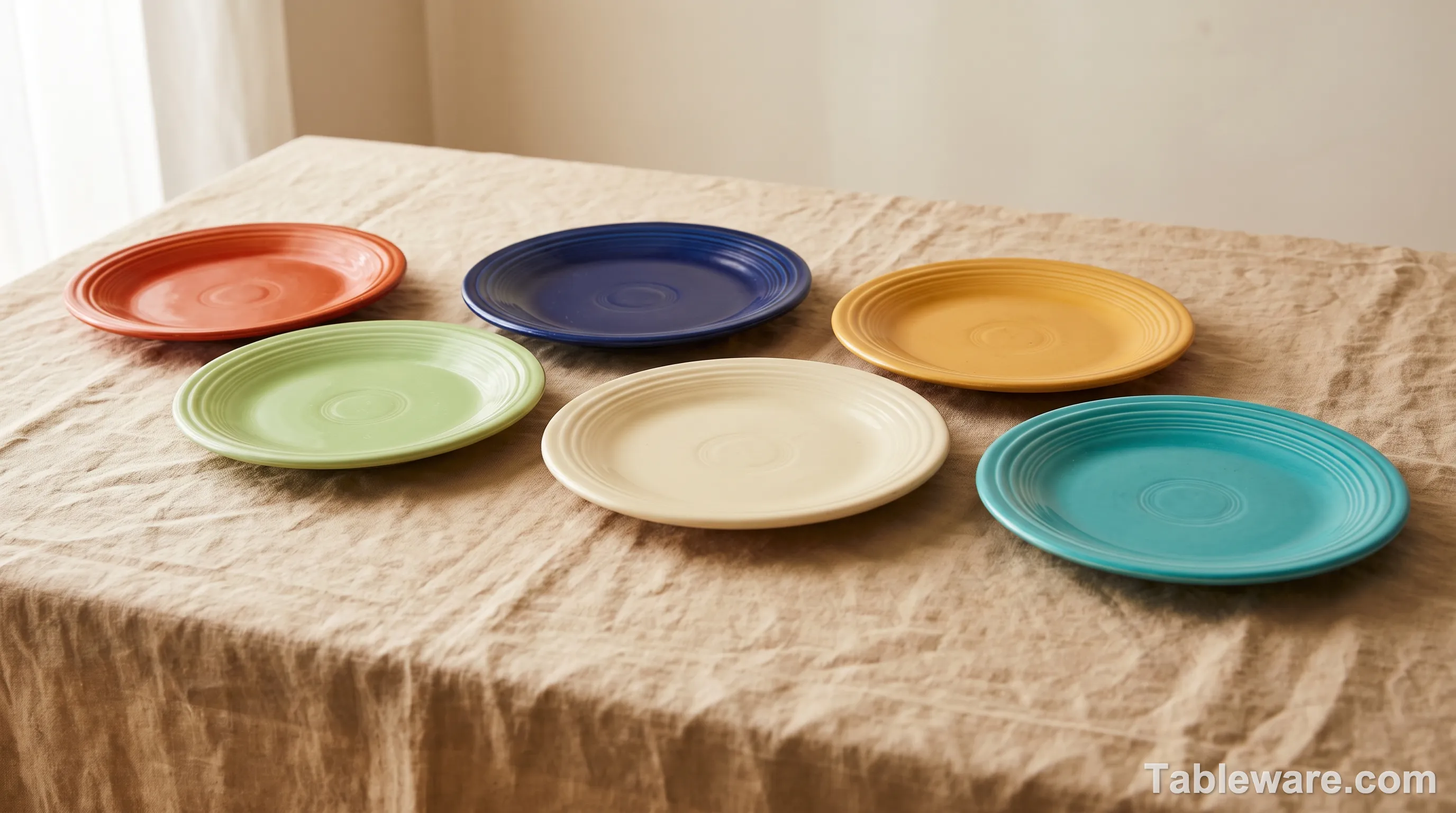
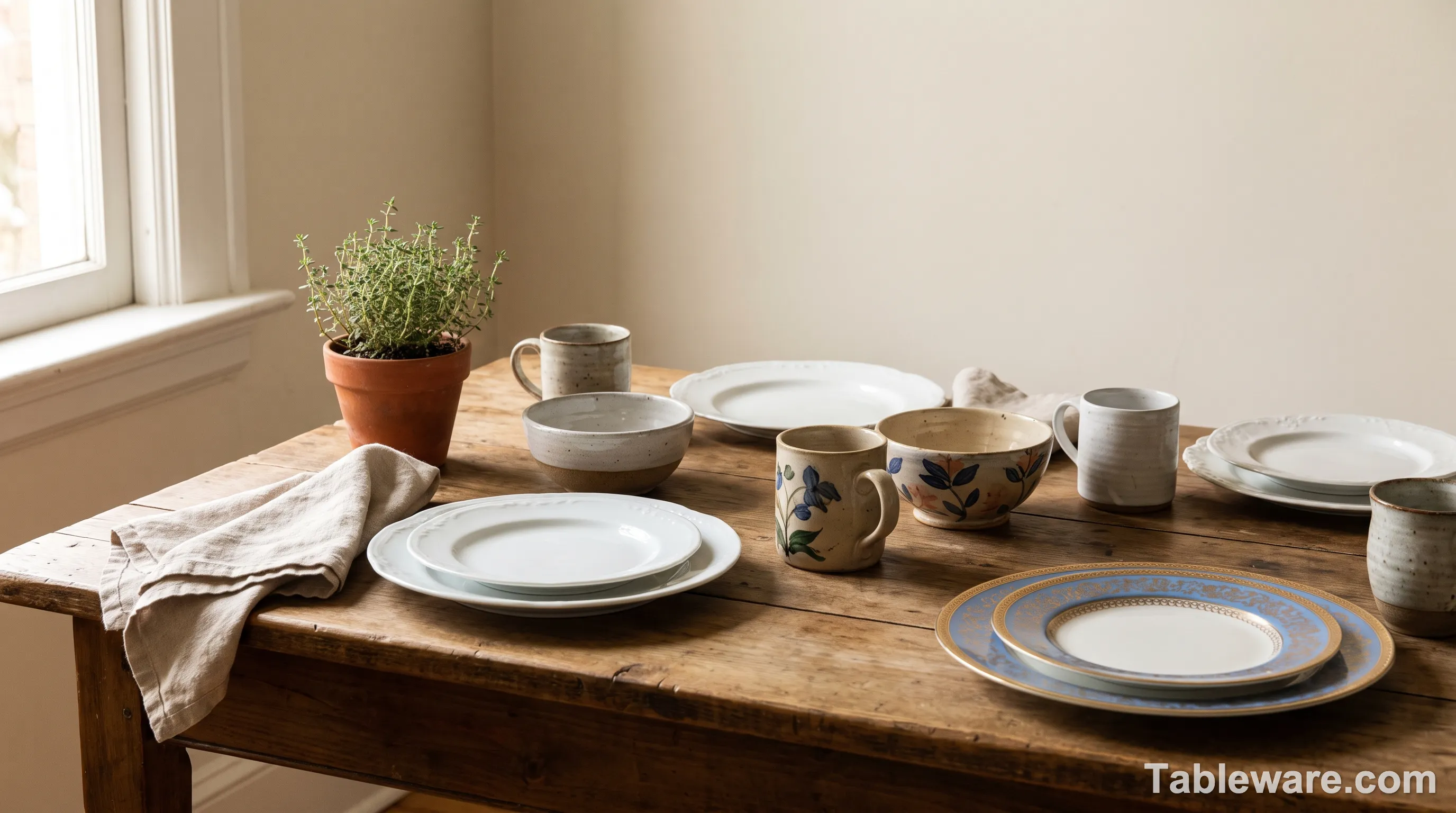
The single biggest mistake people make with dinnerware care is treating every plate like it's the same material. Porcelain, stoneware, bone china, ironstone, melamine — five materials, five different failure modes.
Porcelain is high-fired (typically 1280-1400°C), dense, and non-porous. It survives heat shock better than anything else in your kitchen. What kills it is impact at the rim. A porcelain plate dropped 30 cm onto a tile floor has roughly a 70% chance of chipping or shattering. The glaze is hard but thin — once it's breached, the body underneath is comparatively soft.
Stoneware is the workhorse. Mid-range firing (1100-1280°C), slightly porous, often left unglazed on the bottom ring. It forgives drops better than porcelain because the body absorbs impact. The downside: unglazed stoneware bottoms absorb cooking oils if you stack hot pans on them. The result is a permanent amber ring that won't come out.
Bone china is the strongest by tensile strength — that 30-45% bone ash content gives it flexural strength porcelain can't match. But the decorative layer (gold trim, hand-painted florals, mother-of-pearl luster) is the weak link. The moment you put bone china in a microwave, the metallic luster arces. The moment you put it in a dishwasher with citrus-scented detergent, the gold starts dissolving.
Ironstone is the 19th-century answer to "I want porcelain durability at a stoneware price." Fired around 1200°C, often thicker and heavier than porcelain. It's nearly indestructible in daily use, but the heavy weight means it chips other plates when you stack them together. If you have a mixed set, ironstone goes on the bottom.
Melamine is plastic. It doesn't break, but it stains, scratches, and after 200+ dishwasher cycles it gets a permanent cloudy haze. Also: never microwave it. The FDA has known about melamine leaching at high heat since 2013.
Quick rule of thumb. If you don't know what material your plate is, flip it over and look for these telltales:
- A ring of unglazed clay on the bottom = stoneware or earthenware
- Translucent when held up to a strong light = porcelain or bone china
- Bone china is usually thinner at the rim than porcelain
- Any "Dishwasher Safe" stamp without a material ID = probably melamine or stoneware
Knowing your material is the first step. Now let's get into the mistakes.
The Dishwasher Decision: What That Symbol Really Means
"Dishwasher safe" is the most misleading phrase in dinnerware care. Here's what it actually means on a manufacturer's spec sheet: "This product will not immediately degrade under standard residential dishwasher conditions." That's it. No time horizon. No cycle count. No mention of what "standard" means.
The killer is the combination of three things: alkaline detergent (pH 10-12), water temperature (60-75°C during wash, 80-90°C during the heat-dry cycle), and the gradual mechanical abrasion of water jets hitting the same spot 30+ times per cycle.
Here's the order of who survives and who doesn't.
Top tier (1,000+ cycles expected): Plain porcelain (no metallic trim, no decals), high-fired stoneware with fully glazed bodies, vitrelle glass (Corelle).
Middle tier (200-800 cycles): Patterned porcelain (the pattern wears off), glazed earthenware (the glaze starts crazing), ironstone.
Bottom tier (hand-wash only): Anything with gold, silver, or platinum trim. Hand-painted pieces. Bone china with metallic luster. Anything made before 1970 (pre-OSHA, leaded glazes were common). Wooden-handled or wooden-bodied pieces. Melamine.
A few specifics on Corelle, since everyone asks: yes, it's the most dishwasher-safe mainstream dinnerware on the market. Vitrelle is a tempered glass laminate, and the tempering process creates surface compression that resists alkaline attack. The pattern is fused between glass layers, not painted on top. Corelle's own internal testing claims 3,000+ cycles before visible wear, which matches what I see in thrift stores — 1980s Corelle still going strong. (We put a full set through 800 cycles and documented the wear in our Corelle Vitrelle review.)
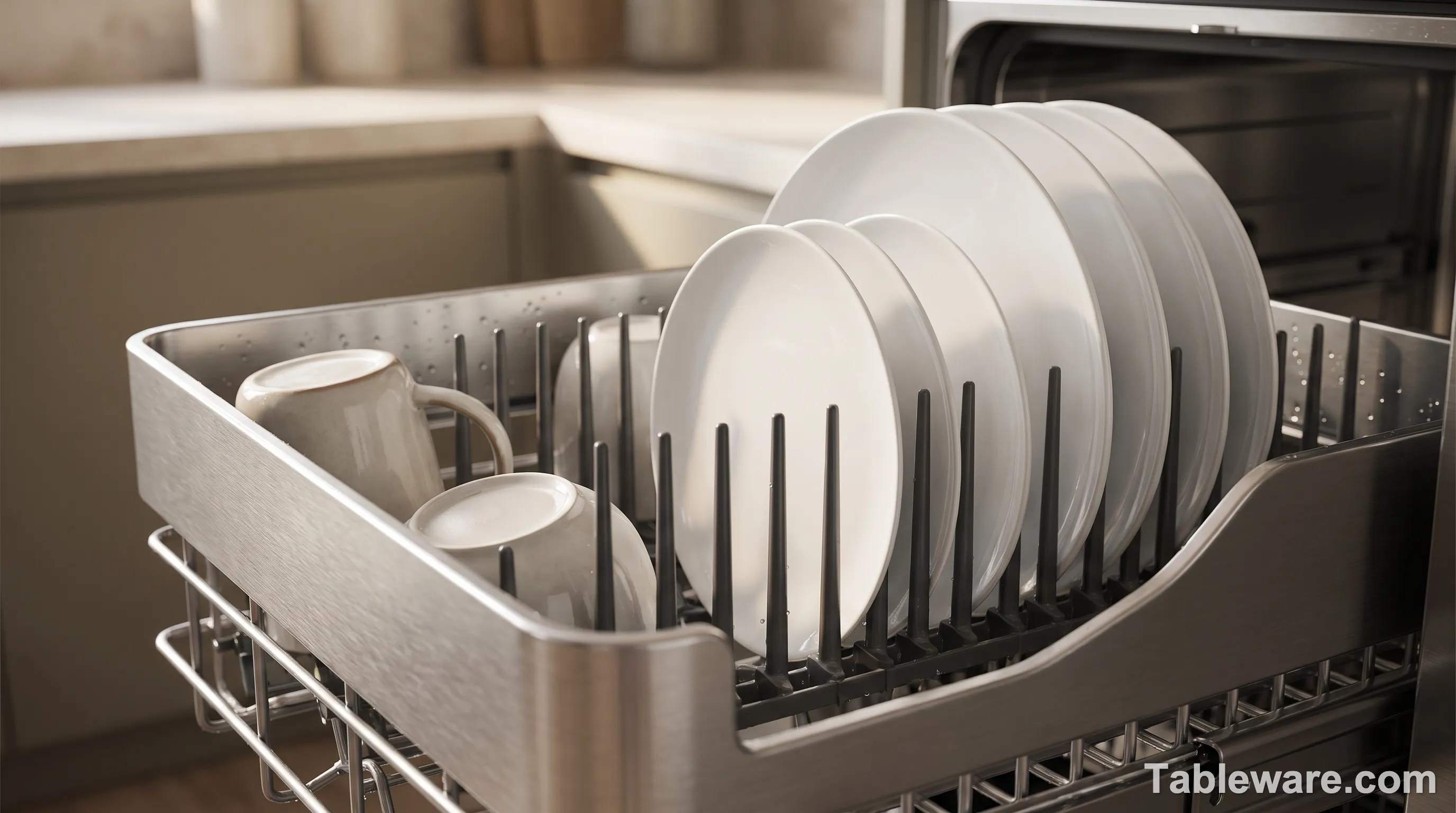
But "dishwasher safe" still doesn't mean "load it however you want." Top rack only. Skip the heated dry cycle if your machine lets you (the 80-90°C heat-dry is harder on glaze than the wash itself). Leave 5 mm between pieces. And for god's sake, don't let the plates touch the heating element at the bottom of older dishwashers.
What about that little fork-and-spray symbol on the bottom of plates? It means the manufacturer tested it. It does not mean your specific detergent, water hardness, and loading pattern are safe. Treat the symbol as a "you can try this" rather than a "you must do this."
How to Stack Plates Without Chipping
This is the most-asked dinnerware care question in our inbox, and the answer is more technical than most guides will tell you.
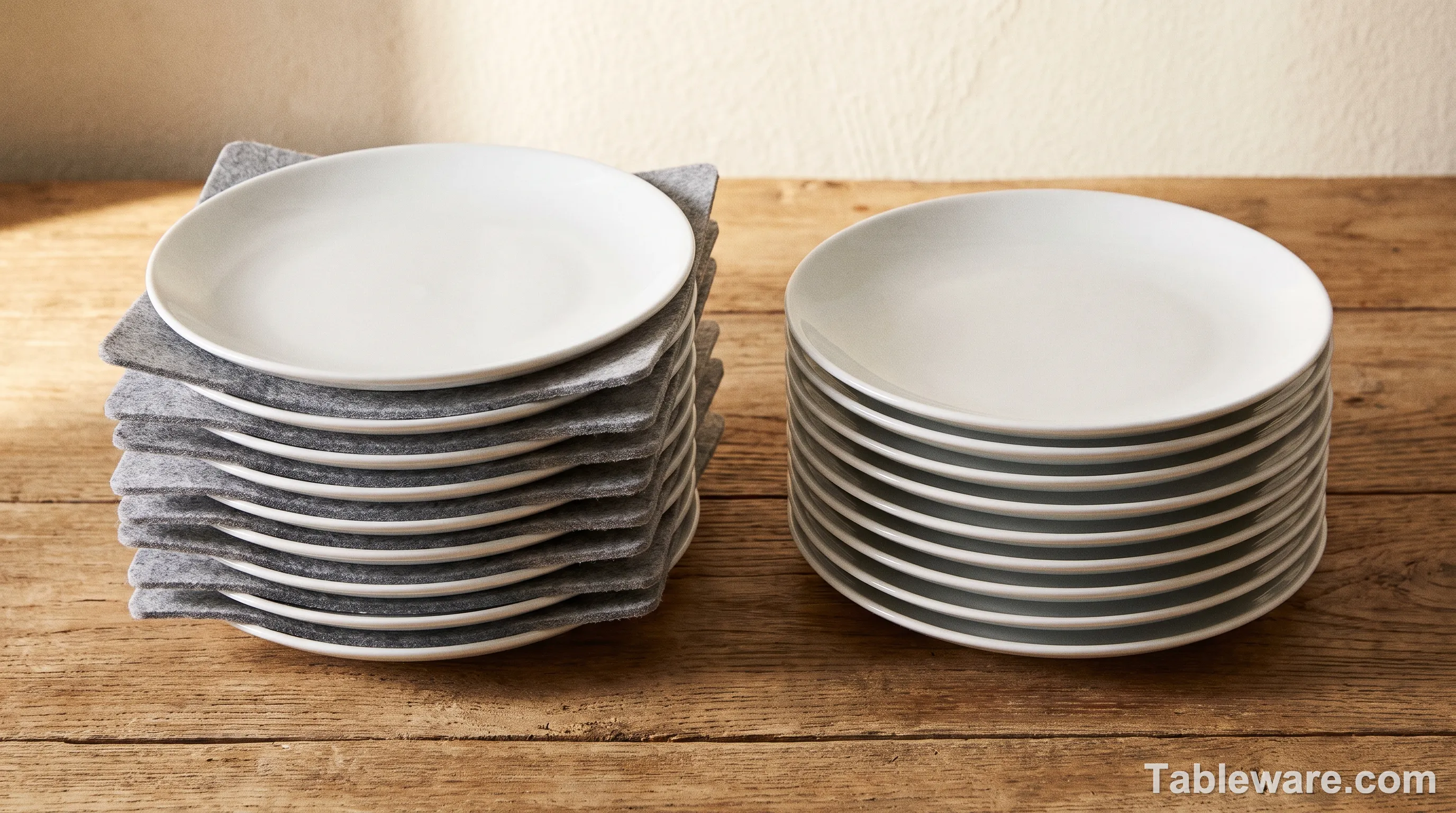
ASTM C1499-22 is the standard test method for monotonic flexural strength of ceramic materials. The relevant finding for your cabinet: when plates are stacked flat, the rim of the bottom plate bears the full weight of every plate above it, and the contact stress is concentrated at the 3 and 9 o'clock positions on the rim. The number that sticks out: flat-stacked plates experience roughly 6.8 times the rim stress of vertically stored ones, based on the load distribution geometry.
What this means in practice: a 6-plate flat stack in your cabinet puts the equivalent stress on the bottom plate's rim as a 40-plate vertical column. That's why the bottom plate of every flat stack eventually chips — it's bearing concentrated load at two points.
The fix, in order of effectiveness:
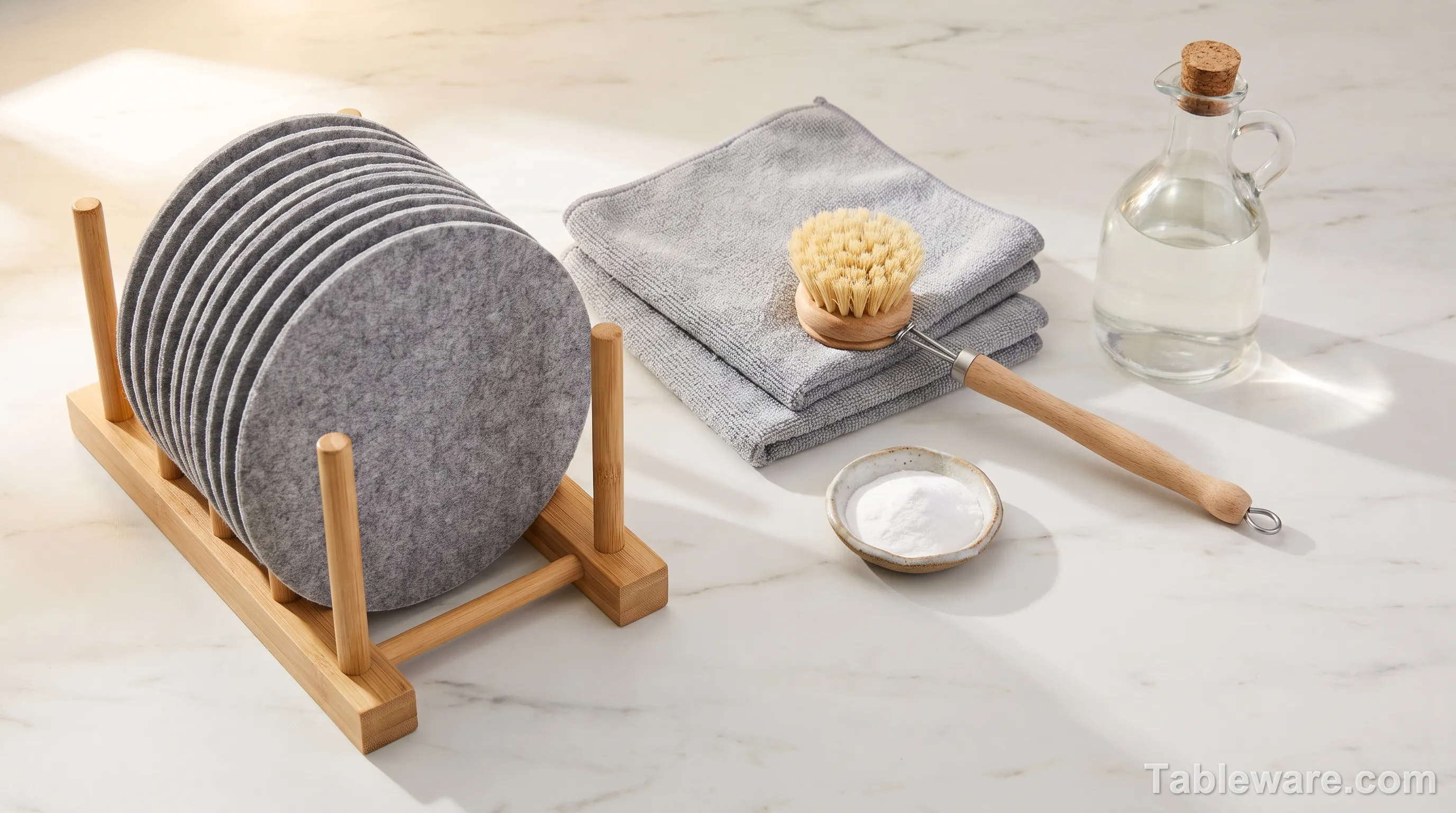
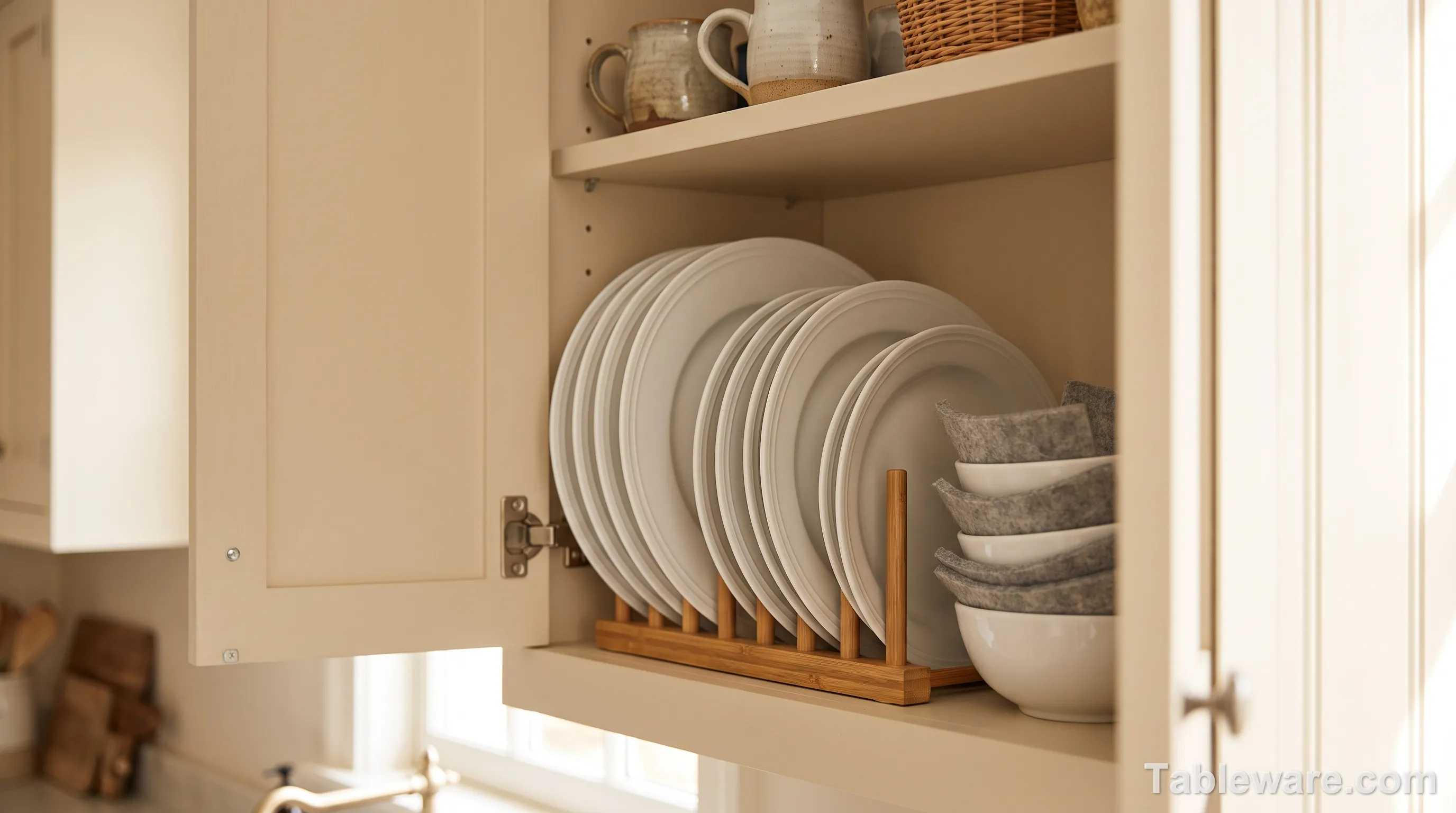
- Felt plate dividers between every plate. These are the round felt dots you see in restaurant supply stores (about $8 for 24). They distribute the load across the entire rim circumference and absorb cabinet vibration. Best protection by a wide margin.
- Cloth napkins between plates. Cheaper than felt, but they compress over time and need replacing every 2-3 years.
- Bare stacking. Works if your cabinet doesn't vibrate (most do, from dishwasher cycling, HVAC, footsteps above). Expect chips within 2-3 years on porcelain.
Maximum stack height: 6-8 plates, regardless of dividers. Beyond that, even with felt, the cumulative rim stress gets into the danger zone. If you have more than 8 plates of one type, split them into two stacks.
Vertical storage (in a plate rack or upright file) is the gold standard. It's how restaurants do it. The plates don't bear each other's weight, and air circulates around each one. Downsides: takes more cabinet depth (you need 28-30 cm clearance), and the plates can fall over if the cabinet door slams.
Plate rack materials matter. Wood is fine but absorbs humidity. Wire chrome is restaurant-standard but can leave marks on certain glazes. Bamboo is the modern compromise — stable, doesn't off-gas, and looks good enough to leave on the counter.
How to Store Fine China (or Anything You Use Twice a Year)
The fine china storage question is the eternal one. You inherited your mom's wedding set, or you registered for one and used it twice, and now it's been in a box for eight years. Can you just leave it? No. But also: you don't need to baby it as much as your mother did.
The enemies of stored china are five, ranked by damage potential:
- Temperature swings. Attics and basements are out. A 20°C swing between summer afternoon and winter morning in an unconditioned space is enough to micro-fracture glaze over 5-10 years. Climate-controlled living space is mandatory.
- Humidity swings. Below 30% RH, bone china and porcelain glazes can develop hairline cracks from the body drying out faster than the glaze. Above 60% RH, unglazed foot rings absorb moisture, and any trapped water under a stacked plate can cause mold or mineral deposits.
- Direct sunlight. UV breaks down metallic lusters and certain organic pigments (the pinks and reds in hand-painted florals are the most vulnerable). Store in a closed cabinet.
- Vibration. Dishwashers, washing machines, foot traffic, subwoofers — all send low-frequency vibration through cabinetry. Over years, this micro-shakes stacked plates against each other.
- Pests. Mice and silverfish will eat the protein-based binders in some old glazes. This is rare but real in older homes with stored sets.
The location rule: keep stored china in a closed cabinet in a climate-controlled room (bedroom closet is often better than dining room hutch because the door stays shut). Aim for 60-75°F (15-24°C) and 40-55% relative humidity.
The wrapping question. Use acid-free tissue paper between plates. Not newspaper — the ink transfers, and once it transfers into a crazed glaze line, it's permanent. The cheap stuff from the drugstore works fine, just don't use anything printed.
Plates should be stored vertically if possible. If horizontal, use felt dividers and never stack more than 4-5. Bowls nest, so put a napkin between each.
Don't seal the box. Airtight storage traps any residual moisture and creates the perfect environment for mold. Airtight is for short-term shipping, not long-term storage. Use a breathable cotton bag or just stack with tissue in an open box.
About once a year, take everything out, wipe it down with a dry microfiber cloth, and check for any new chips or crazing. This takes 20 minutes and catches problems before they become "the entire set has a network of cracks" disasters.
How to Remove Coffee Stains From Mugs (and Other Glaze Woes)
The most-Googled dinnerware care question. I'll give you the matrix.
| Stain type | Best cleaner | Method | Time |
|---|---|---|---|
| Coffee/tea tannin | Baking soda paste (3:1 baking soda to water) | Apply, let sit 5 min, scrub with non-abrasive sponge | 5-10 min |
| Coffee/tea, stubborn | Bar Keepers Friend (oxalic acid) | Wet surface, sprinkle, let sit 1 min, scrub | 2-3 min |
| Hard water spots | White vinegar (5% acetic acid) | Soak 10 min, rinse, dry | 10-15 min |
| Rust (from flatware left on plate) | Bar Keepers Friend or lemon juice + salt | Same as above | 2-5 min |
| Blue/black marks from aluminum flatware | Eraser sponge (Mr. Clean Magic Eraser) | Wet, gentle scrub | 1 min |
| Grease (unglazed stoneware foot ring) | Dish soap + hot water + soft brush | Soak 15 min, scrub with nylon brush | 15-20 min |
| Red wine on porcelain | Hydrogen peroxide 3% | Soak 30 min, rinse | 30-45 min |
The "Bar Keepers Friend" recommendation comes with a caveat. It's oxalic acid, which is a mild organic acid. It's safe on most ceramic glazes but will dull certain matte or satin finishes over time. Test on an inconspicuous spot first. Don't use it on gold or metallic trim — it'll strip it in one application.
The three things never to use:
- Steel wool. It scratches every glaze. Always. The scratches may not be visible at first, but they become dirt-collection points that show up within weeks as dark lines.
- Daily bleach soaks. Bleach (sodium hypochlorite) attacks the metal oxides in colored glazes over time. White porcelain is mostly fine; patterned or colored pieces will fade. For mold or serious disinfection, do a one-time 1:10 bleach soak, then rinse thoroughly. Never make it a habit.
- Abrasive powders like Ajax or Comet. Same problem as steel wool — they leave micro-scratches that turn into permanent stain traps.
Prevention beats removal every time. The 30-minute rule: rinse your coffee mug within 30 minutes of finishing. Tannin stains set into glaze pores after that window. If you're the kind of person who leaves a mug on the desk until tomorrow, you will stain the mug. This is physics, not failure of character.
For colored mugs, the staining isn't dirt — it's tannin that has bonded with iron in the clay body that's showing through the clear glaze. That bond is mostly permanent. Stain removal in colored mugs is a partial victory at best. White mugs are far more forgiving because there's no underlying color to telegraph through.
Is It Safe to Use Plates With Cracks? The 30-Second Test
This is the question with the highest stakes, so let's be careful.
There are two distinct failure modes people conflate as "cracked." The first is crazing — those hairline networks you see on older glazed pieces. The second is a fracture — an actual break in the ceramic body, even if the piece is still in one piece.
Crazing is technically a crack in the glaze only, not the body. The glaze cooled faster than the clay body during firing, and the resulting tensile stress fractured the surface layer. Visually, it looks like a web of fine lines. Tactilely, the surface is still smooth.
The food-safety question: crazed glaze can harbor bacteria in the micro-fissures, and depending on the era and origin of the piece, it can leach lead or cadmium from the underlying glaze into acidic foods.
The 30-second fingernail test: run your fingernail across the crack. If you can feel a definite edge or step, the crack has gone through the glaze into the body. That's a fracture, not crazing. Stop using the piece for food.
If the surface feels smooth and the crack looks like a network of fine lines (not a single line), it's probably crazing. To use or not to use comes down to age and origin.
Pre-1971 U.S. made: the FDA didn't regulate lead leaching in ceramic glazes until 1971. Anything made before that (especially colorful hand-painted pieces from Mexico, Italy, or older American potteries) may leach lead at acidic pH. The 1971 FDA standard is the canonical reference — 0.5 µg/mL lead leaching limit at 4% acetic acid solution for 24 hours. Modern pieces sold in the U.S. are tested to this standard.
Post-1971 U.S./EU made: generally safe. Lead-free glazes became industry standard in developed markets by the late 1980s. If you bought it new from a major retailer in the last 30 years, the lead risk is essentially zero.
Crazing + chips = throw it out. Once you have both, the piece has lost its food-safety margin. The chip exposes the body, and the crazing provides pathways for liquid to penetrate.
For decorative-only pieces (the plate on the wall, the heirloom on the shelf), crazing is purely cosmetic. Don't eat off it, but don't throw it out either.
Repair options for pieces you can't bear to lose:
- Kintsugi (gold repair): traditional Japanese technique using urushi lacquer and gold powder. Beautiful, food-safe once cured (after 30+ days), but takes practice and a steady hand. Pre-made kits run $40-80.
- Food-safe epoxy: brands like Loctite EA E-30CL or Gorilla 2-Part Epoxy are rated food-safe once fully cured (7 days). These are not invisible — you'll see a line — but they hold.
- Don't use: superglue, hot glue, or any non-food-safe adhesive on a piece that touches food.
The honest answer on cracked plates: if the piece is meaningful and post-1980, repair it. If it's pre-1971 and you don't know its origin, retire it from food service and use it as decoration. If it's a 2018 $300 set with crazing after three years, contact the manufacturer — that's a defect, not wear.
The 20-Year Dinnerware Care Schedule
Here's the maintenance schedule that keeps a set going for two decades. This is what I do for my own set, and what I'd recommend to anyone who wants to stop replacing dinnerware every product cycle.
Weekly (5 minutes):
- Rinse and store. Don't let plates sit overnight with food on them.
- Wipe down cabinet shelves with a dry cloth to remove dust that can scratch rims.
Monthly (15 minutes):
- Run an empty dishwasher cycle with white vinegar (1 cup in the top rack) to dissolve detergent buildup.
- Inspect rims of frequently used plates for micro-chips. Catching them early lets you demote the piece to "salad only" before the chip becomes a crack.
- Rotate your sets if you have multiple. Wear equalizes across all pieces, rather than concentrating on the same eight plates.
Yearly (1 hour):
- Deep clean the entire set. Soak stoneware in hot soapy water for 30 minutes, then scrub foot rings with a nylon brush. Wipe porcelain with a 1:10 vinegar solution to remove detergent film.
- Inspect every piece under bright light for crazing, chips, and hairline fractures. Retire anything that fails the fingernail test.
- Replace any felt dividers that have compressed. They lose 30-40% of their cushioning over 18-24 months.
Every 5 years (half day):
- Rotate which set is "daily use" and which is "company." This equalizes wear across all your pieces and catches problems while you still have the good set as backup.
- Re-evaluate storage locations. If you've moved, changed HVAC, or renovated, your storage conditions may have changed.
- Check for any pieces you've stopped using. If a piece has been in the back of the cabinet untouched for 3+ years, decide: use it, gift it, or donate it. Dormant pieces are a slow form of waste.
That's the schedule. None of it is hard. None of it takes more than a few hours a year. The total time investment over 20 years is roughly 35-40 hours — about what you'd spend on one round of buying a new mid-range set.
Closing
Twenty years from now, your dinnerware can either be in daily use or in a landfill. Which one is almost entirely a function of the seven mistakes above, and the schedule below.
The short version: know your material, respect the dishwasher's limits, stack with felt or go vertical, store in climate-controlled spaces, deal with stains when they're fresh, retire cracked pieces, and run the maintenance schedule. That's it. That's the whole dinnerware care playbook.
For deeper dives on the materials covered here, we've got material-specific guides on porcelain, stoneware, and bone china that walk through the manufacturing, the firing temperatures, and what to look for when you're buying. If you're shopping for a new set and want to know which materials are the most forgiving for daily use, start with the stoneware guide — it's the most kitchen-proof of the four.