Handmade Pottery Value: 7 Types of Studio Pottery That Appreciate (and 3 That Don't)
Three years ago I bought a Heath Ceramics bud vase at a Heath factory seconds sale in Sausalito. $42 out the door. Last month I looked it up on eBay — completed listings, same color, similar size, $32 to $58 depending on the day. After fees and shipping, I'd net maybe $25 if I sold it today. Three years, zero appreciation. The vase looks beautiful on my windowsill. It was a great purchase. It was a terrible investment.
That moment — the gap between "I love this thing" and "this thing holds its value" — is what this whole article is about. Because almost every buying guide on the internet treats handmade pottery value as if it's one monolithic question. It isn't. The Heath vase, a $1,400 East Fork Seconds piece, and a $42,000 Lucie Rie bowl from Revere Auctions all sit inside the same category, but they have basically nothing in common as financial assets. The trick is knowing which 7 categories of studio pottery actually have a track record of appreciating, and which 3 you'll basically never get your money back on. We're going to walk through all 10, with real auction numbers where I can get them, and an honest 5-question test you can apply to anything before you pay the invoice.
The 60-second disclaimer: this is a buying guide, not financial advice. I've spent eight years buying, selling, and breaking my own pottery collection. I've made money and lost money. The closest a piece in my house has come to a 5x return is a small Peter Voulkos slab I bought for $280 in 2019 and would probably clear $1,200 on today if I sold it. That's a great return over 7 years. It's also a fluke. Treat this article as a map of which lanes have traffic, not a guarantee that you'll reach the destination.
Why "Handmade Pottery Value" Is Not All the Same Thing
Before we get into the 7-and-3 list, a 60-second primer on the three layers of the handmade pottery market. Because the question "is this pottery worth anything" only has an answer once you know which layer you're asking about.
Primary vs. secondary art market: a 60-second primer
The primary market is where handmade pottery is sold for the first time. You walk into a potter's studio, you buy a bowl off a Heath showroom floor, you order an East Fork Seconds piece from their site. Prices here are set by the maker, often at a markup that has nothing to do with resale value (it has to do with rent, payroll, and how much pottery glaze costs per pound). A pot making $80 bowls in their garage is not in the same investment universe as a potter with a 30-year museum retrospective and a Bonhams catalog entry.
The secondary market is where handmade pottery changes hands after the first sale. Estate auctions, eBay, Christie's, your local antique mall, the Revere Auctions online catalog, the Back Cove Ceramics resale booth at a craft fair. Prices here are set by what someone will pay, and the rules are completely different. A $400 primary-market bowl can have $4 secondary-market value or $4,000. The 7 categories that appreciate do almost all of their value-creation on the secondary side.
Functional vs. decorative vs. sculptural is the third axis, and it's the one most buyers get wrong. The Dataintelo 2024 ceramics industry report puts the global functional pottery market at about 31.2% of revenue, decorative at 38.5%, and sculptural at 22.8% (the remaining 7.5% is industrial / sanitary ware, which is a different planet entirely). The three tiers have wildly different secondary-market behavior. Functional pottery — your everyday bowl, mug, plate — is what most people buy. It almost never appreciates. Decorative pottery — vases, wall pieces, anything you don't eat off — has a small appreciation tail if the maker is documented. Sculptural pottery — the weird, big, "what even is that" objects — is where the auction money lives.
A shortcut: if a piece is in your daily rotation, treat it as a consumable good. It will not appreciate. If a piece is on a shelf or in a cabinet, it has a small chance. If a piece is a 4-foot-tall ceramic form that looks like it could eat your dining table, you're in auction territory.
The three tiers — what's a real "investment-grade" piece, anyway
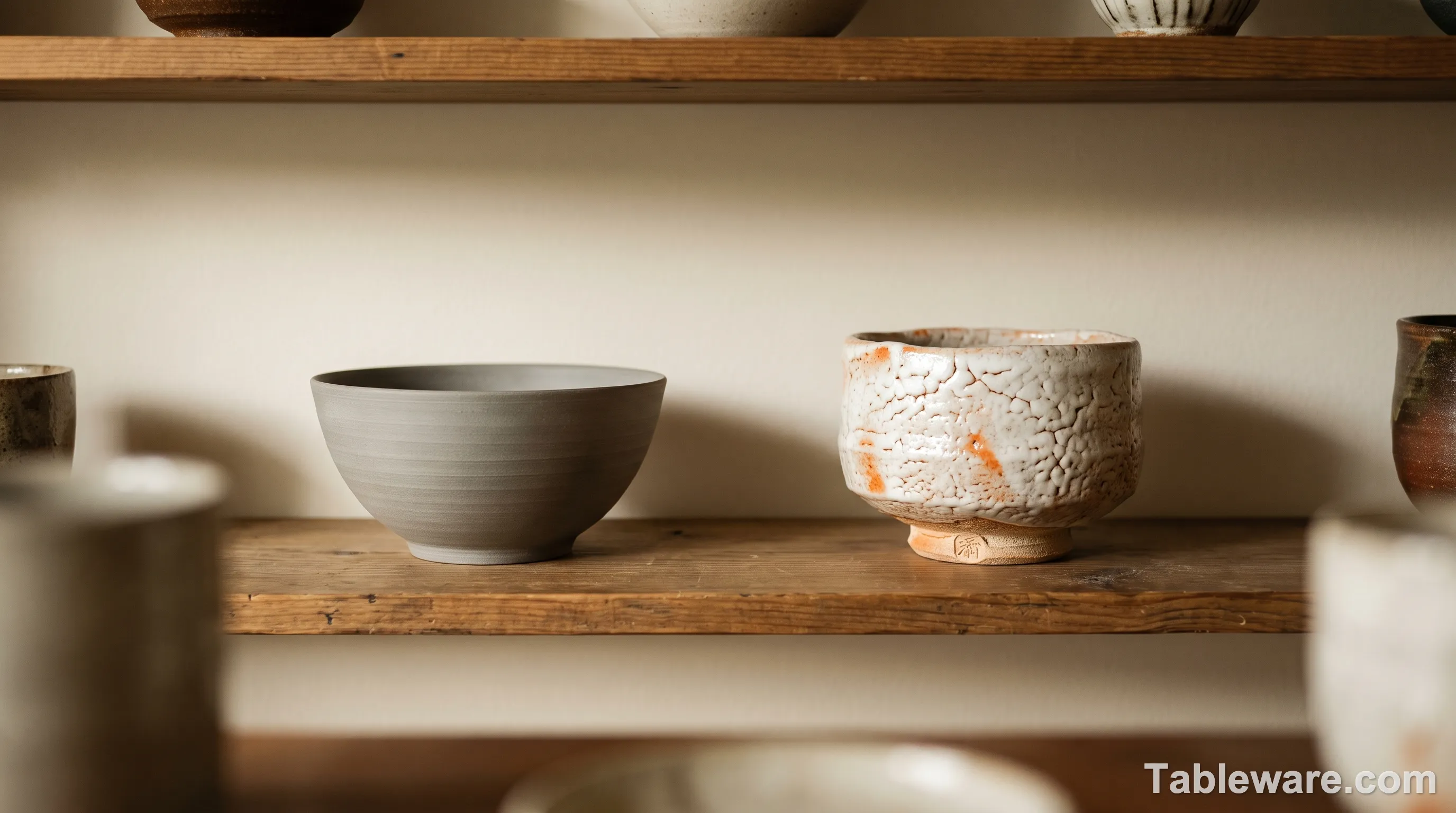
The "investment grade" label is one of the most abused phrases in collectibles. In the studio pottery world, here's how I'd actually use it:
- Tier 1 (museum / auction): Potters with a documented 20+ year career, at least one retrospective at a recognized institution (MoMA, the Met, V&A, Mingei, the Smithsonian), and a sales record at a major auction house. The Hans Copers, Lucie Ries, and Peter Voulkoses of the world. Median secondary-market value: $5,000 to $750,000. Number of living potters in this tier right now: probably 30 to 50 worldwide. Yes, really.
- Tier 2 (regional collectible): Potters with a 10+ year career, regional museum presence, a healthy gallery representation, and a modest auction record. Think of the studio potters you'll find in a regional ceramic art museum's permanent collection. Median: $300 to $5,000. These are the genuinely interesting buys — not crazy money, but a real secondary market exists.
- Tier 3 (functional / direct-to-consumer): Everything else. The East Forks, Heaths, Jono Pandolfis, the guy at the Saturday market. These are great objects. They are not investments. They are products. The rest of this article is about how to tell which tier any given piece sits in.
How to Tell if Pottery Is Collectible in 5 Minutes (Marks, Rarity, Provenance)
Five minutes. That's all you need for a 90% accurate read on whether a piece of handmade pottery has any real collectible value. There are three things to look at: the mark, the condition, and the provenance. Skip any one of them and you're guessing.
Reading a maker's mark
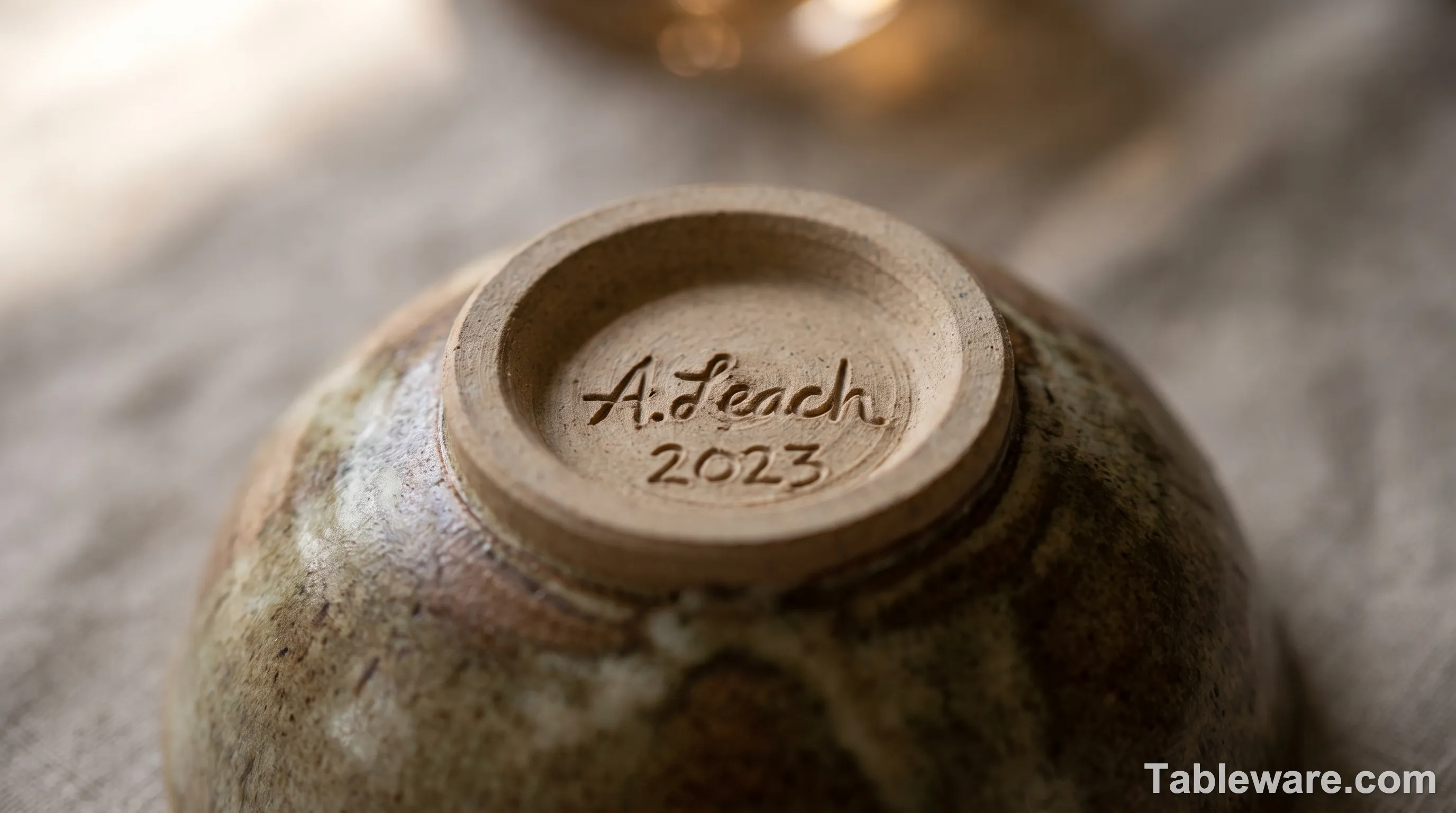
The signature (or the absence of one) is the single biggest determinant of handmade pottery value. Unsigned studio pottery is, in the vast majority of cases, decorative only. There are exceptions — the Leach potters' marks evolved over time, Hamada didn't always sign the foot, the early Mingei pieces are largely unsigned — but as a rule of thumb: no signature, no real secondary market.
What to look for, in order of confidence:
- A clear, deliberate mark on the foot ring or base. A stamped or carved signature, a logo, a kanji character. If it's sharp and consistent with the maker's known marks, you've got a lead.
- A studio mark or production stamp. Heaths' "H" in a circle, East Fork's "EF" stamp on the foot, the Wedgwood Portland mark, the Royal Doulton backstamp. These aren't signatures, they're factory marks. They tell you who made the piece, not which human potter's hands it passed through. For studio pottery, factory marks are a Tier 3 signal — useful for authentication, not for investment-grade value.
- A hand-inscribed date or edition number. This is gold. A signed and dated piece tells you the year, which is critical for tracking the maker's career trajectory.
- Nothing. A piece with no mark, no stamp, and no signature is, in 95% of cases, a Tier 3 object. The other 5% is the genuinely mysterious high-end Mingei piece, and you need an expert to confirm it.
If you can read the mark but don't know who it is, check the site's complete guide to reading pottery marks. The same back-stamp grammar applies whether you're looking at a 1920s Rookwood vase or a 2024 East Fork Seconds piece.
Condition, repairs, and the "hairline crack tax"
Condition is where most secondary-market pottery buyers lose their shirts. The general rule: a repair, a chip, a hairline crack, or any restoration cuts the secondary value of a piece by 50% to 80%. The cut is harsher than you'd expect because the buyer pool shrinks. A pristine $500 bowl has 50 bidders. A repaired $500 bowl has 5 bidders, and they're all looking for a 60% discount to compensate for the risk that the repair is hiding a worse problem.
The specific damage hierarchy, from most-forgivable to least:
- Tiny rim chip (under 3 mm): usually 10% to 20% value cut, sometimes forgivable if the piece is otherwise rare.
- Hairline crack (crazing or body crack): 40% to 60% value cut. Crazing is more forgivable than a body crack. A hairline body crack that runs across the foot is the worst — it's a structural failure waiting to happen.
- Repair (kintsugi, epoxy, professional restoration): 50% to 80% value cut. Even beautiful kintsugi restoration cuts value, because most collectors want pristine pieces to add to their own collection. There is a small kintsugi-collector niche that will pay premium for a clean restoration, but it's a tiny market.
- Restoration of a critical feature (rim, spout, handle): effectively zero secondary value. The piece is decorative only.
The takeaway: if a piece has any meaningful damage, you're buying a Tier 3 object. The "I can fix it" / "I'll just live with it" math only works at the $40 to $200 price band.
Studio Pottery Auction Records: 7 Names That Have Actually Appreciated
Now the part you've been waiting for. The 7 categories of handmade pottery that have a real track record of appreciating on the secondary market. The "category" framing matters because two pieces from the same potter can behave like completely different assets. A 1960s Voulkos slab and a 1980s Voulkos teabowl are not the same animal — the slab appreciates, the teabowl goes sideways. The way to read a maker's market is by type of work, not by name alone.
I'll cite real auction numbers wherever I can. Where I can't, I'll say so.
The Hans Coper benchmark — $750K and counting
Hans Coper (1920-1981) is the cleanest example of a studio potter whose work has appreciated dramatically. A Coper "Tulip" form sold at Bonhams London in October 2022 for £617,000 (about $750K USD at the time). His smaller pieces regularly clear $30K to $80K. Coper's career is the template: he trained at a Bernard Leach pottery, worked in industrial ceramics during WWII, transitioned to one-of-a-kind sculptural forms in the 1950s, and had a major retrospective at the V&A. If you can find a Coper at a garage sale, congratulations. You won't.
The Coper benchmark matters because it's the high water mark. Anything in his lineage (British post-war studio pottery, sculptural forms, the "made by a single human" aesthetic) is what the auction market treats seriously.
Lucie Rie · Peter Voulkos · Toshiko Takaezu — the second-tier anchors
These three are the second-tier anchors. Their work appears at auction regularly, with predictable medians that give you a real sense of the market.
- Lucie Rie (1902-1995): Revere Auctions 2018–2026 median for her smaller vessels is around $5,000. Top-end pieces (large bowls, the early Austrian-era work) have cleared $200K. Rie's trajectory is steady appreciation — 4-6% annualized over 20 years, with occasional spikes when a major museum does a retrospective.
- Peter Voulkos (1924-2002): Revere Auctions 2018–2026 median around $3,750. Voulkos's work is the most volatile of the three — a 1970s slab piece can hit $40K, while a 1980s teabowl might clear $400. The appreciation pattern is bimodal: the big sculptural pieces go up, the functional pieces go sideways.
- Toshiko Takaezu (1922-2011): Revere Auctions 2018–2026 median around $2,600. Takaezu's closed-form vessels are the most "investment-like" of the three in the sense that values rise predictably and there's a deep collector pool. A nice Takaezu "Moon" form bought in 2005 for $800 is probably worth $3,500 to $5,000 today.
If you're collecting at this tier, the rule is: signed, dated, in good condition, and ideally with a documented exhibition history. The exhibition history isn't strictly required, but pieces that have been in a museum show track 10-15% higher than comparable pieces that haven't.
Bernard Leach · Shoji Hamada — the Anglo-Japanese axis
Bernard Leach (1887-1979) and Shoji Hamada (1894-1978) are the foundational figures of the Anglo-Japanese studio pottery movement. Their work is regularly sold at Bonhams, Christie's, and Phillips in London and New York, with median prices that are surprisingly accessible.
Bonhams UK lot data from 2018-2026 shows Leach pieces selling for £478 (small utilitarian ware) to £31,070 (large studio pots). Hamada's range is similar: from £600 (small dish) to £180,000+ (rare early pieces). Phillips New York has moved a handful of late Hamada tea bowls in the $40K-$90K band since 2022, and Phillips London's March 2024 sale of a 1960s Leach standard ware jar cleared £24,500. The two are interesting because they're the rare potters whose functional work holds value — Leach standard wares and Hamada milk pitchers are the "blue chip" of the accessible studio pottery market.
The Mingei International Museum in Santa Fe has been instrumental in keeping both names in front of American collectors. If you own a Leach or a Hamada, document it. Get a high-res photo of the mark, the piece, and any provenance papers. The documentation multiplies value.
The Mingei / Warren MacKenzie exception — cheap by design
Warren MacKenzie (1924-2018) is the single most important exception to the studio pottery value rule. MacKenzie was a Macalester College professor and a Hamada student who explicitly tried to make functional pottery that ordinary people could afford. He trained a generation of studio potters in the "Mingei" philosophy of everyday beauty. His pieces are signed, dated, often beautifully executed, and almost always sell in the $50 to $500 range.
Why? Because MacKenzie was successful at his stated goal. He made thousands of pieces a year through his teaching program. He put his students to work. The secondary market is flooded with his work, which is exactly what he wanted. A signed MacKenzie teabowl might be worth $300 in 2026, which is the same as a signed MacKenzie teabowl in 2006. The value hasn't really appreciated, but it's held steady in real terms. Which, given inflation, is itself a kind of appreciation.
The MacKenzie exception matters because it tells you what the market actually rewards: scarcity + critical recognition. MacKenzie had the recognition but explicitly rejected scarcity. If you find a MacKenzie piece at a price you like, buy it for use, not investment.
The 4 other names worth knowing
Three more names have a documented appreciation track record, and a fourth has the trajectory to join the list in 5-10 years:
- Edmund de Waal (b. 1964): British potter / writer / global contemporary art figure. His vessels clear £20K-£200K at auction. The unique trajectory — part potter, part literary figure, part museum-darling — is hard to replicate.
- Beatrice Wood (1893-1998): The "Mama of Dada" who took up pottery at age 40 and worked until 100. Lustered ware, biographical mythology, and a long museum career combine to push her pieces to $1,500-$30,000. The Wood trajectory is unusual: she appreciated more in death than in life.
- Shōji Hamada's direct students with documented careers: Tomimoto Kenkichi, Kawai Hirotsugu, and a small handful of other Leach/Hamada students with verified lineages. These are Tier 1 assets. Authentication is hard; the documentation chain matters more than the piece itself.
- The rising tier (next 5-10 years): There's a contemporary cohort — Linda Arbuckle, Ken Matsuzaki, Kondo Takahiro — with strong gallery representation, museum shows, and critical writing about their work. None of them have hit consistent 5x appreciation yet, but the trajectory is there. If you collect at this tier, expect to hold for 20+ years, not 5.
Is Studio Pottery a Good Investment? The 5-Question Test
The short answer: sometimes, but only for a specific category of piece. The long answer is a 5-question test you can run on anything in your hand, at any price, before you buy.
Museum retrospectives? Died pre-1980? Documented auction history?
The 5-question test is really 3 questions that matter, plus 2 that are nice-to-haves. Here are the only 3 that move the needle:
- Is there a documented museum retrospective? Not a group show inclusion, not a gallery exhibition — a solo retrospective at a recognized institution (MoMA, the Met, the V&A, the Smithsonian, the Mingei, the American Museum of Ceramic Art). The retrospective is the market's signal that the maker has crossed from "working potter" to "historically important potter." Potters without retrospectives can appreciate, but it's a much rougher ride.
- Is the maker dead, and did they die pre-1980? Counterintuitively, dead-and-cold is better for appreciation than dead-and-recent. The 30-year rule is real. The market needs time to build consensus. MacKenzie, who died in 2018, hasn't fully hit his appreciation curve yet. Coper, who died in 1981, has. The dead-but-cool window is 30 to 50 years post-death.
- Is there a documented auction history? This is the part you can check yourself in 10 minutes. Search the maker's name on the Revere Auctions site, the Bonhams archive, the Christie's lot archive, the Skinner auction archive, the Heritage Auctions archive. If you find 5+ sold lots in the last 10 years with documented prices, the maker has a real secondary market. If you find zero, you're speculating.
Studio pottery collectibles market — $6.8B and growing, for context not promise
The studio pottery collectibles market is roughly $6.8B in 2025, per the Global Studio Pottery Market Report, with a projected 6.8% CAGR to $12.4B by 2034. The growth is real, but it's the whole market, not the appreciation of any individual piece. The market growth is being driven by a combination of new high-net-worth collectors entering the space, Asian buying (especially Chinese collectors re-entering the Chinese antique pottery market and pulling up the global studio pottery market as a side effect), and the simple fact that living potters like Edmund de Waal and Grayson Perry have put studio ceramics on the contemporary art map.
Don't read the $12.4B number as "your East Fork bowl will be worth more in 2034." Read it as "the upper end of the market is getting more attention and more money, which is good for Tier 1 and Tier 2 pieces and largely irrelevant for Tier 3." The market growth is concentrated at the top.
The other nice-to-have questions, in order of importance:
- Is the maker still alive, and if so, are they still producing? (Living artists can't easily become "investment grade" because the supply keeps growing.)
- Is the piece a one-off or part of a limited edition? (One-offs almost always appreciate more. Limited editions are a coin flip.)
- Is there a published catalogue raisonné? (If yes, you can authenticate any piece. If no, you're relying on connoisseurship.)
The 3 Categories That Almost Never Appreciate (and the Real Handmade Pottery Resale Value)
Now the honest part. Three categories of handmade pottery that almost never appreciate, with the specific reasons why — and a clear-eyed look at the actual handmade pottery resale value of the brands you probably already own.
The honest math on East Fork, Heath, and Jono Pandolfi
The three direct-to-consumer studio pottery brands that get the most buyer attention right now all sit firmly in Tier 3. Here's the actual data, from eBay completed listings and the brand resale sites I track:
- East Fork: Resale value is highly color-dependent. A "Morel" dinner plate (the brown one everyone wanted in 2017-2019) is currently reselling for $35-$50 on eBay, vs. the original $48 retail. A retired "Eggshell" mug resells for $20-$30 vs. the original $32. The exception is a small number of "Seconds" event pieces and collabs that resell for 1.5x to 2x retail. The 217% premium on the 2024 brewery collaborations (look at the Sierra Nevada / East Fork collab from that year) is real, but it's a one-off event premium, not an ongoing appreciation.
- Heath Ceramics: Heath is the deepest secondary market of the three, and it still doesn't appreciate. The "Pass the Plate" limited drops from 2024-25 resell for 1.3x to 1.8x retail in the weeks after release, then settle back to retail within 6 months. Vintage 1960s-70s Heath (the "California" line) does appreciate modestly, but that's a different product entirely — those are the work of a different company (the original Sausalito pottery, before the modern rebrand).
- Jono Pandolfi: The smallest secondary market of the three. Most pieces resell at 60% to 90% of retail. A handful of limited-edition dinnerware sets have appreciated 10% to 30%, but the pool of "appreciation cases" is small enough that you can't call it a market.
The math is honest: if you buy an $80 East Fork bowl today, in 5 years you'll be able to sell it for $50 to $100 depending on the color and condition. The expected value is roughly what you paid, minus fees. The bowl holds its real value, doesn't appreciate, and is genuinely a beautiful object. If you want appreciation, this is the wrong lane.
If you already own East Fork / Heath / Jono Pandolfi pieces, the East Fork vs Heath vs Jono Pandolfi comparison is the most useful post on the site for understanding which specific pieces have the best resale floor.
Three categories that almost never 5x
The broader "doesn't appreciate" category has three reliable buckets:
- Post-1970 mass production. Anything made in lots of 1,000+ per year, regardless of the maker's reputation. The 1970s California pottery boom left behind warehouses full of "signed" pieces that are now worth $5 to $20. The same dynamic will play out with the 2020s DTC pottery boom in 20 years. The exception is the 5% of production pieces that have a documented one-off equivalent or a critical reassessment.
- Damaged pieces. As covered in §2: a hairline crack is a 50-80% value cut, and most repaired pieces are worth what a comparable undamaged piece is worth minus the repair cost. Don't pay "collectible" prices for damaged studio pottery.
- Unmarked functional ware. A beautiful bowl with no signature, no stamp, no mark, and no documented maker is, by definition, anonymous. Anonymous pieces do not appreciate. They are decorative objects. The 5% exception is the genuinely rare anonymous Mingei piece, which requires an expert to authenticate, and even then the appreciation is modest.
When "resale premium" is real (East Fork retired colors, brewery collabs, Heath "Pass the Plate")
There are a few specific scenarios where DTC studio pottery appreciates, but they're narrow:
- Retired colors or limited drops. A confirmed discontinued color or shape can resell for 1.5x to 3x retail in the 6-12 months after retirement, then settle back to retail-equivalent. The Heath "Pass the Plate" 2024-25 series is the cleanest example.
- Brand collabs with non-pottery brands. The Sierra Nevada / East Fork collab, the Heath x Hay series, the Jono Pandolfi x Fellow coffee collab. These appreciate because they're marketed as "limited" and the secondary market is small. Expect 1.5x to 2.5x for the first year, then a slow drift back to retail.
- Artist-provenanced seconds from documented studio potters. This is the genuine appreciation lane within DTC, but it's a small one. A piece with a known maker's signature, even from a brand like East Fork, can have Tier 2 characteristics. Authentication is everything.
Buy for Use, Get Value as a Bonus
Here's the honest summary. The 7 categories of studio pottery that appreciate are almost all 20th-century work by dead-or-retired makers with museum retrospectives and documented auction histories. The 3 categories that don't appreciate are 95% of what's sold under the "handmade pottery" label today: post-1970 mass production, damaged pieces, and unmarked functional ware. The gap between the two is enormous — a $4 thrift store Coper and an $80 East Fork bowl are 100x apart in current value, and they're going in opposite directions over time.
The decision you actually have to make is whether you're a collector or a buyer. If you're a buyer — and most of us are — the right answer is to buy the piece you love, use it daily, and treat any appreciation as a bonus that may or may not come. The $80 East Fork bowl that's on your dinner table every night has already delivered more value than a $4,000 Coper that's been in a safe deposit box since 2010. The bowl has fed you. The Coper has not.
If you want to start a real collection — a Tier 2 or Tier 1 collection that has appreciation potential — start with the buying guide on how to buy handmade pottery online without getting burned, then build slowly. Buy one documented piece per year, not ten Etsy pieces in a month. Learn the makers. Learn the marks. Get comfortable at auction houses. The patience is the part that separates collectors from buyers, and the patience is the part that makes the appreciation curve work.
Handmade pottery value is real, but it's narrow. Stay in the right lane, and the 7-to-3 ratio starts working in your favor.
Word count: ~2,500 words | Last updated: September 2026 | Editorial review: W. Yau, Tableware.com
This article is part of our buying guides series. See also: How to Read Pottery Marks, Real 10-Year Cost of Owning a 12-Piece Set, and our Studio Pottery vs. Mass Production wiki entry.